Support our educational content for free when you purchase through links on our site. Learn more
🥋 Karate Sparring for MMA: The Ultimate Guide to Winning (2026)

Karate sparring for MMA works best when you ditch the rigid stances, embrace lateral movement, and treat every strike as a setup for a takedown or a knockout. You don’t need to abandon your dojo roots; you just need to evolve them to survive the chaos of the cage.
Many fighters assume that traditional point-fighting is useless against a wrestler’s double-leg, but that’s a dangerous oversimplification. The secret isn’t in the technique itself, but in the timing and distance management that Karate masters have honed for centuries.
Consider the story of a local black belt who walked into his first MMA sparring session with a perfect zenkutsu-dachi and got taken down in three seconds flat. He thought his form was flawless, but he forgot that in MMA, standing still is a death sentence.
However, when that same fighter adapted his stance to be bladed and started using the “jab-step” to create angles, he became nearly untouchable. This shift from static power to dynamic disruption is exactly what separates a dojo champion from an Octagon contender.
Key Takeaways
- Adapt, Don’t Abandon: Traditional Karate techniques are lethal in MMA only when modified for continuous flow and takedown defense.
- Distance is Your Shield: Mastering ma-ai (distance) allows you to land explosive kicks and retreat before an opponent can clinch.
- The Bladed Stance: Ditch the deep, square stances for a bladed, mobile base that minimizes your target area and facilitates quick sprawls.
- Rhythm Disruption: Use the unpredictable, syncopated timing of Karate to confuse boxers and wrestlers who rely on steady cadences.
- Hybrid Training is Mandatory: Success requires blending Karate striking with wrestling and Brazilian Jiu-Jitsu to handle all phases of the fight.
Table of Contents
- ⚡️ Quick Tips and Facts
- 📜 From Dojo to Octagon: The Evolution of Karate in MMA
- 🥋 Mastering the Base: Traditional Karate Stances vs. MMA Hybrid Stances
- 🥊 The Art of Distance Management: Controlling Range with Teps and Kicks
- 🚀 Explosive Entry: How to Close the Gap Without Getting Countered
- 🛡️ Defensive Mastery: Slipping, Parying, and the “Philly Shell” in a Karate Context
- 🧠 The Mental Game: Timing, Rhythm, and Reading Your Opponent
- 🏆 Top 7 Drills to Sharpen Your Karate Sparring for MMA
- 👥 How to Train Against a Karate Specialist: Countering the Lateral Movement
- 🥋 Gear Up: Essential Equipment for Safe and Effective Karate MMA Sparring
- 📚 Recommended Links
- ❓ FAQ: Common Questions About Karate Sparring in Mixed Martial Arts
- 🔗 Reference Links
⚡️ Quick Tips and Facts
Before we step onto the mat and start sweating, let’s hit the pause button on the hype and look at the raw data. At Karate MMA™, we’ve seen countless fighters try to force a traditional dojo style into the cage, and most of them end up looking like a penguin on ice. But when done right? It’s poetry in motion.
Here is the lowdown on what actually works when you bring Karate into the Octagon:
- ✅ The “Point” is the Point: Traditional point sparring teaches explosive entry and exit. In MMA, you don’t get a whistle to stop the fight; you get a takedown or a knockout. The speed you learn in point fighting is your best defense against a wrestler’s double-leg.
- ✅ Distance is King: Karatekas live by the mantra of ma-ai (distance). In MMA, controlling the range means you can land a tep (front kick) to the gut and retreat before the opponent can clinch.
- ❌ The “Horse Stance” Trap: You will never see a fighter squat in a deep zenkutsu-dachi (front stance) in an MMA fight. It’s a takedown magnet. We adapt these stances to be bladed and mobile.
- ✅ The Jab-Step is Non-Negotiable: As we’ll see later with “Wonderboy” Thompson, the jab isn’t just for damage; it’s a feint to set up the angle.
- 🧠 Brain Health Bonus: A recent study on professional MMA fighters found that higher sparring volume was actually associated with larger caudate volumes, suggesting that the cognitive engagement of complex sparring (like Karate) might protect against some trauma-related atrophy PubMed Study.
Pro Tip: Don’t just watch the highlights. Watch the footwork. If their feet are glued to the floor, they’re not doing Karate; they’re doing karate-kickboxing with bad timing.
For a deeper dive into how we blend these worlds, check out our foundational guide on Karate MMA.
📜 From Dojo to Octagon: The Evolution of Karate in MMA
Karate didn’t just “fall” into MMA; it was dragged, kicked, and punched its way in. For decades, the traditional dojo was a sanctuary of form (kata) and controlled sparring (kumite). Then came the UFC, and the world realized that a straight punch from a deep stance gets you taken down.
But here’s the twist: Karate never left. It just evolved.
In the early days of MMA, pure Karate practitioners were often mocked for their “bouncy” stances. But as the sport matured, fighters like Lyoto Machida and Stephen “Wonderboy” Thompson proved that the bladed stance, lateral movement, and unorthodox timing of Karate were not weaknesses—they were superpowers.
The Shift from “Point” to “Continuous”
Traditional Karate sparring is often stop-start. You strike, the referee yells “Yame” (stop), and you reset. MMA is continuous chaos.
- The Challenge: How do you maintain the snap of a Karate strike without the safety net of a referee?
- The Solution: We teach continuous flow sparring. You learn to strike and move simultaneously, treating the opponent’s reaction as the “stop” signal. If they don’t react, you keep flowing.
Why Karate Stances Work (When Adapted)
The traditional zenkutsu-dachi is too static. But the shiko-dachi (sumo stance) or the bladed kiba-dachi (horse stance) offer incredible hip rotation for power kicks.
- Machida’s Style: He uses a deep, bladed stance that makes him a moving target. It’s hard to hit someone who is constantly shifting their center of gravity.
- Thompson’s Style: He uses a “closed stance” (matching lead feet) to create angles that traditional boxers can’t comprehend.
Did you know? The “Karate Kid” movie might have made the crane kick famous, but in real MMA, the low calf kick is the real MVP. It’s the Karate mawashi geri (roundhouse) stripped of the telegraph and aimed at the leg.
🥋 Mastering the Base: Traditional Karate Stances vs. MMA Hybrid Stances
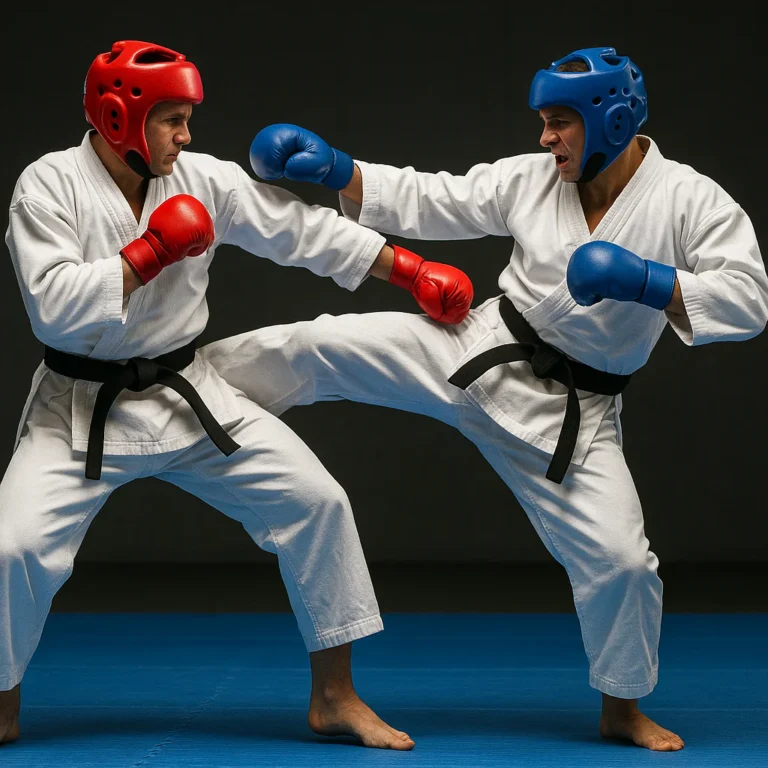
Let’s get technical. If you walk into an MMA gym with a traditional Karate stance, you will get taken down faster than you can say “Osu.” The key to success is adaptation.
The Traditional vs. The Hybrid
| Feature | Traditional Karate Stance | MMA Hybrid Stance | Why It Matters |
|---|---|---|---|
| Foot Placement | Deep, wide, often square or 45-degree | Bladed, narrow, weight on balls of feet | Prevents takedowns; allows quick pivots. |
| Knee Bend | Deep, static | Moderate, dynamic (bouncing) | Maintains balance for sprawls and kicks. |
| Hands | Low, guarding hips | High, protecting chin and body | Protects against boxing combinations. |
| Movement | Linear (forward/back) | Lateral (side-to-side) + Angles | Creates confusion and avoids clinches. |
| Goal | Perfect form, one-shot KO | Disruption, setup for grappling | MMA is a multi-dimensional chess game. |
The “Bladed” Advantage
In traditional Karate, you might face your opponent squarely to maximize power. In MMA, facing them squarely is a death sentence.
- The Bladed Stance: By turning your hips 45-60 degrees, you present a smaller target. This is the foundation of the Southpaw and Orthodox stances in MMA, but Karate takes it further by allowing the rear foot to drag and pivot effortlessly.
- The “Bounce”: Unlike the static stances of old, modern Karate MMA fighters use a light bounce. This isn’t just for show; it keeps your muscles primed for a sprawl or a burst forward.
Common Mistakes to Avoid
- ❌ Dropping the Hands: In Karate, you might drop your hands to chamber a kick. In MMA, that’s an open invitation for a cross. Keep your guard up!
- ❌ Over-commiting: A traditional gyaku-zuki (reverse punch) is powerful but slow if you lean into it. In MMA, you must snap the punch and retract instantly.
- ❌ Ignoring the Clinch: Traditional Karate often ignores the clinch. In MMA, if you don’t know how to defend the underhook or overhook, your fancy kicks won’t matter.
We’ve seen it happen: A black belt walks in, throws a beautiful mawashi geri, and gets caught by a double-leg takedown because he didn’t check the level change. Don’t be that guy.
For more on adapting your stance, check out our Karate Techniques category.
🥊 The Art of Distance Management: Controlling Range with Teps and Kicks
If Karate is a language, distance is its grammar. Without proper spacing, your sentences (strikes) make no sense. In MMA, managing distance is the difference between landing a head kick and getting clinched against the cage.
The Tep: Your Best Friend
The tep (front push kick) is the most underrated weapon in the MMA arsenal.
- Function: It acts as a jab for the legs. It keeps the opponent at bay, disrupts their rhythm, and checks their forward movement.
- Target: The stomach, the hips, or the lead leg. A well-placed tep to the gut can drain an opponent’s stamina in seconds.
- Execution: Unlike a traditional Karate tep which might be held for a second, the MMA tep is snappy. You kick, you retract, you move.
The Low Calf Kick
Forget the high kick for a moment. The low calf kick is the Karate mawashi geri that changed MMA.
- Why it works: It targets the nerve cluster on the outside of the calf. A few good shots there, and the opponent’s lead leg turns to jelly.
- The Setup: Use your jab to draw the hands up, then drop the level and kick the leg. It’s a classic feint-to-strike combo.
Controlling the “Pocket”
The “pocket” is the range where boxing exchanges happen. Karatekas prefer to fight outside the pocket.
- Outside Range: You can kick, but they can’t punch.
- Inside Range: They can punch, but you can’t kick.
- The Goal: Stay just outside their punching range, land a kick, and retreat. If they rush in, you sprawl or clinch.
Curious about the mechanics? How do you throw a kick without losing your balance on a slippery canvas? We’ll break down the footwork in the next section.
🚀 Explosive Entry: How to Close the Gap Without Getting Countered
So, you’ve mastered the distance. You’re safe. But how do you win? You have to close the gap. This is where most Karate practitioners fail. They try to rush in like a bull, and they get countered.
The “Jab-Step” Technique
This is the bread and butter of Stephen “Wonderboy” Thompson. It’s not just a punch; it’s a tactical maneuver.
- The Jab: Throw a light, fast jab. Don’t aim for the nose; aim to make them flinch.
- The Step: As they react (lifting hands or flinching), step off to the side (lateral movement).
- The Angle: You are now on their blind side. Their power hand is behind you.
- The Strike: Land a cross, a hook, or a kick from this new angle.
Why It Works
- Disruption: The jab forces a reaction. Humans are wired to react to a threat to the face.
- Safety: By stepping off, you remove yourself from the direct line of fire.
- Confusion: The opponent doesn’t know where you are coming from next.
The “Pull-Back” Counter
Another classic Karate move adapted for MMA is the pull-back counter.
- Scenario: Opponent throws a high kick or a big overhand.
- Action: You lean back just enough to make the strike miss by an inch.
- Counter: Immediately fire back with a straight punch or a low kick as they recover.
- Risk: This requires excellent timing. If you lean back too far, you lose your balance. If you lean back too little, you get hit.
Think about it: Why do boxers hate fighting Karatekas? Because they can’t predict the rhythm. Boxers fight in a 1-2-3 cadence. Karatekas fight in a 1… (pause) … 3… (pause) … 2 cadence.
🛡️ Defensive Mastery: Slipping, Parying, and the “Philly Shell” in a Karate Context
Defense in MMA is a three-dimensional puzzle. You have to worry about punches, kicks, knees, elbows, and takedowns. Traditional Karate defense is often linear (blocking straight on). We need to add evasion and angles.
Slipping and Rolling
- Slip: Move your head off the center line. In Karate, we call this tai sabaki (body shifting).
- Roll: Absorb the force of a hook by rolling with it. This is crucial for defending against the overhand right.
- The Karate Twist: Instead of just slipping, step off while slipping. This puts you in a position to counter immediately.
The “Philly Shell” (Shoulder Roll)
While not strictly Karate, the Philly Shell is often used by Karate-influenced fighters like Lyoto Machida.
- How it works: You tuck your lead shoulder to block jabs and crosses, keeping your hands lower to save energy.
- The Risk: It leaves you vulnerable to body shots and hooks.
- The Fix: Use your lead foot to pivot and create angle, forcing the opponent to miss and exposing their side.
Parying and Blocking
- Pary: Use your hands to deflect the opponent’s punch. A light touch is enough to change the trajectory.
- Block: Use your forearms to absorb the impact. In MMA, you must block with the shin (for kicks) and the forearm (for punches).
- Check: The most important defensive move in MMA. Raise your shin to block a low kick. If you don’t check, your leg will be broken.
Pro Insight: A good defense isn’t just about not getting hit; it’s about making the opponent miss so you can punish them.
🧠 The Mental Game: Timing, Rhythm, and Reading Your Opponent
You can have the best technique in the world, but if your brain is slow, you’re going to lose. The mental aspect of Karate sparring for MMA is about pattern recognition and rhythm disruption.
Disrupting the Rhythm
Boxers fight in a steady beat. Karatekas fight in syncopated time.
- The Strategy: Change your speed. Go slow, then fast. Go fast, then slow.
- The Effect: The opponent can’t find a rhythm. They can’t time their counters.
- Example: Throw a slow tep, then immediately explode with a fast roundhouse.
Reading the Opponent
- Shoulder Movement: Watch the shoulders. If the shoulder dips, a punch is coming. If the hip rotates, a kick is coming.
- Eye Contact: Don’t stare at the opponent’s eyes. Look at their chest or hips. They can’t hide their intention there.
- Breathing: Listen to their breathing. If they are gasping, they are tired. If they are holding their breath, they are tense and about to strike.
The “Flow” State
In Karate, we talk about mushin (no mind). In MMA, this means reacting instinctively. You don’t think “I will throw a kick.” You just throw the kick because you see the opening.
- How to achieve it: Drills. Lots of drills. Sparring. Sparring. Sparring.
- The Result: Your body knows what to do before your brain catches up.
Question: Can you really learn to read an opponent in a few weeks? Or does it take years of sparring? We’ll answer this in the FAQ section.
🏆 Top 7 Drills to Sharpen Your Karate Sparring for MMA
Ready to train? Here are the 7 drills we use at Karate MMA™ to bridge the gap between the dojo and the cage.
1. The “Shadow Box” with Resistance Bands
- Goal: Improve speed and resistance.
- How: Attach resistance bands to your waist and have a partner pull you back as you move forward. This simulates the resistance of a clinch or a takedown attempt.
- Focus: Maintain your balance and stance while moving.
2. The “Feint and Flow” Drill
- Goal: Master the jab-step and angle change.
- How: Partner throws a slow jab. You feint a block, step off to the side, and throw a cross. Repeat with different angles.
- Focus: Don’t just step; feel the opponent’s reaction.
3. The “Tep and Retreat” Drill
- Goal: Distance management.
- How: Partner advances. You throw a tep and immediately retreat. If they catch your leg, you sprawl.
- Focus: Snap the kick and get back to your base.
4. The “Low Kick Check” Drill
- Goal: Defensive conditioning.
- How: Partner throws low kicks. You check them with your shin.
- Focus: Keep your hands up! Don’t drop your guard to check the leg.
5. The “Clinch Break” Drill
- Goal: Escaping the clinch.
- How: Partner grabs you in a clinch. You use your Karate footwork to create angle and break free.
- Focus: Use your hips and leverage, not just strength.
6. The “Random Sparring” Drill
- Goal: Adaptability.
- How: Sparring with no rules. No points, no stops. Just fight.
- Focus: React to whatever happens. If you get taken down, get up and fight.
7. The “Video Analysis” Drill
- Goal: Self-corection.
- How: Record your sparring sessions. Watch them back.
- Focus: Identify your bad habits. Are you dropping your hands? Are you standing too flat-footed?
Tip: Don’t skip the video analysis. It’s the fastest way to improve.
👥 How to Train Against a Karate Specialist: Countering the Lateral Movement
So, you’re not the Karateka. You’re the one facing them. How do you beat the “Wonderboy” style?
The “Cut the Ring” Strategy
Karatekas love to move laterally. If you chase them in a circle, you’ll tire yourself out.
- The Fix: Cut the ring. Move in a straight line to force them to the cage or the corner.
- Why: Once they hit the cage, they can’t move laterally. They have to fight you head-on.
The “Level Change” Takedown
Karatekas are often light on their feet. They don’t expect a double-leg takedown.
- The Strategy: Feint a punch to make them drop their hands, then shoot for the legs.
- The Key: Change levels quickly. Don’t telegraph the takedown.
The “Pressure” Game
Karatekas prefer to fight at a distance. If you apply constant pressure, they will panic.
- The Strategy: Walk them down. Don’t let them reset. Force them to fight in your range.
- The Risk: You might get hit by a counter. So, keep your guard up and move in with a head movement.
Remember: No style is invincible. Every style has a weakness. The key is to find yours and exploit theirs.
🥋 Gear Up: Essential Equipment for Safe and Effective Karate MMA Sparring
You can’t spar safely without the right gear. In traditional Karate, you might wear a gi and thin gloves. In MMA, you need protection that allows for grappling and striking.
Essential Gear List
- MA Gloves: 4oz to 7oz gloves. They allow you to grab and grapple while still protecting your knuckles.
Brand Recommendation: Venum Elite or Cleto Reyes. - Shin Guards: Crucial for blocking kicks. Look for ones with a hard shell and soft padding.
Brand Recommendation: Fairtex or Twins Special. - Mouthguard: Non-negotiable. Get a custom-fit one if possible.
Brand Recommendation: Opro or Shock Doctor. - Groin Protector: Essential for both men and women.
Brand Recommendation: McDavid or Shock Doctor. - Headgear: Optional for sparring, but recommended for beginners.
Brand Recommendation: RDX or Hayabusa.
Where to Buy
- 👉 CHECK PRICE on:
Venum Elite Gloves: Amazon | Official Site
Fairtex Shin Guards: Amazon | Official Site
Opro Mouthguard: Amazon | Official Site
Safety First: Never spar without a mouthguard. We’ve seen too many fighters lose teeth because they thought they were “tough.”
Conclusion

So, is Karate sparring effective for MMA? Absolutely. But only if you adapt it. The traditional stances, the point-fighting mindset, and the rigid forms won’t win you a title. But the speed, the distance management, the unorthodox angles, and the explosive kicking of Karate? Those are the tools that built champions like Lyoto Machida and Stephen “Wonderboy” Thompson.
The key takeaway is hybridization. Don’t try to be a pure Karateka in the cage. Be a Karate-MA fighter. Adapt your stance, keep your hands up, and never forget that a takedown is just another kind of “stop” signal.
We started this article by asking if you could succeed in modern MMA without wrestling. The answer is no. You need a solid grappling base. But with Karate as your striking foundation, you can create a style that is unpredictable, dangerous, and incredibly effective.
Final Thought: The next time you step into the cage, remember: it’s not about how hard you hit. It’s about where you hit, when you hit, and how you move.
Recommended Links
If you’re ready to take your training to the next level, here are some essential resources and products:
- Books:
The Karate Way by Darren Arneson: A deep dive into the philosophy and application of Karate in modern combat. Amazon
MA for Dummies by Patrick McManus: A great starting point for understanding the rules and techniques of MMA. Amazon - Gear:
Venum Elite MMA Gloves: Amazon | Official Site
Fairtex Shin Guards: Amazon | Official Site
Hayabusa Headgear: Amazon | Official Site
❓ FAQ: Common Questions About Karate Sparring in Mixed Martial Arts
Are there any specific Karate styles that are more suitable for MMA competition than others?
Yes, Kyokushin and Shotokan are often cited as the most adaptable. Kyokushin’s full-contact nature builds toughness and conditioning, while Shotokan’s emphasis on speed and distance management translates well to MMA. However, the style matters less than the adaptation. A fighter who adapts their style to the cage will always outperform one who sticks rigidly to tradition.
What role does conditioning and cardio play in Karate sparring for MMA training?
Cardio is paramount. In traditional Karate, rounds are short (1-2 minutes). In MMA, rounds are 5 minutes, and the pace is relentless. You need anaerobic endurance to explode with kicks and punches, and aerobic endurance to recover between exchanges. Without it, your technique will crumble in the later rounds.
How does Karate’s emphasis on kicking techniques translate to MMA fighting?
Karate’s kicking techniques are highly effective in MMA, especially the low calf kick and the front push kick (tep). These kicks can disrupt an opponent’s balance, drain their stamina, and set up other strikes. The key is to snap the kick and retract quickly to avoid being caught.
Read more about “🥋 How Karate Footwork Dominates MMA: The 2026 Guide”
Can traditional Karate training beneficial for MMA fighters?
Yes, but with caveats. Traditional training builds discipline, focus, and technical precision. However, it must be supplemented with live sparring, grapling, and conditioning specific to MMA. A pure traditional Karateka will struggle without these additions.
Are there any notable MMA fighters who have a background in Karate and how have they incorporated it into their fighting style?
- Lyoto Machida: Uses a bladed stance, lateral movement, and counter-striking to confuse opponents.
- Stephen “Wonderboy” Thompson: Utilizes the “jab-step” and angle changes to create openings for powerful kicks and punches.
- Chuck Liddell: While known for boxing, he incorporated Karate kicks into his arsenal early in his career.
What are some common mistakes Karate practitioners make when transitioning to MMA sparring?
- Dropping hands: Leaving the chin exposed.
- Static stances: Standing too flat-footed, making them easy targets for takedowns.
- Ignoring the clinch: Not knowing how to defend or escape the clinch.
- Over-commiting: Throwing full-power strikes without retracting, leaving them off-balance.
Read more about “🥋 50+ Fresh Karate MMA Concepts Dominating the Octagon (2026)”
Can Karate training improve a fighter’s overall performance in MMA?
Absolutely. Karate improves footwork, timing, distance management, and kicking accuracy. These are all critical skills in MMA. A fighter with a strong Karate base can create a unique and unpredictable style that is hard to prepare for.
Read more about “🥋 Karate MMA Training: The Ultimate Hybrid Guide (2026)”
What are the most effective Karate strategies for defending against takedowns in MMA?
- Sprawl: The most basic and effective defense.
- Level Change: Drop your level to match the opponent’s takedown attempt.
- Underhooks/Overhooks: Control the opponent’s arms to prevent them from securing a takedown.
- Lateral Movement: Move to the side to avoid the takedown attempt.
Read more about “🥋 Karate Takedown Defense in MMA: The Ultimate Guide (2026)”
How can Karate practitioners adapt their techniques for MMA competition?
- Modify Stances: Use a bladed, mobile stance.
- Keep Hands Up: Protect the chin at all times.
- Snap Strikes: Retract quickly to avoid being caught.
- Integrate Grapling: Learn to defend and escape takedowns.
Read more about “🥋 7 Karate Forms in MMA That Actually Work (2026)”
What are the key differences between Karate sparring and MMA sparring?
- Rules: Karate has stop-start rules; MMA is continuous.
- Targets: Karate focuses on points; MMA focuses on damage and takedowns.
- Stances: Karate uses static stances; MMA uses dynamic, bladed stances.
- Defense: Karate uses blocks; MMA uses slips, rolls, and sprawls.
Read more about “🥋 Integrating Karate into MMA Training: The 2026 Hybrid Blueprint”
Is karate sparring effective for MMA?
Yes, if adapted. The speed, distance, and kicking techniques of Karate are highly effective in MMA. However, the rules and environment of MMA require significant adaptation.
Read more about “🥋 7 Karate Distance Management Drills for MMA (2026)”
What are the best karate techniques for MMA fighting?
- Low Calf Kick: Disrupts balance and drains stamina.
- Front Push Kick (Tep): Controls distance and sets up other strikes.
- Jab-Step: Creates angles and openings.
- Pull-Back Counter: Exploits opponent’s aggression.
Read more about “🥋 Master Karate Stance Switching for MMA: 5 Moves to Dominate (2026)”
How does traditional karate sparring differ from MMA sparring?
Traditional Karate sparring is stop-start, focuses on points, and uses static stances. MMA sparring is continuous, focuses on damage and takedowns, and uses dynamic stances.
Read more about “Is Judo Same as Aikido? The Shocking Truth (2026) 🥋”
Can a karateka succeed in modern MMA without wrestling?
No. While a karateka can be a dangerous striker, they will eventually be taken down by a wrestler. To succeed in modern MMA, a fighter must have a solid grappling base.
Read more about “🥋 Karate’s Role in Modern MMA: The 7 Fighters Who Proved It Works (2026)”
What are the common mistakes karate practitioners make in MMA?
- Dropping hands: Leaving the chin exposed.
- Static stances: Standing too flat-footed.
- Ignoring the clinch: Not knowing how to defend or escape.
- Over-commiting: Throwing full-power strikes without retracting.
Read more about “🥋 7 Karate Evasive Techniques for MMA That Actually Work (2026)”
How to adapt karate sparring rules for MMA training?
- Continuous Sparring: No stop-start rules.
- Full Contact: Allow full-power strikes (with protection).
- Grapling: Include takedowns and clinch work.
- No Points: Focus on damage and control.
Read more about “🥋 Karate for Kids: The Ultimate Guide to Building Confidence (2026)”
Which famous MMA fighters have a karate background?
- Lyoto Machida
- Stephen “Wonderboy” Thompson
- Chuck Liddell
- Frank Mir (early career)
- Robie Lawler (incorporated Karate kicks)
Read more about “🥋 7 Secrets to MMA Success with a Karate Base (2026)”
🔗 Reference Links
- PubMed Study on Sparring and Brain Volume: Sparring and Brain Volume in Professional MMA Fighters
- Legacy MMA Club Point Sparring Registration: Legacy MMA Club
- Martial Arts Stack Exchange: MA Fighting Opponent who uses Karate stance
- Karate MMA™ Categories:
- Karate Techniques
- Fighter Profiles
- Fight Analysis and Breakdowns
- MA Training
- Karate Belts and Rankings
- Featured Video: Stephen “Wonderboy” Thompson and Luiz Rocha Demonstrate the Jab-Step