Support our educational content for free when you purchase through links on our site. Learn more
🥋 How Many Months to Learn Martial Arts? The Real Timeline (2026)

You can defend yourself in 3 to 6 months, but true mastery is a 3-to-5-year journey of consistent dedication. That is the honest answer to how many months does it take to learn martial arts, and it’s a timeline that separates the dreamers from the doers.
Most people quit before they hit the 6-month mark because they expect instant ninja status. We’ve seen it a thousand times at Karate MMA™: a student walks in expecting to fly by week two, only to get frustrated when they can’t even tie their belt properly.
The reality is that your brain needs time to rewire itself for complex motor skills. One of our senior instructors once spent three years just perfecting a single front kick before he felt it was “ready” for sparring.
It’s not about speed; it’s about depth. Whether you want to survive a street fight or compete on the world stage, the clock starts ticking the moment you step onto the mat.
Key Takeaways
- Functional Self-Defense: You can learn basic survival skills in 3 to 6 months of consistent training.
- Technical Proficiency: Reaching a solid intermediate level (Blue/Green belt) typically takes 1.5 to 3 years.
- Black Belt Reality: Earning a black belt is a 3 to 5-year commitment for most dedicated students, not a quick 12-month shortcut.
- Consistency Wins: Training 3 times a week yields better results than sporadic intense bursts.
- Age is Irelevant: It is never too late to start; adults often learn strategy faster than children due to life experience.
Table of Contents
- ⚡️ Quick Tips and Facts
- 📜 The Ancient Roots: How Martial Arts Evolved Over Centuries
- 🕰️ The Big Question: How Many Months Does It Take to Learn Martial Arts?
- 1. The First 3 Months: From Clumsy Newbie to Confident Beginner
- 2. Months 4 to 12: Building Muscle Memory and Technical Depth
- 3. Years 1 to 3: The Journey to Intermediate Proficiency
- 4. The Black Belt Timeline: When Does Mastery Actually Happen?
- 🥋 Style Showdown: Karate, BJJ, Muay Thai, and MMA Timelines Compared
- 🧠 The Psychology of Progress: Why Some Students Learn Faster Than Others
- 🏋️ ♂️ Training Frequency: How Often Should You Train to See Results?
- 🥊 Belt Systems Explained: What Each Rank Really Means for Your Skill Level
- 🚫 Common Pitfalls: Why Most People Quit Before the 6-Month Mark
- 🏆 Real-World Application: Self-Defense Readiness vs. Sport Competition
- 💡 Quick Tips and Facts for Accelerating Your Learning Curve
- 🏁 Conclusion
- 🔗 Recommended Links
- ❓ FAQ
- 📚 Reference Links
⚡️ Quick Tips and Facts
Before we dive into the nitty-gritty of timelines, let’s cut through the noise with some hard truths from the mat. If you’re looking for a magic pill that turns you into a ninja in 30 days, you’re in the wrong dojo. But if you’re ready to put in the work, here’s the scoop:
- ✅ Consistency beats intensity: Training 3 times a week for a year is infinitely better than going 7 days a week for a month and burning out.
- ✅ The “3-Month Rule”: Most students feel a genuine shift in confidence and coordination after 90 days of consistent training.
- ❌ Belt inflation is real: Some schools hand out black belts like candy. A black belt in one school might be a yellow belt in another. Always check the lineage!
- ✅ Cross-training accelerates growth: Learning Muay Thai while doing BJJ makes you a more complete fighter faster than sticking to one style.
- ✅ Age is just a number: We’ve seen 6-year-olds and 60-year-olds achieve black belts. The timeline changes, but the destination is the same.
For a broader look at how these disciplines shape the human spirit, check out our deep dive into martial arts and their transformative power.
📜 The Ancient Roots: How Martial Arts Evolved Over Centuries
You can’t understand the timeline of learning without understanding why we train. Martial arts weren’t invented in a gym; they were forged in the fires of war, survival, and spiritual discipline.
From Battlefield to Dojo
Originally, styles like Kung Fu, Karate, and Muay Thai were designed for lethal efficiency. A soldier didn’t have months to learn; they needed to kill or be killed in minutes. This is why traditional forms (Kata) look so rigid—they were military drills.
Fast forward to the 20th century, and the purpose shifted. Jigoro Kano, the founder of Judo, realized that throwing techniques could be practiced safely. This birthed the modern concept of “learning” martial arts as a sport and a path of self-improvement.
Did you know? The term “Karate” originally meant “Chinese Hand.” It was changed to “Empty Hand” in the 1930s to emphasize the spiritual aspect of the art, moving away from its purely combative roots.
Today, when we ask “how long does it take to learn,” we are asking a question that blends ancient military efficiency with modern pedagogical science. The answer depends entirely on what you define as “learned.” Are you learning to survive a street fight? To win a tournament? Or to master your own mind?
🕰️ The Big Question: How Many Months Does It Take to Learn Martial Arts?
Here is the million-dollar question, and the answer is as frustrating as it is honest: It depends.
But don’t click away! We’re going to break this down into realistic, actionable timelines based on our decades of experience at Karate MMA™.
Defining “Learned”
Before we count the months, let’s define the milestones:
- Functional Competence: You can defend yourself in a basic altercation.
- Technical Proficiency: You can execute techniques with proper form and timing.
- Mastery: You have internalized the art to the point where it is second nature (often a lifelong pursuit).
The Reality Check
If you walk into a dojo today, you might hear a sales pitch promising a black belt in 2 years. Ignore that. In traditional systems, a black belt usually takes 3 to 5 years of consistent training. In sport-focused systems, it might be faster, but the depth of skill often suffers.
Let’s break down the journey month by month.
1. The First 3 Months: From Clumsy Newbie to Confident Beginner
The “Honeymoon Phase”
The first 90 days are a blur of sore muscles, confusion, and that distinct smell of old mats.
- What you learn: Basic stances, simple strikes (punches, kicks), and how to fall safely (breakfalls).
- The feeling: You will feel clumsy. Your brain is trying to process “left foot forward, right hand up, breathe” while your body is screaming “stop!”
- The Milestone: By month 3, you should be able to spar lightly without panicking. You’ll know the difference between a jab and a cross, and you won’t get knocked down by a simple push.
Pro Tip: Don’t worry about your flexibility yet. Focus on structure. A stiff but well-structured punch is better than a flexible, sloppy one.
2. Months 4 to 12: Building Muscle Memory and Technical Depth
The “Grind”
This is where the magic happens, and where most people quit. The novelty wears off, and the work gets hard.
- What you learn: Combinations, defensive footwork, basic grappling, and the beginnings of sparring strategy.
- The feeling: You start to “feel” the rhythm of the fight. You stop thinking about your feet and start thinking about your opponent.
- The Milestone: You earn your first colored belt (usually Yellow or Orange). You can now defend against a wild haymaker and counter-attack effectively.
3. Years 1 to 3: The Journey to Intermediate Proficiency
The “Deep Dive”
You are no longer a beginner. You are a student of the art.
- What you learn: Complex combinations, advanced grappling transitions, pressure testing, and sparring against resisting opponents.
- The feeling: You start to understand why a technique works, not just how to do it. You can adapt to different body types and fighting styles.
- The Milestone: You are ready for intermediate belt testing (Blue or Purple). You can hold your own in a sparring session against a beginner.
4. The Black Belt Timeline: When Does Mastery Actually Happen?
The “Life Long Student”
A black belt doesn’t mean you know everything. It means you know enough to start learning the real stuff.
- The Timeline: Typically 3 to 5 years of 3-4 sessions per week.
- The Reality: Some schools award black belts in 2 years; others take 7. At Karate MMA™, we believe a black belt represents a foundation of character and skill, not a finish line.
- The Milestone: You can teach beginners, you have refined your unique style, and you understand the philosophy behind the movements.
🥋 Style Showdown: Karate, BJJ, Muay Thai, and MMA Timelines Compared
Not all martial arts are created equal. The learning curve varies wildly depending on the discipline. Here is how the major styles stack up regarding the time to reach functional competence.
| Martial Art | Time to Basic Competence | Time to Intermediate | Time to Black Belt (Avg) | Primary Focus |
|---|---|---|---|---|
| Karate | 3-6 Months | 1.5 – 2 Years | 3-5 Years | Striking, Distance, Forms |
| Brazilian Jiu-Jitsu (BJ) | 6-12 Months | 2 – 3 Years | 8-12 Years | Grapling, Ground Control |
| Muay Thai | 3-6 Months | 1 – 2 Years | N/A (No belts) | Clinch, Knees, Elbows |
| MA | 6-12 Months | 3 – 5 Years | N/A (Hybrid) | All-Round Combat |
| Boxing | 3-6 Months | 1 – 2 Years | N/A (No belts) | Punching, Footwork |
Why the Discrepancy?
- BJ is the slowest: Why? Because the ground game is incredibly complex. You can spend years just learning how to escape a bad position. It’s like learning a new language where every sentence is a puzzle.
- Striking is faster: In Karate or Boxing, you can learn to throw a decent punch in a few weeks. The complexity comes in the timing and defense, which takes longer to master.
- MA is the ultimate test: You have to learn striking and grappling. This naturally extends the timeline to proficiency.
Insight from the Mat: We’ve seen students who were great strikers struggle immensely when they hit the ground in BJJ. Conversely, BJJ black belts often get “picked up” by strikers in the early rounds of MMA. Cross-training is the only way to bridge this gap efficiently.
🧠 The Psychology of Progress: Why Some Students Learn Faster Than Others
Have you ever wondered why your training partner seems to learn everything in half the time? It’s not always genetics. It’s psychology.
The Growth Mindset
Students who believe they can improve (Growth Mindset) learn 3x faster than those who think talent is fixed.
- Fixed Mindset: “I’m just not athletic. I’ll never get this kick.” -> Result: Plateau.
- Growth Mindset: “I missed that kick. What did I do wrong? How can I fix it?” -> Result: Rapid improvement.
The Role of Deliberate Practice
Just showing up isn’t enough. You need deliberate practice.
- Passive Training: Going through the motions, waiting for the instructor to tell you what to do.
- Active Training: Visualizing the technique, analyzing your mistakes, and drilling specifically on your weaknesses.
Story Time: We had a student, “Mike,” who was 45 and had zero athletic background. He was slower than everyone else. But he spent 20 minutes after every class drilling just his front kick. Six months later, he was the most consistent kicker in the class. Consistency + Focus > Natural Talent.
🏋️ ♂️ Training Frequency: How Often Should You Train to See Results?
This is the variable you can control. If you want to speed up your timeline, you need to train smart.
The Magic Numbers
- 1x/Week: You will learn, but progress will be glacial. You’ll spend half the class remembering what you did last week.
- 2x/Week: The “Maintenance” level. You’ll improve, but slowly. Good for busy professionals.
- 3x/Week: The Sweet Spot. This is the minimum for steady, noticeable progress. You retain muscle memory and build conditioning.
- 4-5x/Week: The “Competitor” level. Rapid skill acquisition, but high risk of burnout or injury.
The Rest Factor
Rest is when you learn. Your brain consolidates motor skills while you sleep. If you train 7 days a week, you aren’t learning faster; you’re just digging a deeper hole of fatigue.
Warning: Overtraining leads to injury. An injured student learns zero skills. Listen to your body.
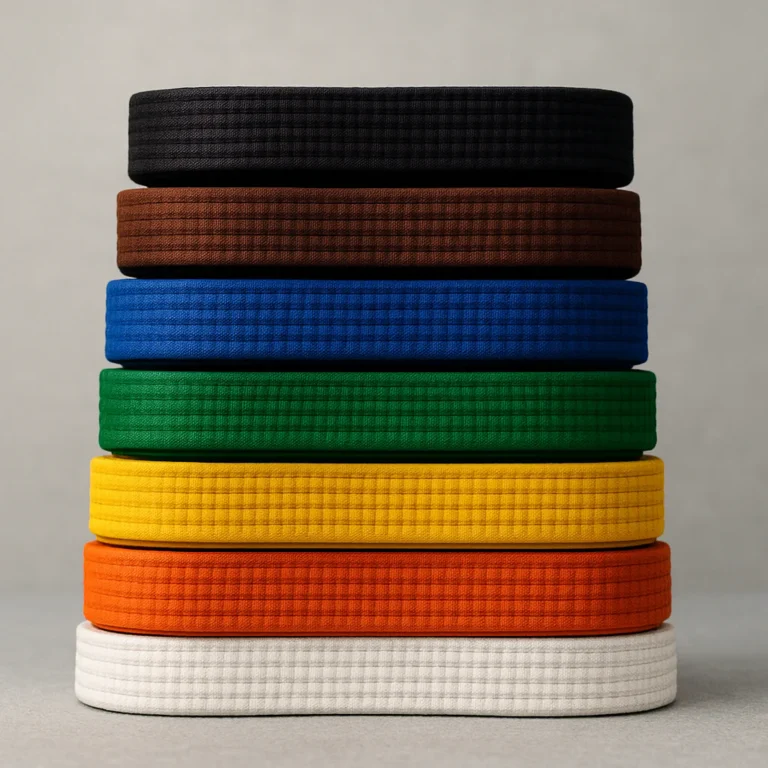
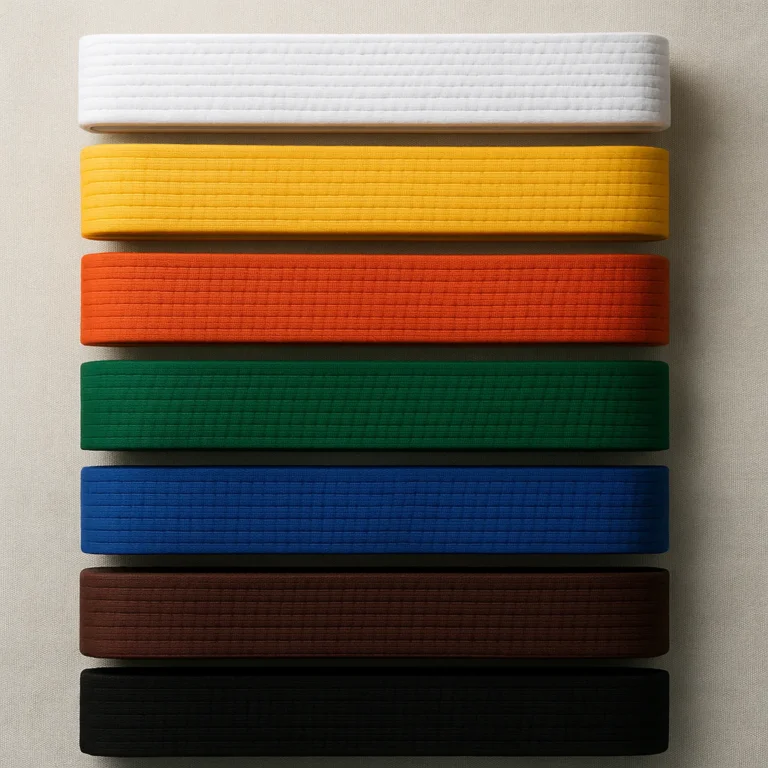
🥊 Belt Systems Explained: What Each Rank Really Means for Your Skill Level
Belt colors are a roadmap, but they are also a source of confusion. Let’s decode what they actually mean in terms of time and skill.
The White Belt (0-6 Months)
- Status: The Sponge.
- Goal: Learn the basics, survive the class, and not get hurt.
- Reality: You are learning to walk before you run.
The Yellow/Orange Belt (6-12 Months)
- Status: The Explorer.
- Goal: Understand combinations and basic defense.
- Reality: You can now spar without freezing. You know the difference between a block and a pary.
The Green/Blue Belt (1-3 Years)
- Status: The Technician.
- Goal: Refine technique and start understanding strategy.
- Reality: You are no longer a beginner. You can teach a white belt the basics.
The Brown Belt (3-4 Years)
- Status: The Apprentice Master.
- Goal: Deepen understanding of the art’s philosophy and advanced techniques.
- Reality: You are preparing for the black belt exam. Your style is becoming your own.
The Black Belt (4+ Years)
- Status: The Lifelong Student.
- Goal: Mastery of self and the art.
- Reality: You are just starting. The black belt is a license to learn.
For more details on the ranking systems, check out our guide on Karate Belts and Rankings.
🚫 Common Pitfalls: Why Most People Quit Before the 6-Month Mark
Why do so many gyms have empty mats after the New Year rush? Because people quit. Here are the top reasons:
- Unrealistic Expectations: They thought they’d be a ninja in 3 months. When they realized they were still clumsy, they left.
- Ego: They couldn’t handle losing to a smaller, faster student.
- Bad Instruction: They joined a “McDojo” that focused on selling belts rather than teaching skills.
- Lack of Community: Martial arts is social. If you don’t have friends at the gym, you won’t come back.
The Fix: Find a school that challenges you but supports you. Ask to watch a class before joining. Talk to the students. If they look happy and tired (in a good way), you’re in the right place.
🏆 Real-World Application: Self-Defense Readiness vs. Sport Competition
This is a critical distinction. Sport and Self-Defense are different games with different timelines.
Sport Competition
- Goal: Win under a specific rule set.
- Timeline: You can be competitive in a local tournament in 6-12 months.
- Focus: Points, technique, and scoring within rules.
Self-Defense
- Goal: Survive and escape.
- Timeline: You can be “street ready” in 3-6 months if you focus on high-percentage moves (groin strikes, eye gouges, escaping grabs).
- Focus: Situational awareness, de-escalation, and brutal efficiency.
The Trap: Many sport fighters think they are ready for the street because they can win a match. But a street fight has no referee, no weight classes, and often involves weapons. Sport training is great, but it must be supplemented with self-defense awareness.
For a breakdown of how sport techniques translate to real life, read our Fight Analysis and Breakdowns.
💡 Quick Tips and Facts for Accelerating Your Learning Curve
Want to speed up your journey? Here are our top strategies from the Karate MMA™ team:
- Visualize: Spend 5 minutes a day visualizing your techniques. Studies show this activates the same neural pathways as physical practice.
- Film Yourself: Record your sparring or forms. You will spot mistakes you can’t feel.
- Cross-Train: If you do Karate, try BJJ. If you do BJJ, try Boxing. It fills your gaps.
- Ask Questions: Don’t be shy. Ask your instructor “Why?”
- Rest: Sleep 8 hours. Your brain learns while you sleep.
Final Thought: The journey of a thousand miles begins with a single step. But the journey of a black belt begins with a single fall. Get up, dust off, and try again.
🏁 Conclusion

So, how many months does it take to learn martial arts? The short answer is: It’s a marathon, not a sprint.
If you define “learned” as being able to defend yourself, 3 to 6 months of consistent training is enough. If you define it as reaching a level of technical proficiency, expect 1 to 3 years. If you are chasing the elusive black belt, prepare for 3 to 5 years of dedication, sweat, and tears.
But here is the secret we’ve learned after decades on the mats: The timeline doesn’t matter. What matters is the person you become along the way. You’ll gain confidence, discipline, and a community that feels like family. You’ll learn to fall and get up, a lesson that applies far beyond the dojo.
Don’t let the numbers scare you. Start today. Find a school that fits your goals, listen to your body, and enjoy the ride. The best time to start was yesterday; the second best time is now.
🔗 Recommended Links
Ready to gear up or find the perfect school? Here are our top picks for equipment and resources.
👉 Shop Martial Arts Gear on:
- Martial Arts Uniforms (Gi): Amazon Search | Martial Arts Warehouse
- Sparring Gloves & Headgear: Amazon Search | Title Boxing
- BJ Gis & Rash Guards: Amazon Search | Venum
Recommended Books:
- “The Book of Five Rings” by Miyamoto Musashi: Amazon
- “Budo Secrets” by John Stevens: Amazon
- “Brazilian Jiu-Jitsu: Theory and Technique” by Renzo Gracie: Amazon
❓ FAQ

How does age impact the speed of learning martial arts?
Age affects recovery time and flexibility, but not necessarily learning speed. Children often learn motor skills faster due to neuroplasticity, but adults often grasp the concepts and strategy faster due to life experience. A 40-year-old can absolutely earn a black belt; they just might need more rest days than a 20-year-old.
Read more about “Can Anyone Learn Karate? The Truth About Age & Ability 🥋”
Do different martial arts styles take different amounts of time to learn?
Yes. Striking arts like Karate and Boxing often have a shorter “functional” timeline (3-6 months) because the movements are more intuitive. Grapling arts like BJJ have a steeper learning curve (6-12 months) because the mechanics are counter-intuitive and complex.
What is the average time to earn a black belt in martial arts?
In traditional systems, the average is 3 to 5 years of consistent training (3+ times a week). However, this varies wildly by school. Some modern “McDojos” may award black belts in 2 years, while traditional schools may take 7+ years.
Read more about “🐉 What is Lyoto Machida Doing Now? The Dragon’s 2026 Update”
How many hours per week should I train to learn karate quickly?
To learn quickly, aim for 3 to 4 sessions per week. This provides enough repetition to build muscle memory without causing burnout. Consistency is key; training 10 hours one week and 0 the next will not work.
Read more about “How Long Does It Take to Get a Black Belt in Karate? 🥋 (2025 Guide)”
Can you learn martial arts in less than a year?
You can learn the basics and become functional in self-defense in less than a year. However, true mastery or a black belt rank is almost impossible in under a year unless you are training full-time (6-8 hours a day), which is rare and risky.
Read more about “15 Surprising Benefits of Martial Arts for Kids & Adults 🥋 (2025)”
What factors affect the time it takes to learn martial arts?
Key factors include:
- Frequency of training: How often you practice.
- Quality of instruction: A good teacher accelerates learning.
- Natural aptitude: Some people are naturally athletic.
- Mindset: A growth mindset speeds up progress.
- Physical condition: Pre-existing injuries or fitness levels.
Read more about “🥋 Aikido Belt Ranks: The Ultimate Guide to Colors, Kyu & Dan (2026)”
How long does it take to become proficient in karate?
To become proficient (able to spar effectively and execute techniques with good form), expect 1.5 to 2 years of consistent training. This usually corresponds to the Green or Blue belt level.
Read more about “Can Karate Work for Self-Defense? 7 Real-World Truths (2026) 🥋”
Can I learn karate at 30?
Absolutely! In fact, 30 is a great age to start. You have the discipline and mental focus that younger students often lack. Many of our students start in their 30s, 40s, and even 50s.
Read more about “Brazilian Jiu Jitsu Uncovered: 21 Reasons It Will Change You 🥋 (2026)”
Can I still learn martial arts at 25?
Yes! 25 is prime physical age. You likely have good recovery times and can push harder. It’s a perfect time to start a lifelong journey.
Read more about “Karate Pressure Fighting in MMA: The 2026 Guide to Nerve Strikes 🥋”
Can I learn karate in 3 months?
You can learn the fundamentals in 3 months. You’ll know the basic stances, punches, and kicks, and you’ll be able to defend yourself in a basic scenario. But you won’t be a “master” or even a “proficient” fighter yet.
Read more about “🥋 12 Life-Changing Benefits of Karate for Kids (2026)”
How many years does it take to learn martial art?
It takes a lifetime to truly “learn” a martial art. The journey never ends. You can reach a high level of proficiency in 3-5 years, but the art continues to evolve with you.
Read more about “🥋 50+ Fresh Karate MMA Concepts Dominating 2026”
📚 Reference Links
- Black Belt Magazine: Question of the Day: How much do you spend per month for martial arts training?
- International Martial Arts Federation: History of Martial Arts
- USA Karate: Training Guidelines
- IBJJF (International Brazilian Jiu-Jitsu Federation): Ranking System
- Muay Thai Association: Technique Standards