Support our educational content for free when you purchase through links on our site. Learn more
🥋 7 Shotokan Karate Secrets That Dominate MMA (2026)

Ever watched a fighter move like a ghost, vanish from a punch, and reappear with a single, fight-ending front kick? That’s the Shotokan karate magic we’re talking about. While traditionalists once scoffed at the idea of “point-fighting” styles surviving in the brutal octagon, the data tells a different story. From the legendary Lyoto Machida dismantling champions with unorthodox angles to Stephen Thompson controlling the distance like a grandmaster, Shotokan has proven it’s not just a relic of the past—it’s a lethal weapon for the modern era.
But here’s the twist: the Shotokan that works in the UFC isn’t the one you see in the dojo. It’s a hybridized, evolved beast that traded deep, static stances for a bouncing, bladed footwork designed to evade takedowns and explode with precision. In this deep dive, we’re breaking down exactly how this style survives against wrestlers and brawlers, revealing the 7 specific techniques that turn karatekas into champions, and exposing the common myths that keep fighters from unlocking its full potential. Are you ready to see why the “Black Swan” strategy is the future of striking?
Key Takeaways
- Adaptation is Non-Negotiable: Traditional deep stances are a liability; successful MMA karate relies on a shallow, bladed, and bouncing stance to defend takedowns.
- Distance is the Ultimate Weapon: Shotokan excels at long-range control, using the Mae Geri (front kick) and Kizami-Zuki (lead punch) to keep opponents at bay before they can engage.
- The “Stop-Hit” Philosophy: Unlike volume-based strikers, Shotokan practitioners focus on single, explosive counter-strikes that interrupt an opponent’s offense.
- Hybridization is Key: To survive in the cage, Shotokan must be seamlessly integrated with wrestling and BJJ to handle the inevitable clinch and ground game.
- Proven Track Record: With champions like Lyoto Machida and Stephen Thompson dominating the UFC, Shotokan is undeniably effective in modern MMA when properly adapted.
Table of Contents
- ⚡️ Quick Tips and Facts
- 📜 The Genesis of Shotokan: From Dojo to Octagon History
- 🥋 Why Shotokan Karate Works in MMA: The Mechanics of Success
- 🏆 Top 7 Shotokan Practitioners Who Conquered the MMA World
- Lyoto Machida: The Black Swan’s Unorthodox Blueprint
- Stephen Thompson: The “Wonderboy” Distance Master
- Georges St-Pierre: The Shotokan Foundation of a Champion
- Dan Henderson: The H-Bomb’s Karate Roots
- Chuck Liddell: The Iceman’s Karate Influence
- Frank Shamrock: The Pioneer of Hybrid Karate
- Rory MacDonald: The Canadian Karateka’s Evolution
- 🥊 Shotokan vs. Other Styles: How It Compares in the Cage
- 🧠 Mastering the Shotokan Stance: From Zenkutsu Dachi to MMA Footwork
- 👊 Essential Shotokan Techniques for Mixed Martial Arts
- The Gyaku-Zuki: The Straight Punch That Changes Fights
- The Mae Geri: Front Kick as a Range Finder and Weapon
- The Yoko Geri: The Side Kick to the Body and Head
- The Kizami-Zuki: The Jab That Keeps Opponents Guessing
- The Ura Mawashi Geri: The Hook Kick Surprise
- 🛡️ Defending the Shotokan Style: Countering Grapplers and Brawlers
- 🔄 Adapting Traditional Kata for Modern Combat Scenarios
- 🧪 Training Drills: Bridging the Gap Between Dojo and Octagon
- 🤔 Common Myths and Misconceptions About Shotokan in MMA
- 📈 The Future of Shotokan: Evolution and Integration in Combat Sports
- 🏁 Conclusion
- 🔗 Recommended Links
- ❓ FAQ
- 📚 Reference Links
⚡️ Quick Tips and Facts
Before we dive into the deep end of the octagon, let’s hit the highlights. If you’re wondering whether Shotokan karate belongs in the modern MMA mix, the short answer is a resounding yes, but with a massive asterisk: adaptation is everything.
Here are the non-negotiables you need to know right now:
- The “Black Swan” Effect: Shotokan’s unorthodox, bladed stance creates a “black swan” scenario for opponents—rare, unpredictable, and devastating when it strikes.
- Distance is King: Unlike Muay Thai’s clinch-heavy approach, Shotokan masters the art of long-range fighting, making it nearly impossible for graplers to get close without eating a kick.
- Speed Over Power: While Kyokushin is known for brute force, Shotokan relies on explosive speed and timing. It’s about hitting the opponent before they even realize you’ve moved.
- The Stance Secret: The deep, traditional Zenkutsu Dachi (front stance) is a no-go in the cage. However, the bladed, bouncing stance derived from it is a goldmine for evasion.
- Not Just Kicks: While the front kick (Mae Geri) is the signature weapon, the straight punch (Gyaku-Zuki) is often the silent killer that ends fights.
For a deeper dive into why this style dominates the cage, check out our breakdown on the 🥋 7 Unbeatable Advantages of Karate in MMA (2026).
But here’s the million-dollar question: How do you take a style designed for point-sparring on a wooden floor and make it work against a 250-pound wrestler trying to rip your head off? The answer lies in the evolution of the art, a story we’re about to unravel.
📜 The Genesis of Shotokan: From Dojo to Octagon History

To understand why Shotokan karate works in MMA, you have to understand where it came from. It wasn’t born in a cage; it was forged in the dojos of Okinawa and mainland Japan by Gichin Funakoshi, the father of modern karate.
Funakoshi didn’t just teach fighting; he taught a philosophy. He famously said, “There is no first attack in karate.” This defensive mindset is the bedrock of the style. In the early 20th century, Shotokan was about character building, discipline, and perfecting the Kata (forms).
The Shift from Point to Full Contact
For decades, Shotokan was synonymous with point sparring (Ippon Kumite). You strike, the referee stops, you get a point, you reset. This created fighters with lightning-fast reflexes and incredible precision, but it also created a habit of stopping after a hit.
“The founding of the WKF in 190 led to a ‘softening’ of competition rules… affecting the process of developing real fighters.” — Analysis of Karate’s Evolution in Combat Sports
This “softening” is exactly why many traditionalists thought karate was dead in the water for MMA. But then, the MA revolution happened. Fighters like Lyoto Machida and Stephen Thompson didn’t just bring the old school; they brought the new school. They took the linear movement and bladed stance of Shotokan and stripped away the “stop-and-go” rules, replacing them with continuous flow and grappling defense.
The Bridge to the Cage
The transition wasn’t overnight. It required a fundamental shift in how the Zenkutsu Dachi (front stance) was utilized. In the dojo, you sink deep into the stance for power. In the cage, that deep stance is a death sentence against a double-leg takedown.
The Evolution:
- Traditional: Deep, static, powerful, linear.
- MA Adaptation: Shallow, bouncing, bladed, dynamic.
This adaptation allowed Shotokan practitioners to maintain their range control while staying mobile enough to defend takedowns. It’s a perfect example of how a martial art can survive and thrive by evolving.
🥋 Why Shotokan Karate Works in MMA: The Mechanics of Success
So, why does this specific style, often mocked by those who only know the “karate kid” movies, actually work so well in the UFC? It comes down to three mechanical pillars: Distance Management, Timing, and Unorthodox Angles.
1. The Bladed Stance: A Target Minimizer
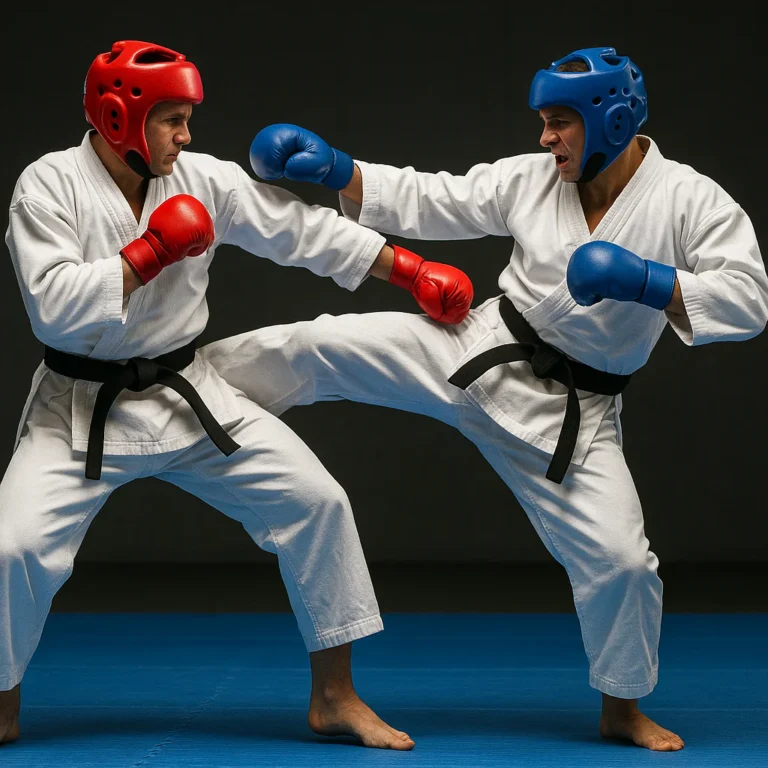
Most strikers (boxers, Muay Thai fighters) stand relatively square to their opponent. This presents a large target area. Shotokan fighters, however, stand bladed (side-on).
- ✅ Advantage: Your torso is a much smaller target.
- ✅ Advantage: It’s harder for a wrestler to grab your hips for a takedown.
- ❌ Disadvantage: Your lead leg is exposed to low kicks.
This stance allows the fighter to “slip” punches effortlessly and launch counter-strikes from angles that look impossible to the untrained eye.
2. The “Stop-Hit” Philosophy
In boxing, you might throw a jab to set up a cross. In Shotokan, the philosophy is often the stop-hit. You don’t throw a combination; you throw one perfect strike that interrupts the opponent’s attack.
“The best offense is a good foundation in karate… providing a strategic advantage in MMA.” — Karate in MMA: The Driving Force
This is why you see fighters like Lyoto Machida waiting for the opponent to commit, then exploding forward with a single, fight-ending kick or punch. It’s not about volume; it’s about precision.
3. The Bounce and Feint
Shotokan training emphasizes constant movement. The “bounce” isn’t just for show; it’s a feinting mechanism. By constantly shifting weight and bouncing, a karateka makes it impossible for the opponent to gauge distance.
- The Trap: The opponent thinks you are out of range.
- The Reality: You are one explosive step away from a knockout.
This creates a psychological advantage. Opponents often become hesitant, afraid to step in, which leads to them making mistakes that the karateka exploits.
🏆 Top 7 Shotokan Practitioners Who Conquered the MMA World
If you think Shotokan is just for the dojo, look at the trophy cases of these seven legends. They didn’t just “use” karate; they mastered it and adapted it to become some of the most dangerous strikers in history.
1. Lyoto Machida: The Black Swan’s Unorthodox Blueprint
Style: Shotokan (under father Yoshizo Machida)
Record: 26-1-0
The Legacy: Machida is the undisputed king of Shotokan in MMA. He won the UFC Light Heavyweight title with a style that baffled everyone. He didn’t throw combinations; he threw one-shot KOs.
- Key Technique: The Mae Geri (Front Kick) to the face.
- Why He Won: He used the bladed stance to make himself a ghost, then exploded with a front kick that looked like it came from nowhere.
- The Adaptation: Machida integrated BJJ to handle the few times opponents got close, but his striking was pure, unadulterated Shotokan.
2. Stephen Thompson: The “Wonderboy” Distance Master
Style: American Kenpo (Heavily influenced by Shotokan mechanics)
Record: 17-6-1
The Legacy: “Wonderboy” brought the karate bounce back to the mainstream. His ability to control distance is unmatched.
- Key Technique: The Kizami-Zuki (Jab) and spinning back kicks.
- Why He Won: Thompson uses the bladed stance to make opponents miss, then counters with surgical precision. He treats the octagon like a point-fighting arena but with full contact.
- The Adaptation: He learned to check leg kicks (a Shotokan weakness) and improved his clinch work, but his striking remains rooted in karate.
3. Georges St-Pierre: The Shotokan Foundation of a Champion
Style: Kyokushin (with heavy Shotokan influence in early career)
Record: 26-2-0
The Legacy: While GSP is often cited as Kyokushin, his early training and striking mechanics were deeply rooted in the linear, explosive nature of Shotokan.
- Key Technique: The Gyaku-Zuki (Reverse Punch) and front kicks.
- Why He Won: GSP’s ability to switch stances and control the center of the cage is a direct result of his karate background.
- The Adaptation: He is the ultimate hybrid, blending karate striking with elite wrestling and BJJ.
4. Dan Henderson: The H-Bomb’s Karate Roots
Style: Shuri-ryu (A style closely related to Shotokan)
Record: 32-15-0
The Legacy: Before he was known for the “H-Bomb,” Henderson was a karate champion. His striking was built on linear power.
- Key Technique: The overhand right and the front kick.
- Why He Won: Henderson’s ability to close the distance with a straight-line attack made him a nightmare for strikers who expected a brawler.
5. Chuck Liddell: The Iceman’s Karate Influence
Style: Kempo/Koei-kan (Shotokan-adjacent)
Record: 21-7-0
The Legacy: The “Iceman” was one of the first to show that a karate base could dominate the heavyweight division.
- Key Technique: The spinning back fist and the straight left.
- Why He Won: Liddell’s footwork was pure karate. He moved laterally and struck with explosive speed, confusing opponents who were used to boxing footwork.
6. Frank Shamrock: The Pioneer of Hybrid Karate
Style: Shuri-ryu
Record: 23-4-0
The Legacy: Frank was a pioneer in the 90s, showing that karate could be the foundation for a complete MMA game.
- Key Technique: The spinning heel kick and the front kick.
- Why He Won: He was one of the first to integrate karate striking with ground fighting seamlessly.
7. Rory MacDonald: The Canadian Karateka’s Evolution
Style: Shotokan
Record: 23-7-0
The Legacy: MacDonald is a modern example of a pure Shotokan practitioner who adapted to the modern game.
- Key Technique: The Mae Geri and Yoko Geri (Side Kick).
- Why He Won: MacDonald’s striking is technical and precise, often catching opponents off guard with long-range kicks.
🥊 Shotokan vs. Other Styles: How It Compares in the Cage
How does Shotokan stack up against the other giants of the MMA world? Let’s break it down.
| Feature | Shotokan | Muay Thai | Boxing | Wrestling/BJ |
|---|---|---|---|---|
| Stance | Bladed, Bouncing | Square, Planted | Square, Mobile | Low, Sprawling |
| Primary Weapon | Front Kick, Straight Punch | Elbows, Knees, Clinch | Punches | Takedowns, Submissions |
| Range | Long | Close/Mid | Mid | Close |
| Strengths | Distance Control, Speed, Surprise | Power, Clinch, Durability | Hand Speed, Combinations | Grapling, Control |
| Weaknesses | Leg Kicks, Takedowns | Slow Footwork, Long Range | No Kicks, No Grapling | Striking Defense |
| MA Viability | High (with adaptation) | Very High | High | Essential |
The Verdict: Shotokan is not a “complete” system on its own. It lacks the clinch work of Muay Thai and the grappling of BJJ. However, as a striking base, it offers a unique strategic advantage that other styles cannot replicate: the ability to fight from a distance where opponents cannot reach you.
🧠 Mastering the Shotokan Stance: From Zenkutsu Dachi to MMA Footwork
The biggest mistake a traditional karateka makes in MMA is trying to use the Zenkutsu Dachi (front stance). In the dojo, you sink your hips deep to generate power. In the cage, that deep stance is a takedown invitation.
The Evolution of the Stance
-
Traditional Zenkutsu Dachi:
Pros: Maximum power, stability.
Cons: Slow, easy to takedown, static.
MA Verdict: ❌ Do not use. -
The MMA Bladed Stance:
Pros: Small target, fast movement, hard to takedown.
Cons: Lead leg exposed to low kicks.
MA Verdict: ✅ The Gold Standard.
How to Transition
To adapt, you must raise your center of gravity. Instead of sinking, you bounce.
- The Bounce: Keep your feet light. Constantly shift your weight between your lead and rear foot.
- The Angle: Turn your hips 45 degrees. Your lead shoulder should be pointing at the opponent.
- The Hands: Keep your hands high, but relaxed. Don’t hold them in a traditional “karate block” position; keep them ready to strike or check.
“The bladed stance makes it challenging for opponents to secure traditional double-leg takedowns.” — Karate in MMA Analysis
👊 Essential Shotokan Techniques for Mixed Martial Arts
Not every technique from the dojo translates to the cage. Here are the five that actually work, and how to use them.
1. The Gyaku-Zuki: The Straight Punch That Changes Fights
The Gyaku-Zuki (reverse punch) is the backbone of Shotokan. In MMA, it’s often used as a counter-punch.
- How to use it: As the opponent throws a jab, step in with your rear foot and fire the rear hand straight through their guard.
- Why it works: It travels the shortest distance to the target.
2. The Mae Geri: Front Kick as a Range Finder and Weapon
The Mae Geri is the signature move. It’s used to keep opponents at bay, check takedowns, and score knockouts.
- How to use it: Snap the kick to the solar plexus or face. Don’t chamber it too high; keep it fast.
- Why it works: It’s faster than a roundhouse and harder to see coming.
3. The Yoko Geri: The Side Kick to the Body and Head
The Yoko Geri (side kick) is a powerful tool for stopping forward momentum.
- How to use it: Thrust the heel into the opponent’s ribs or face.
- Why it works: It acts as a “stop sign” for aggressive opponents.
4. The Kizami-Zuki: The Jab That Keeps Opponents Guessing
The Kizami-Zuki (lead hand punch) is used to disrupt rhythm.
- How to use it: Flick it out quickly to the face, then retreat.
- Why it works: It sets up the rear hand or the front kick.
5. The Ura Mawashi Geri: The Hook Kick Surprise
The Ura Mawashi Geri (hook kick) is a high-risk, high-reward technique.
- How to use it: Use it when the opponent is off-balance or committed to a strike.
- Why it works: It catches opponents off guard with an unexpected angle.
🛡️ Defending the Shotokan Style: Countering Grapplers and Brawlers
The biggest criticism of Shotokan is that it’s “useless” against graplers. This is a myth, but only if you know how to defend.
The Takedown Defense
- The Bladed Stance: By standing side-on, you make it hard for a wrestler to get a double-leg. They have to shoot for a single leg, which is easier to defend.
- The Front Kick: Use the Mae Geri to the chest or face to stop the wrestler from closing the distance.
- The Sprawl: If they get close, you must sprawl. This is where cross-training in BJJ is essential.
The Clinch Defense
Shotokan doesn’t have a traditional clinch. If you get clinched, you are in trouble.
- Solution: Learn to underhook and overhook to create space, then kick or punch your way out.
🔄 Adapting Traditional Kata for Modern Combat Scenarios
Kata are often criticized as “dance moves” with no practical application. But when adapted, they are gold mines for muscle memory and combinations.
From Kata to Cage
- Bassai Dai: The explosive movements in this kata translate to explosive entries in the cage.
- Kanku Dai: The high kicks and hand techniques can be adapted for head kicks and elbow strikes.
The Key: Don’t practice Kata for the sake of Kata. Practice the applications (Bunkai) of the movements. What if the opponent grabs your wrist? What if they throw a punch? The Kata tells you the answer.
🧪 Training Drills: Bridging the Gap Between Dojo and Octagon
How do you train Shotokan for MMA? You need live sparring and pressure testing.
1. The “No-Stop” Sparring Drill
- Goal: Eliminate the “stop-and-go” habit of point sparring.
- Method: Spar with a partner where you are not allowed to stop after a hit. You must flow into the next technique.
2. The Takedown Defense Drill
- Goal: Learn to defend against a double-leg.
- Method: Have a partner shoot for a takedown while you practice the front kick and sprawl.
3. The Distance Control Drill
- Goal: Master the bladed stance.
- Method: Move around the cage, keeping your opponent at the end of your front kick. If they get too close, you strike. If they back up, you advance.
🤔 Common Myths and Misconceptions About Shotokan in MMA
Let’s bust some myths once and for all.
Myth 1: “Shotokan is too slow for MMA.”
- Fact: Shotokan is one of the fastest striking styles. The misconception comes from the deep stances of traditional training. In MMA, the stance is shallow and fast.
Myth 2: “Karate doesn’t work against wrestlers.”
- Fact: Karate is excellent for keeping wrestlers at bay. The front kick is a perfect tool to stop a takedown.
Myth 3: “You need to be a black belt to use Shotokan in MMA.”
- Fact: You need to understand the mechanics, not the belt rank. Many successful MMA fighters have only a few years of karate training.
Myth 4: “Shotokan is just for point fighting.”
- Fact: While it started as point fighting, the principles of distance, timing, and speed are universal.
📈 The Future of Shotokan: Evolution and Integration in Combat Sports
Where is Shotokan going? The future looks bright.
- Hybridization: More fighters are blending Shotokan with BJJ, Muay Thai, and wrestling.
- New Leagues: The rise of Karate Combat (a full-contact league) is bringing traditional karate back to the spotlight, proving that the style can be adapted for full contact.
- Next Generation: Young fighters are studying the old masters but training in the new way. The future of Shotokan in MMA is evolution, not stagnation.
As we’ve seen, the style is not dying; it’s transforming. The next generation of fighters will likely be even more proficient at blending the linear power of Shotokan with the fluidity of modern MMA.
🏁 Conclusion

So, does Shotokan karate work in MMA? Absolutely. But not in the way you might think. It doesn’t work because of the deep stances or the point-sparring rules. It works because of the fundamental principles of distance, timing, and speed.
The legends like Lyoto Machida and Stephen Thompson didn’t just copy the old school; they reimagined it. They took the bladed stance, the front kick, and the straight punch and adapted them for the chaos of the octagon.
The Verdict:
- ✅ Pros: Unmatched distance control, explosive speed, unorthodox angles, hard to takedown.
- ❌ Cons: Vulnerable to leg kicks, requires grappling defense, needs adaptation of traditional stances.
Our Recommendation: If you are a martial artist looking to add a new dimension to your game, study Shotokan. But don’t just study it in the dojo. Study it in the cage. Adapt it. Make it your own. The future of MMA is not about one style; it’s about hybridization. And Shotokan is a key ingredient in that mix.
🔗 Recommended Links
If you want to dive deeper into the world of Shotokan and MMA, here are some essential resources:
- Books:
- The Shotokan Karate: A Complete Guide – A comprehensive guide to the style.
- Karate: The Definitive Guide – Covers the history and techniques.
- Gear:
MA Gloves: Venum Elite MMA Gloves – Great for sparring.
Shin Guards: Fairtex Shin Guards – Essential for protecting your legs. - Training:
Online Courses: Udemy: Karate for MMA – Learn the basics from the comfort of your home.
❓ FAQ
Can shotokan karate techniques be effectively used in combination with other martial arts disciplines in MMA competition?
Yes, absolutely. In fact, that’s the secret to its success. Shotokan provides the striking foundation (distance, speed, angles), while other disciplines like BJ (grapling), Muay Thai (clinch), and Wrestling (takedowns) fill in the gaps. Fighters like Georges St-Pierre and Lyoto Machida are perfect examples of this hybrid approach.
Are there any notable MMA fighters who have a background in shotokan karate?
Yes, many. The most famous include Lyoto Machida, Stephen Thompson, Georges St-Pierre (early training), Dan Henderson, Chuck Liddell, Frank Shamrock, and Rory MacDonald. These fighters have proven that Shotokan can be a dominant force in the octagon.
Read more about “🥋 7 Unbeatable Advantages of Karate in MMA (2026)”
How does shotokan karate’s emphasis on linear movement and deep stances impact MMA fighting?
The linear movement allows for explosive, straight-line attacks that are hard to predict. However, the deep stances of traditional Shotokan are not suitable for MMA. They must be adapted to a shallow, bouncing, bladed stance to prevent takedowns and maintain mobility.
What are the key differences between shotokan karate and other karate styles used in MMA?
- Shotokan: Focuses on linear movement, bladed stance, and long-range fighting.
- Kyokushin: Focuses on close-range, full-contact fighting, and body conditioning.
- Goju-Ryu: Focuses on circular movements, breathing, and close-range grappling.
- Kenpo: Focuses on speed, combinations, and self-defense.
Can shotokan karate training improve a fighter’s overall performance in the UFC?
Yes. It improves footwork, distance control, timing, and striking precision. These are essential skills for any MMA fighter, regardless of their primary style.
How effective is shotokan karate against other martial arts styles in MMA?
It is highly effective against boxers and Muay Thai fighters due to its long-range and unorthodox angles. However, it requires grapling defense to be effective against wrestlers and BJ practitioners.
Read more about “🥋 Is Karate Effective in MMA? The Shocking Truth (2026)”
What are the advantages of shotokan karate in MMA fighting?
- Distance Control: Keeps opponents at bay.
- Speed: Explosive, fast strikes.
- Angles: Unorthodox angles that are hard to defend.
- Takedown Defense: Bladed stance makes it hard to grab.
Read more about “🥋 Karate vs MMA: Who Really Wins in 2026?”
What style of karate does Conor McGregor use?
Conor McGregor primarily uses Boxing and Taekwondo. While he has some karate influence, his style is not rooted in Shotokan.
Read more about “🥋 The 30 Most Legendary Karate Fighters in MMA History (2026)”
Does Shotokan work in a street fight?
Yes. The principles of distance, timing, and speed are universal. However, the deep stances and point-sparring rules must be adapted for real-world scenarios.
Read more about “🥋 How Aikido Builds Fitness & Focus (2026)”
Is shotokan karate effective in MMA?
Yes. As proven by Lyoto Machida and Stephen Thompson, Shotokan is a highly effective style in MMA when adapted correctly.
Read more about “🥊 Is Aikido a Combat Sport? The Brutal Truth (2026)”
What are the best shotokan techniques for MMA?
- Mae Geri (Front Kick)
- Gyaku-Zuki (Reverse Punch)
- Yoko Geri (Side Kick)
- Kizami-Zuki (Lead Hand Punch)
- Ura Mawashi Geri (Hook Kick)
Read more about “🥋 What Does Aikido Do? The 2026 Truth About Harmony & Defense”
Can shotokan karate be used for MMA sparring?
Yes. But it must be live sparring with full contact and no stopping. Traditional point sparring is not sufficient for MMA preparation.
Read more about “🥋 What Is the Best Martial Art to Do? 12 Top Styles for 2026”
Which famous MMA fighters have a shotokan background?
Lyoto Machida, Stephen Thompson, Georges St-Pierre, Dan Henderson, Chuck Liddell, Frank Shamrock, and Rory MacDonald.
Read more about “🥋 Karate MMA: The Ultimate Guide to Striking Mastery (2026)”
How does shotokan karate compare to other karate styles in MMA?
Shotokan is unique in its linear movement and bladed stance. Other styles like Kyokushin are more close-range and full-contact, while Goju-Ryu is more circular and grapling-oriented.
Read more about “🥋 20+ Martial Arts Styles: Your Ultimate Guide”
What are the limitations of shotokan karate in mixed martial arts?
- Vulnerability to leg kicks.
- Lack of traditional clinch work.
- Need for grappling defense.
- Adaptation of traditional stances required.
Read more about “🥋 Is Karate Really Like Cobra Kai? (2026 Truth)”
How can a shotokan practitioner adapt their style for MMA?
- Raise your center of gravity.
- Adopt a bladed, bouncing stance.
- Train live sparring with full contact.
- Learn grappling defense (BJ/Wrestling).
- Focus on continuous flow, not point sparring.
Read more about “🥋 Aikido: The Ultimate Guide to Harmony, Self-Defense & Mastery (2026)”