Support our educational content for free when you purchase through links on our site. Learn more
🥋 How Karate Makes MMA Striking Less Predictable


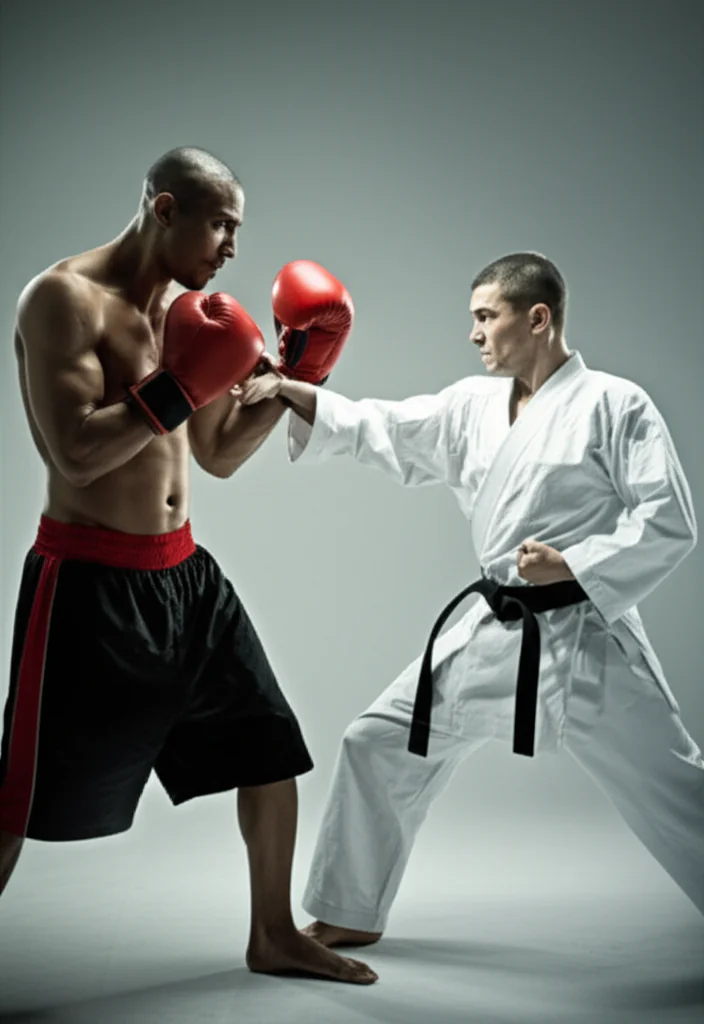
Karate’s influence on MMA striking diversity is clearest in how fighters control distance, change rhythm, and launch sudden attacks—not in any single signature move. Its best techniques work as part of a complete MMA game, backed by boxing, wrestling defense, and clinch skills.
We’ve seen the difference in the gym: a partner who keeps stepping straight into range gets met by a side kick, then finds the striker has already angled away. The kick gets the attention, but the footwork creates the real puzzle.
From Lyoto Machida’s patient counterstriking to Stephen Thompson’s mobile karate-influenced approach, elite fighters show how these ideas can shape an MMA bout. They also show why a long stance or flashy kick needs a dependable answer when the opponent shoots, clinches, or cuts off the cage.
Key Takeaways
- Karate adds variety through distance control, explosive entries, feints, and angle changes.
- Its techniques work best when adapted to MMA’s low kicks, clinch fighting, cage pressure, and takedowns.
- Karate is a toolkit, not a complete MMA system: blend it with boxing, wrestling defense, and grapling.
- Watch the setup and exit, not just the strike. Footwork and timing often make a karate-inspired attack effective.
- There is no one-size-fits-all style: the right karate principles depend on the fighter, opponent, and ruleset.
Table of Contents
- ⚡️ Quick Tips and Facts
- 🥋 What Karate’s Influence on MMA Striking Diversity Really Means
- 📜 From the Dojo to the Octagon: Karate’s History in MMA
- Traditional Karate Styles and Their Fighting Principles
- How Early MMA Helped Karate Adapt
- 🎯 How Karate Expands MMA’s Striking Arsenal
- Unorthodox Stances, Angles, and Footwork
- Blitzes, Side Kicks, and Spinning Attacks
- Long-Range Counters and Intercepting Strikes
- 📏 Distance, Timing, and Angles: Karate’s Tactical Edge
- Managing Range Against Boxing and Muay Thai
- Drawing Reactions and Countering Entries
- Why Footwork Matters as Much as Kicking
- ⭐ 10 Karate-Inspired Skills That Diversify MMA Striking
- 1. Side-on Stance and Mobile Guard
- 2. In-and-Out Footwork
- 3. Blitz Entries
- 4. Side Kicks to the Body
- 5. Front Kicks for Range Control
- 6. Lead-Leg Attacks
- 7. Angle Changes After Combinations
- 8. Intercepting Counters
- 9. Feints and Rhythm Breaks
- 10. Unpredictable Kicking Setups
- 🥊 Karate vs. Boxing, Muay Thai, Taekwondo, and Kickboxing
- What Karate Adds to an MMA Striking Mix
- Where Other Striking Styles Have the Advantage
- 🏆 Fighters Who Brought Karate Into the MMA Spotlight
- Lyoto Machida and Distance-Based Counterstriking
- Stephen Thompson and Sport Karate Footwork
- Georges St-Pierre and Karate-Inspired Adaptation
- Other Notable Karate-Based MMA Strikers
- 🧩 Why Karate Works Best as Part of a Complete MMA Game
- Wrestling Threats and the Risk of Long Stances
- Cage Position, Clinch Fighting, and Leg Kicks
- Adapting Traditional Techniques to MMA Gloves and Rules
- 🛠️ How MMA Fighters Can Train Karate-Inspired Striking
- Stance and Footwork Drills
- Safe Partner Drills for Timing and Distance
- Building Kicks Into Punching Combinations
- Sparing Progressions and Common Training Mistakes
- 📊 What Fight Footage Can—and Cannot—Tell Us
- How to Spot Karate Influence in MMA
- Separating Style Labels From Effective Technique
- 🚀 The Future of Karate in MMA Striking
- Hybrid Styles and Evolving Fight Strategies
- What the Next Generation Can Borrow From Karate
- ✅ Practical Takeaways for Fighters, Coaches, and Fans
- Conclusion
- Recommended Links
- FAQ
- Reference Links
⚡️ Quick Tips and Facts
Karate has not replaced boxing, Muay Thai, wrestling, or Brazilian jiu-jitsu in MMA. Its bigger contribution is making striking more varied: fighters can manage distance differently, attack from unusual angles, change rhythm, and exit before opponents settle into predictable exchanges.
For more on how karate translates into mixed martial arts, see our Karate and MMA guide.
| Quick fact | What it means in MMA |
|---|---|
| Karate often favors long range | The fighter may use footwork, feints, and front or side kicks to control when an exchange begins. |
| A bladed stance can make entries explosive | It may help with straight-line attacks, but can leave the lead leg exposed to low kicks. |
| Karate’s value is tactical as well as technical | Rhythm changes and distance traps can make an opponent miss before a counter lands. |
| Karate techniques need MMA-specific adaptation | The fighter must account for leg kicks, cage pressure, clinches, takedowns, and gloves. |
| Strong karate-based MMA is usually hybrid | Karate principles work best alongside boxing, wrestling defense, and grapling. |
Our coaching shorthand: use karate to create the problem; use a complete MMA skill set to solve whatever the opponent does next. 🥋
🥋 What Karate’s Influence on MMA Striking Diversity Really Means
When we talk about karate’s influence on MMA striking diversity, we are not claiming that every side kick or sudden lunge belongs exclusively to karate. Many martial arts share techniques. The clearer influence is a collection of habits: manage range, disrupt rhythm, attack in bursts, and leave on angle.
That matters because MMA striking is not one fixed style. A fighter who mostly boxes may prefer combinations at punching range. A Muay Thai fighter may pressure with kicks, knees, elbows, and clinch work. A karate-influenced fighter can add a different question: Can you hit me before I decide to enter?
The answer, of course, depends on the opponent. A long stance can help create space but invite low kicks. A quick retreat can frustrate a puncher but walk the karateka into the fence. The style adds options; it does not grant a force field.
Karate adds principles, not a sealed-off rulebook
Karate’s contribution often shows up in the way a fighter uses familiar techniques:
- Distance control: staying just beyond a preferred attack and stepping in as the opponent commits.
- Linear acceleration: covering ground quickly with straight punches or a blitz.
- Angular exits: striking, then moving off the opponent’s return line.
- Rhythm variation: changing pace so attacks do not arrive on a steady beat.
- Long-range kicking: using front and side kicks to interrupt entries or protect space.
- Counterstriking: drawing an attack and responding while the opponent is extended.
Some commentators describe karate as “another tool for fighters willing to evolve.” That framing is useful: karate does not need to beat every style to influence the sport. It only needs to offer reliable tools that fit a fighter’s game.
What “striking diversity” looks like in a bout
Imagine two athletes who both throw a straight punch. One advances behind a conventional boxing combination. The other bounces out of range, draws a step, then bursts in with a straight counter and angles away. The punch may look familiar; the entry, timing, and exit tell a different story.
That kind of variety can make an opponent hesitate. Hesitation can create openings—but it also gives a wrestler time to change levels. We will return to that trade-off when we look at takedown defense.
For more technique breakdowns, visit our Karate Techniques and Fight Analysis and Breakdowns sections.
📜 From the Dojo to the Octagon: Karate’s History in MMA
Karate entered MMA through several routes: traditional dojo training, full-contact competition, kickboxing, family martial-arts backgrounds, and athletes who later blended striking with wrestling and grapling. There is no single “karate style” in the cage. Shotokan, Kyokushin, Goju-ryu, Kempo, and other systems differ in training methods, rules, and preferred ranges.
Early MMA helped expose a simple truth: a technique practiced against a predictable partner may need significant changes when the opponent can punch, kick the legs, clinch, and wrestle. The fighters who made karate principles work generally adapted them rather than trying to recreate point-sparing conditions.
Traditional Karate Styles and Their Fighting Principles
| Style or tradition | Common training emphasis | Potential MMA contribution | Adaptation to consider |
|---|---|---|---|
| Shotokan | Linear movement, long-range attacks, decisive entries | Explosive straight punches, in-and-out footwork, distance traps | Avoid predictable retreats; defend leg kicks and takedowns |
| Kyokushin | Full-contact striking, conditioning, body attacks | Durability, powerful kicks, comfort under pressure | Traditional rules may not include punches to the head, so boxing defense needs work |
| Goju-ryu | Close-range methods, breathing and body conditioning | Compact striking ideas and close-range toughness | Translate drills into live MMA exchanges and clinch situations |
| Kempo/Kenpo traditions | Varied combinations and practical self-defense concepts | Combination striking and rapid changes of line | Training quality and competition rules vary widely |
| Sport karate | Speed, distance, timing, scoring attacks | Fast entries, evasive movement, sharp reactions | Point-stop habits may not transfer directly to continuous fighting |
These are broad descriptions, not guarantees. A school’s live training, coaching, and rules matter at least as much as its style label. A karateka who spars intelligently against wrestlers may better prepared for MMA than a student from a supposedly “more practical” style who never trains under pressure.
The World Karate Federation outlines the sport’s international competition framework; its rules help explain why sport-karate movement can look different from MMA striking. The International Kyokushin Karate Organization provides background on Kyokushin’s full-contact tradition.
How Early MMA Helped Karate Adapt
Early mixed-rules competition challenged every martial art to answer the same questions: Can this technique land against a resisting opponent? What happens if it misses? Can the athlete defend a takedown afterward?
Karate-based fighters had to adjust:
- Shorten or modify the stance when the opponent threatened low kicks or level changes.
- Keep the hands useful for defense, rather than relying only on distance to avoid punches.
- Reduce the commitment of missed attacks, because a failed kick can lead to a catch, counter, or takedown.
- Practice against graplers, not just other strikers.
- Use the cage as a tactical constraint, since there is no endless retreating from a skilled pressure fighter.
A useful overview from FightBook MMA describes karate as “another tool for fighters willing to evolve.” We agree with the spirit of that line. The caveat is that evolution means testing techniques against the full set of MMA threats, not just polishing them in a familiar drill.
🎯 How Karate Expands MMA’s Striking Arsenal
Karate can diversify MMA striking through stance, movement, entry, and timing. A single technique rarely explains the whole effect. The same side kick can be a body attack, a range-finder, a way to interrupt forward pressure, or a feint that sets up a punch.
Unorthodox Stances, Angles, and Footwork
A bladed stance turns the body partly sideways. That can reduce the target presented to an opponent and make a fast straight-line entry feel sudden. It can also make the lead leg easier to attack, particularly with low kicks. Experienced fighters adjust by changing stance width, switching stance, checking, or moving the lead leg out of range.
Karate footwork may include:
- Quick advances and retreats to invite a reaction.
- Lateral steps to avoid moving straight back toward the fence.
- Stance changes that alter which side leads.
- Small rhythm hops or pauses that make timing less obvious.
- Angle exits after a punch or kick lands.
The goal is not to bounce endlessly. Movement should earn something: a safer angle, a clearer counter, or a better position. As one of our coaches puts it, “If your feet are busy but your opponent is still choosing the exchange, you are doing cardio in a fighting stance.”
Blitzes, Side Kicks, and Spinning Attacks
A blitz is a sudden, committed entry—often with straight punches—designed to cover distance before the opponent can reset. It can work beautifully when the opponent is backing up, hesitating, or reaching. It can also run straight into a counter or a level change if the setup is careless.
A side kick can push or strike along a relatively direct line. Fighters may use it to the body or leg to interrupt movement, but targeting and legality depend on the ruleset and situation. Spinning attacks add another line of attack, though they are higher-risk: the fighter briefly loses sight of the opponent and may expose the back or give up position.
| Technique | Useful purpose | Main risk | Coaching cue |
|---|---|---|---|
| Blitz | Explosive entry and straight-punch surprise | Overcommitting into counters or takedowns | Enter behind a feint, jab, or opponent’s reaction |
| Lead-leg side kick | Interrupt pressure and manage range | Leg catch, imbalance, or predictable timing | Recover the leg quickly and keep hands ready |
| Front kick | Stop forward motion or attack the body | Catching, parying, or countering during recovery | Vary the target and avoid launching from too far away |
| Spinning kick | Attack an unexpected angle | Turning away, missing, or losing position | Use only when the setup and exit are clear |
| Reverse punch | Fast, direct counter or blitz punch | Loading up and telegraphing the shoulder | Keep it compact; pair it with angle exit |
A second overview, MA Ailm’s guide to karate in MMA, emphasizes the “half-beat”: attacking in the tiny timing gap between an opponent’s actions. That phrase captures a real tactical idea, though fighters should not treat it as magic. The gap has to be read, created, and trained.
Long-Range Counters and Intercepting Strikes
Karate-influenced fighters may use a front kick, side kick, or straight punch to intercept an opponent’s entry. Instead of waiting for a combination to arrive, they meet the movement early. A successful intercept can stop an attack before it develops; a mistimed one can leave the fighter open.
A practical sequence:
- Show a small feint to learn whether the opponent paries, retreats, or rushes.
- Hold a range just outside the opponent’s preferred attack, without drifting toward the fence.
- Intercept the entry with a straight strike or kick if the opponent commits.
- Recover the stance and defend the return, especially the opponent’s follow-up shot or takedown.
- Exit at angle or re-establish distance, rather than admiring the strike.
This is why the karate game is not simply “hit without being hit.” The more complete objective is to control how the exchange unfolds. That distinction separates purposeful distance management from backing away and hoping the cage is farther than it looks.
📏 Distance, Timing, and Angles: Karate’s Tactical Edge
Distance is not a fixed measurement. It changes with stance, reach, movement, fatigue, and the opponent’s preferred attacks. A fighter might be outside punching range but still inside kicking range—or close enough for a wrestler to shoot.
Managing Range Against Boxing and Muay Thai
Karate’s long-range tactics can be useful against boxers who want to establish punching combinations and Muay Thai fighters who want to advance into kicks or clinch range. But no style has one universal distance. A boxer may use a long jab; a Muay Thai specialist may attack with a tep or low kick; a wrestler may cross the gap without exchanging punches.
| Opponent’s likely plan | Karate-influenced response | What can go wrong |
|---|---|---|
| Boxer closes behind punches | Step off-line, counter straight, exit | Retreating in a straight line can lead to cage pressure |
| Muay Thai fighter attacks with low kicks | Change stance, check, counter, or attack at a different range | A bladed stance may leave the lead leg exposed |
| Pressure fighter walks forward | Use front/side kicks and lateral movement | Kicks may be caught; movement can become predictable |
| Wrestler level-changes | Keep stance recoverable, frame, sprawl, or angle away | Long, narrow stances may slow defensive reactions |
| Counterstriker waits | Feint, vary rhythm, and take space carefully | Repeated blitzes can become easy to time |
The underlying concept is familiar across combat sports: make the opponent commit before choosing your response. But a fighter cannot stay at a perfect distance forever. Eventually, they need to attack, defend, clinch, or reposition.
Drawing Reactions and Countering Entries
A feint is useful only if it creates information or a reaction. We often teach athletes to note what the opponent does after a shoulder twitch, level change, or small step. Does the opponent pary? Fire a jab? Reach for a leg? Freeze?
Then the fighter can build a simple decision tree:
- If the opponent reaches to pary, change levels or attack another line.
- If the opponent rushes, intercept or angle out.
- If the opponent waits, take ground carefully and make them react.
- If the opponent shoots, defend first; do not force a counter that compromises balance.
A fighter who uses feints well is not merely being tricky. They are gathering data while hiding intent. More on this kind of tactical reading appears in our fight breakdowns.
Why Footwork Matters as Much as Kicking
A spectacular kick gets attention. Footwork determines whether the fighter can throw it safely, recover, and avoid the response.
A useful movement checklist:
- Do not retreat straight back repeatedly. Use lateral exits or pivot when space allows.
- Keep your stance ready to defend a shot. A dramatic stretch may look graceful right up until a wrestler takes the hips.
- Recover the kicking leg promptly. A slow return can invite a catch or counter.
- Track the fence. The cage turns an open-space retreat into a dead end.
- Change rhythm for a reason. Random bouncing is not automatically deception.
In a sparing session, one of our karate coaches once asked a student to “win the space, not the chase.” The student stopped hopping backward, stepped diagonally after each attack, and suddenly the partner had to turn to follow. The kicks did not get harder. The position got smarter.
⭐ 10 Karate-Inspired Skills That Diversify MMA Striking
These skills are not exclusive to karate, and none is a shortcut around MMA training. They are karate-influenced options that can be adapted to an individual fighter’s stance, ruleset, and wrestling defense.
1. Side-on Stance and Mobile Guard
A slightly bladed stance can reduce the target presented to an opponent and support quick straight attacks. Keep enough width to defend low kicks and sprawls. An extreme side-on posture can sacrifice defensive balance.
2. In-and-Out Footwork
Enter to attack, then leave or angle off before the opponent’s counter develops. The key is a controlled return to a stance, not a frantic hop backward.
3. Blitz Entries
A rapid burst of straight punches can cover distance quickly. Set it up with a feint or by drawing the opponent forward, and finish with angle or defensive reset.
4. Side Kicks to the Body
A side kick can interrupt a forward-moving opponent or make them reset their feet. Because the leg may be caught, practice recovery, hand protection, and follow-up defense.
5. Front Kicks for Range Control
A front kick can attack the body or manage space. It is not identical to a Muay Thai tep in mechanics or use, and fighters may adapt either depending on their training. Vary the timing so it does not become a predictable stop sign.
6. Lead-Leg Attacks
Fast lead-leg kicks can arrive without the same loading motion as a rear-leg strike. They can target the body or leg, depending on the rules and opening. The trade-off is that a repeated lead-leg attack may be checked or countered.
7. Angle Changes After Combinations
A combination should not always end in the same place. After landing, pivot or step off-line to make the opponent turn before responding. This is particularly valuable when the opponent throws back immediately.
8. Intercepting Counters
Meet an opponent’s entry with a straight punch or kick instead of waiting for the full attack. Train this with controlled partner drills first; live timing is less forgiving than a cooperative pad holder.
9. Feints and Rhythm Breaks
Pause, twitch, step, or change cadence to invite a reaction. A good feint resembles an attack enough to matter, but does not compromise balance.
10. Unpredictable Kicking Setups
Use punches to disguise a kick, or a kick feint to create a punching opening. The point is not to spin for spectacle. It is to make the opponent defend one line while the real attack arrives on another.
For guided practice ideas, explore our MA Training resources. If you are training for competition, ask your coach to adapt drills to the ruleset and your grapling level.
🥊 Karate vs. Boxing, Muay Thai, Taekwondo, and Kickboxing
Style comparisons are useful only when they compare training tendencies, not stereotypes. A highly mobile Muay Thai fighter may move more than a stationary karateka; a boxer may be an excellent kicker; and an MMA fighter’s game often combines years of cross-training.
| Striking background | Common strengths it can contribute | Considerations in MMA |
|---|---|---|
| Karate | Range control, quick entries, angle changes, timing | Must address low kicks, clinch, and wrestling |
| Boxing | Punch combinations, head movement, defensive hand skills | Kicking range and takedown threats change stance choices |
| Muay Thai | Kicks, knees, elbows, checks, and clinch striking | Traditional stance and rhythm may need adjustment for MMA wrestling |
| Taekwondo | Fast, varied kicks and long-range movement | Punching, low-kick defense, and takedown defense need integration |
| Kickboxing | Punch-kick combinations and ring-tested pressure | Rules vary; MMA adds takedowns, cage wrestling, and ground transitions |
What Karate Adds to an MMA Striking Mix
Karate can add a different rhythm and entry pattern. Its long-range movement, sudden bursts, and use of the lead leg may give a fighter tools that are less common in a conventional boxing-heavy approach. It can also teach patience: drawing an attack before countering rather than trading automatically.
Where Other Striking Styles Have the Advantage
Muay Thai commonly offers extensive practice with clinch strikes, knees, elbows, and checking kicks. Boxing provides deep development of punching combinations, defensive responsibility, and close-range exchanges. Taekwondo can develop exceptional kicking speed and variety. Kickboxing blends punches and kicks under rules that vary by organization.
The useful question is not “Which style wins?” It is: Which skills are missing from this fighter’s game? A karate specialist who struggles in the pocket should invest in boxing and clinch defense. A boxer who gets kicked at range may benefit from kick defense and long-range movement. A Muay Thai fighter who is easy to time may benefit from feints and rhythm changes.
🏆 Fighters Who Brought Karate Into the MMA Spotlight
Elite fighters rarely represent one style in a pure form. The athletes below illustrate how karate principles can blend with other training. For profiles and more martial-arts biographies, see our Fighter Profiles.
Lyoto Machida and Distance-Based Counterstriking
Lyoto Machida became a prominent example of karate-influenced MMA through his elusive movement, patient counterstriking, and sudden attacks. He used distance to make opponents reach or overcommit, then punished openings. His UFC career included winning the light-heavyweight championship; the UFC’s fighter profile documents his career record and background.
Machida’s lessons are not “never engage” or “always retreat.” They are make the opponent pay for entering badly, and do not allow movement to become passive. His style also relied on excellent athletic timing and broader MMA preparation.
Stephen Thompson and Sport Karate Footwork
Stephen “Wonderboy” Thompson brought a distinctive karate- and kickboxing-influenced look to the UFC: a mobile stance, long-range attacks, quick side kicks, and fast combinations. The UFC fighter page provides official career information.
Thompson’s movement can make opponents turn and reset, but the same distance game must be carefully managed against wrestlers and pressure fighters. His example shows that footwork is an offensive skill: it helps create the range from which attacks become available.
Georges St-Pierre and Karate-Inspired Adaptation
Georges St-Pierre is best remembered as a complete champion whose wrestling and athleticism were central to his success. His karate background contributed to movement, timing, and striking setups, but it should not be treated as the sole explanation for his style. The UFC Hall of Fame profile covers his career.
GSP’s broader lesson is hybridization: a strike can score, draw a reaction, or make a takedown easier. Karate principles can support a wrestling game just as wrestling defense can make karate movement safer.
Other Notable Karate-Based MMA Strikers
- Kyoji Horiguchi: Known for blending fast entries, mobile striking, and wrestling ability. His career illustrates how karate-derived movement can adapt across divisions and promotions.
- Conor McGregor: His stance and distance control have sometimes been compared with karate-influenced approaches, but his striking also draws heavily from boxing, kickboxing, and other influences. It is more accurate to describe him as a hybrid striker than to label him a karate fighter.
- Jon Jones: Has used long-range kicks and unusual striking choices; attributing each technique directly to karate would oversimplify a highly adaptive MMA game.
- Anderson Silva: His movement and counterstriking have invited comparisons to multiple styles, including karate, but his skill set was broad and cannot be reduced to one tradition.
These examples also show why style labels can be slippery. A fighter may use a karate-like stance without having a traditional karate background, while a karate-trained athlete may fight from a compact stance that barely resembles dojo sparing.
🧩 Why Karate Works Best as Part of a Complete MMA Game
Karate’s strengths are easier to use when the fighter can handle what follows. A side kick that creates space is useful; a side kick that gets caught and turns into a takedown is an expensive lesson. The style needs defensive answers as well as offensive tools.
Wrestling Threats and the Risk of Long Stances
A long, bladed stance can support quick movement and straight attacks, but it may make stance recovery or sprawls more difficult. Wrestlers can exploit predictable retreats, overcommitted kicks, and moments when a fighter’s weight is poorly distributed.
Adaptations include:
- Keep the stance mobile rather than fixed.
- Practice reacting to level changes after every kick and punch combination.
- Use a jab, frame, or angle to disrupt the shot.
- Avoid launching long attacks when the opponent is already in range to wrestle.
- Train cage-specific defense, not only open-mat movement.
The UFC’s unified rules overview helps explain the sport’s formal framework, while actual defensive requirements are best learned through qualified MMA coaching and live practice.
Cage Position, Clinch Fighting, and Leg Kicks
The cage changes the geometry of karate movement. In open space, a fighter can circle away. Near the fence, the same retreat may end with nowhere to go. Clinches can also nullify long-range striking, while calf kicks can punish a stance that leaves the lead leg exposed.
A practical cage checklist:
- Notice the fence early instead of waiting until your back touches it.
- Angle off before retreating again.
- Use frames and underhooks to create space if the opponent clinches.
- Check or move away from low kicks, and avoid leaving the lead leg planted.
- Re-enter only when balanced, not while stumbling out of a clinch.
Adapting Traditional Techniques to MMA Gloves and Rules
Traditional training may use bare fists, larger gloves, controlled contact, or point-based scoring. MMA uses small gloves and permits a broader range of transitions, including takedowns and ground fighting. That changes guard position, defensive habits, and the cost of a missed strike.
A karate punch that works in a dojo may need different setup and recovery in MMA. A high kick may be effective but risky if caught. A point-sparing exit may leave the fighter vulnerable to a second attack. The technique is not automatically invalid; the training context may need updating.
The article “Unleashing the Unknown: How Karate Transforms Fighters in the World of Professional MMA” also highlights precision, movement, and adaptation. Its broad message complements the more tactical view in FightBook MMA and MA Ailm: the sources emphasize different benefits, but all point toward adaptation rather than isolated tradition.
If you are reading alongside the first YouTube video embedded above, “Why is Karate So Over Powered in MMA?” by Michael Walsh MMA, use it as a discussion starter, not a final verdict. The useful question is not whether karate is “overpowered”; it is which karate-derived tactics work under pressure, against which opponents, and with what defensive trade-offs.
🛠️ How MMA Fighters Can Train Karate-Inspired Striking
A karate technique becomes an MMA skill when it survives realistic resistance. Start with clean movement, add a partner’s reactions, then test it in controlled sparing with wrestling threats included. Progress gradually; “realistic” does not mean reckless.
Stance and Footwork Drills
Drill: enter, strike, exit
- Mark a starting point and a target line on the mat.
- Begin in a stance that allows both movement and takedown defense.
- Step in with a jab or straight punch.
- Add a controlled side kick or front kick.
- Exit diagonally, then reset your stance.
- Repeat in both stances and vary the rhythm.
Coaching checks:
- Are the hands still protecting the head?
- Does the fighter regain balance after the kick?
- Is the exit moving away from the fence?
- Can the athlete sprawl or defend a clinch immediately afterward?
Safe Partner Drills for Timing and Distance
Drill: read and respond
- Partner A uses a slow, controlled advance, jab, or level-change feint.
- Partner B chooses one response: intercept, angle, check, or disengage.
- Switch roles after several repetitions.
- Increase speed only when both partners maintain control.
Do not start with full-power counters. The objective is to learn what a real cue looks like and to respond without guessing. Coaches should scale contact to experience and use appropriate protective equipment.
Building Kicks Into Punching Combinations
Kicks are safer when they fit into a complete sequence. Try:
- Jab → rear straight → angle out.
- Feint jab → lead-leg side kick → stance recovery.
- Cross → front kick → frame and exit.
- Low-kick feint → straight punch, if the opponent reacts by lowering their guard.
These are templates, not guaranteed combinations. A partner who blocks or counters should change the sequence. In MMA, the fighter must also expect a takedown attempt after a kick.
Sparing Progressions and Common Training Mistakes
A practical progression:
| Stage | Training goal | Constraints |
|---|---|---|
| Solo movement | Balance, stance transitions, and safe recovery | No power or complex combinations required |
| Pads | Accuracy and controlled entry/exit | Coach calls changing targets and rhythms |
| Partner reactions | Read paries, advances, and level changes | Light contact and predictable safety rules |
| Situational sparing | Apply one tactic against active resistance | Start at long range or near the cage |
| Open sparing | Integrate striking with wrestling and clinch defense | Coach supervises intensity and partner matching |
Common mistakes include:
- Over-bouncing: movement without a tactical purpose.
- Backing straight up: surrendering ground until the cage traps the fighter.
- Throwing naked kicks: attacking without a setup or recovery plan.
- Overusing the blitz: repeating the same entry until it becomes easy to counter.
- Ignoring wrestling: treating striking practice as if the opponent cannot change levels.
- Confusing style with skill: assuming a karate label guarantees effective timing.
For more structured training guidance, visit MA Training and browse our Karate Techniques.
📊 What Fight Footage Can—and Cannot—Tell Us
Fight footage can show stance, movement, attack selection, and tactical patterns. It usually cannot prove exactly where a technique came from, how much a fighter trains a given style, or whether a tactic will work for everyone.
How to Spot Karate Influence in MMA
Look for recurring behaviors rather than one flashy technique:
- A noticeably bladed or mobile stance.
- Suden straight-line entries from outside punching range.
- Lead-leg front or side kicks used to manage space.
- Repeated angle exits after attacks.
- Feints and rhythm changes that draw a response.
- Counters timed as an opponent enters.
Then ask what happens when the tactic fails. Does the athlete defend the counter, recover stance, and avoid the takedown? That part matters just as much as the successful highlight.
Separating Style Labels From Effective Technique
A spinning kick is not automatically karate. A side-on stance is not proof of karate training. Techniques travel across styles, and MMA fighters borrow whatever works.
To assess a claim, separate three questions:
- Background: What did the athlete actually train?
- Technique: What movement appears in the bout?
- Influence: Is there evidence the movement comes from karate training, or is it only a visual resemblance?
This approach avoids overclaiming while still recognizing karate’s contribution. It also explains why articles may describe the same fighter differently: one writer emphasizes biography, another observes technique, and a third focuses on tactical resemblance.
🚀 The Future of Karate in MMA Striking
Karate’s likely future in MMA is less about a return to “pure” styles and more about selective hybridization. Coaches can preserve useful principles—timing, distance, explosive movement—while adjusting stance, guard, and attack selection to modern wrestling and cage fighting.
Hybrid Styles and Evolving Fight Strategies
We expect to see more athletes combine karate-influenced movement with:
- Boxing combinations and defensive head movement.
- Muay Thai checks, clinch work, and knee defense.
- Wrestling awareness and cage escapes.
- Kickboxing combinations and sustained pressure.
- Grapling transitions that punish opponents for overcommitting.
The best blend depends on the athlete. A long-range counterstriker may benefit from a different karate toolkit than a pressure wrestler who uses kicks to set up takedowns.
What the Next Generation Can Borrow From Karate
Young fighters can borrow the principles, not just copy a professional’s stance. Build sound balance, learn to enter and exit under control, practice feints that produce reactions, and train against partners who can wrestle.
One unresolved question remains: can a karate-influenced fighter keep the style’s speed and unpredictability while facing elite pressure? The answer will not come from a single highlight. It will come from fighters who can use those qualities across full rounds, defend the inevitable adjustment, and still make their opponent hesitate.
✅ Practical Takeaways for Fighters, Coaches, and Fans
- For fighters: Treat karate as a source of tools—especially distance control, rhythm changes, and sudden entries—not a replacement for the rest of MMA.
- For coaches: Test karate-inspired techniques against low kicks, clinches, cage pressure, and takedowns.
- For fans: Watch the feet and the exits, not just the finishing strike. The setup often tells you more than the highlight.
- For beginners: Prioritize balance, safe partner work, and qualified coaching before attempting high-risk spinning attacks.
- For everyone: Ask whether a tactic controls the exchange and has a plan for what happens if it misses.
Karate’s influence is strongest when it makes MMA striking less predictable without making the fighter less prepared. That is the sweet spot: distinctive offense, sound defense, and no surprise when the opponent changes the rules of the exchange.