Support our educational content for free when you purchase through links on our site. Learn more
Evolution of Karate in Modern MMA: 10 Techniques 🥋


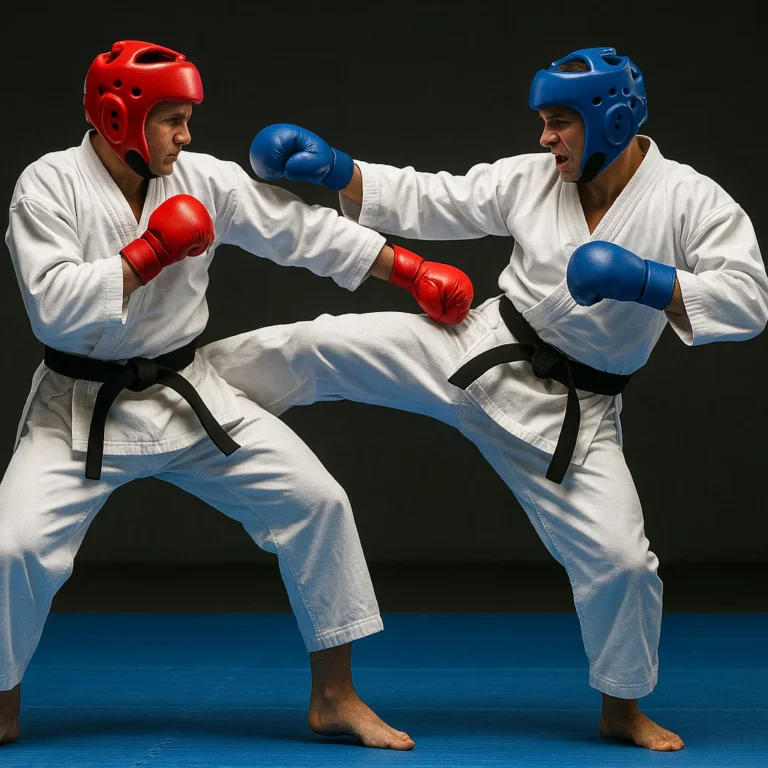
The evolution of karate techniques in modern MMA is all about adaptation: fighters have carried karate’s timing, distance control, fast entries, and dynamic kicks into the cage, then reinforced them with wrestling, clinch work, and ground skills. Karate can make a striker difficult to read, but it works best as part of a complete MMA game—not as a stand-alone answer.
We’ve seen students arrive hoping one spinning kick will solve everything. Usually, the breakthrough comes when they learn to land a simpler strike, recover their stance, and stay ready for the opponent who shoots in as soon as the kick misses.
That’s the fun of karate in MMA: a bladed stance or sudden blitz can make an opponent hesitate, but every clever attack also asks a practical question—what happens if they counter or grab you? The best karate-influenced fighters have answer ready.
Key Takeaways
- Karate’s strongest MMA contributions include range control, explosive entries, feints, counterstriking, and varied kicks.
- Traditional techniques need cage-specific adjustments to account for low kicks, clinches, takedowns, and pressure against the fence.
- A bladed stance can help control distance, but it must remain flexible enough for sprawls, checks, and lateral movement.
- Karate is most effective when blended with wrestling, boxing, Muay Thai, and Brazilian jiu-jitsu.
- The key is not throwing more flashy techniques; it’s landing with purpose, recovering safely, and being prepared for what comes next.
Table of Contents
- ⚡️ Quick Tips and Facts
- 🥋 Karate’s Roots and Its Journey into MMA
- From Okinawan fighting arts to modern karate
- How karate entered the cage
- 🔄 How Karate Techniques Have Evolved in Modern MMA
- Traditional karate principles that still work
- What MMA changed about karate training and tactics
- 🥊 10 Karate Techniques That Shaped Modern MMA
- 1. Bladed stance and distance management
- 2. In-and-out footwork
- 3. Side kicks and front kicks
- 4. Roundhouse kicks and changing targets
- 5. Spinning and back kicks
- 6. Karate-style blitzes and straight punches
- 7. Feints, timing, and counterstriking
- 8. Angles, pivots, and lateral movement
- 9. Stance switches and stance deception
- 10. Clinch entries, takedown defense, and cage awareness
- 👊 Karate in MMA: Standout Fighters and Styles
- Lyoto Machida and the elusive counterstriking style
- Stephen “Wonderboy” Thompson and point-karate movement
- Other MMA fighters with karate-influenced striking
- 🧠 Why Karate Works in the Octagon
- Range control, rhythm, and fast entries
- Unorthodox attacks and opponent reactions
- When karate’s strengths become liabilities
- 🤼 Blending Karate with Wrestling, BJJ, and Muay Thai
- Defending takedowns from a karate stance
- Using kicks and punches to create grapling openings
- Adapting karate for clinch work and cage fighting
- 🏋️ How to Train Karate for Modern MMA
- Build a practical stance and movement base
- Develop MMA-ready kicking and punching combinations
- Add live sparing, wrestling, and cage drills
- Common training mistakes to avoid
- 📊 Karate vs. Other Striking Styles in MMA
- 🔮 The Future of Karate Techniques in MMA
- ✅ Conclusion
- 🔗 Recommended Links
- ❓ FAQ
- Is karate effective in modern MMA?
- Which karate style is best for MMA?
- Can a karate fighter defend against takedowns?
- Do MMA fighters still use traditional karate kicks?
- How can beginners start training karate for MMA?
- 📚 Reference Links
Table of Contents
- ⚡️ Quick Tips and Facts
- 🥋 Karate’s Roots and Its Journey into MMA
- From Okinawan fighting arts to modern karate
- How karate entered the cage
- 🔄 How Karate Techniques Have Evolved in Modern MMA
- Traditional karate principles that still work
- What MMA changed about karate training and tactics
- 🥊 10 Karate Techniques That Shaped Modern MMA
- 1. Bladed stance and distance management
- 2. In-and-out footwork
- 3. Side kicks and front kicks
- 4. Roundhouse kicks and changing targets
- 5. Spinning and back kicks
- 6. Karate-style blitzes and straight punches
- 7. Feints, timing, and counterstriking
- 8. Angles, pivots, and lateral movement
- 9. Stance switches and stance deception
- 10. Clinch entries, takedown defense, and cage awareness
- 👊 Karate in MMA: Standout Fighters and Styles
- Lyoto Machida and the elusive counterstriking style
- Stephen “Wonderboy” Thompson and point-karate movement
- Other MMA fighters with karate-influenced striking
- 🧠 Why Karate Works in the Octagon
- Range control, rhythm, and fast entries
- Unorthodox attacks and opponent reactions
- When karate’s strengths become liabilities
- 🤼 Blending Karate with Wrestling, BJJ, and Muay Thai
- Defending takedowns from a karate stance
- Using kicks and punches to create grapling openings
- Adapting karate for clinch work and cage fighting
- 🏋️ How to Train Karate for Modern MMA
- Build a practical stance and movement base
- Develop MMA-ready kicking and punching combinations
- Add live sparing, wrestling, and cage drills
- Common training mistakes to avoid
- 📊 Karate vs. Other Striking Styles in MMA
- 🔮 The Future of Karate Techniques in MMA
- ✅ Conclusion
- 🔗 Recommended Links
- ❓ FAQ
- How have karate techniques evolved in modern MMA?
- Which karate styles are most effective in MMA?
- How do MMA fighters adapt traditional karate stances for the octagon?
- What karate techniques are commonly used in modern MMA?
- How has karate footwork influenced MMA striking?
- Which UFC fighters have successfully used karate in MMA?
- How does karate compare with kickboxing in modern MMA?
- 📚 Reference Links
⚡️ Quick Tips and Facts
Karate didn’t simply stroll into MMA wearing a black belt and start throwing spinning kicks. It adapted: fighters kept the sharp entries, timing, range control, and kicking variety, then built around them the wrestling, clinch defense, and ground skills the cage demands. For the broader picture, start with our Karate MMA guide.
| Quick fact | Why it matters in MMA |
|---|---|
| Karate is not one uniform style | Shotokan, Kyokushin, Goju-ryu, and other schools train different ranges, rules, and habits. |
| A bladed stance can help manage distance | It presents a narrower target and can make lead-leg attacks quick, but may expose the lead leg and complicate sprawls. |
| Karate’s biggest gifts are often tactical | Timing, feints, bursts, and exits can matter as much as any single kick. |
| MMA rewards adaptation, not style labels | A karate-based striker still needs to defend takedowns, fight off the fence, and handle the ground. |
| Some “karate-looking” techniques have mixed roots | Stance switches, side kicks, and spinning attacks appear across several striking arts; attribution depends on the fighter’s training and use. |
| Training rules change the technique | A point-karate habit built around brief exchanges must be adjusted for continuous striking, low kicks, takedowns, and cage pressure. |
Our short version: keep karate’s speed and unpredictability, but make the stance less vulnerable, the defense more complete, and the combinations ready for contact. ✅
We’ll return to one big question throughout: how much of karate survives once opponents can grab your legs? The answer becomes clearer when we look at how the techniques changed.
🥋 Karate’s Roots and Its Journey into MMA
From Okinawan fighting arts to modern karate
Karate developed in Okinawa from local fighting traditions shaped by cultural exchange and later systematized into distinct schools. Modern karate includes striking methods such as punches, kicks, knees, and open-hand techniques, but its training emphasis varies. Some schools prioritize forms and controlled sparing; others spend more time on hard contact or competition.
That variety matters. When people say “karate doesn’t work in MMA,” they may be picturing a point-fighting rule set. When they say “karate is great in MMA,” they may have in mind a fighter whose karate background is blended with years of boxing, wrestling, and cage-specific sparing. Those are not identical claims.
The Japan Karate Association describes its approach through fundamentals, forms, and sparing. Meanwhile, Kyokushin is known for full-contact competition rules, though those rules also differ from MMA: for example, the permitted targets and use of punches vary. Karate is a family of methods, not one standardized fighting recipe.
“The video’s broad martial-arts history perspective” — from the featured video — emphasizes how distinct arts developed around different problems, from karate’s striking to wrestling’s takedowns and Brazilian jiu-jitsu’s ground control. That’s a useful frame: MMA did not erase the arts; it forced fighters to connect them.
For more technique breakdowns, browse our Karate Techniques section.
How karate entered the cage
Early MMA events made style-versus-style matchups famous. Over time, the sport exposed the limits of relying on a single range or rule set. The historical overview from Diaz Combat Sports describes MMA’s shift toward hybrid skill sets: fighters increasingly combined striking and grapling rather than asking one discipline to solve every exchange.
That evolution did not mean traditional striking vanished. It meant techniques had to survive contact with takedowns, fence pressure, and continuous rounds. Karate-based fighters could use distance and timing to score, but they also needed to remain safe when an opponent changed levels or crowded them.
The core lesson is simple: karate entered MMA most effectively as a striking foundation, not as a complete MMA system. That distinction helps reconcile enthusiastic claims about karate’s effectiveness with the practical reality that modern contenders train across disciplines.
🔄 How Karate Techniques Have Evolved in Modern MMA
Traditional karate principles that still work
Several karate principles translate especially well when adapted to MMA:
- Mai, or distance awareness: reading the space where an attack can land while staying outside the opponent’s best range.
- Timing over constant trading: drawing an attack, then intercepting or countering as the opponent commits.
- Explosive entry and exit: closing distance quickly, scoring, and leaving before the counter or takedown arrives.
- Target changes: making an opponent defend high and low rather than settling into one predictable rhythm.
- Balance and body control: generating force without losing the ability to move, defend, or recover.
In our coaching experience, a new student often wants to learn the “secret kick.” The more useful early lesson is how to recognize range. A well-timed straight punch or front kick can be far more dependable than a flashy technique thrown from the wrong distance.
What MMA changed about karate training and tactics
MA altered the cost of mistakes. In point sparing, a quick touch may end an exchange; in MMA, a failed kick can lead to a caught leg, a counter, or a takedown. A long, narrow stance may support fast lead-leg attacks, but it can make the fighter easier to pressure or attack with low kicks.
Modern karate-influenced fighters therefore tend to modify:
| Traditional tendency | MMA adaptation |
|---|---|
| Deeply bladed stance | More mobile stance, often adjusted to defend low kicks and wrestling |
| Long, isolated attacks | Kicks and punches connected to follow-ups, exits, or level-change defense |
| Pause after scoring | Continuous awareness of counters, clinches, and takedowns |
| Upright distance management | Head, hand, and hip positioning that accounts for punches and wrestling |
| Emphasis on clean single shots | Combination striking, defensive recovery, and cage positioning |
The 2020 Diaz Combat Sports history makes the broader point that modern MMA rewards fighters who combine disciplines. By contrast, Martial Journal’s strategy overview discusses modern trends such as stance switching and calf kicks, rather than documenting a specific karate evolution. Those sources aren’t contradictory: one describes MMA’s hybrid development; the other highlights trends that can influence how karate-based movement is used.
🥊 10 Karate Techniques That Shaped Modern MMA
The techniques below are best understood as tools, not magic spells. Their value depends on distance, opponent reactions, and what the fighter does next.
| Technique or principle | Main benefit | Main risk | MMA-ready adjustment |
|---|---|---|---|
| Bladed stance | Range, quick lead attacks | Leg exposure, weaker wrestling posture | Keep stance adjustable |
| In-and-out movement | Makes opponents miss and reset | Can surrender space near the cage | Exit laterally, not only backward |
| Side/front kick | Stops forward pressure | Can be caught or countered | Retract quickly and cover the head |
| Roundhouse kick | Multiple targets and angles | Leg can be caught; stance may open | Set up with hands and recover stance |
| Spinning/back kick | Surprise and reach | Turning away creates risk | Use sparingly and only with a clear read |
| Blitzing punches | Fast entry and scoring burst | Can run into counters or shots | Change angle and finish with defense |
| Feints/counters | Draws predictable reactions | Feints without threat lose value | Pair with real attacks |
| Angles/pivots | Avoids straight-line exchanges | Poor exits can meet the fence | Reposition before pressure closes |
| Stance switches | Changes attack lines | Momentary balance gaps | Drill switches under live pressure |
| Clinch/takedown awareness | Keeps striking viable | Requires wrestling skill | Tie every kick entry to a defensive plan |
1. Bladed stance and distance management
A bladed stance turns the body partially sideways. That can reduce the target presented to an opponent and make the lead side quick to attack. It also creates trade-offs: a very narrow or side-on stance can make it harder to check low kicks, defend a double-leg, or circle out under pressure.
Coaching cue: stay bladed enough to move and attack, but not so turned that you cannot sprawl, check, or punch in combination. Think “adjustable,” not “locked.”
2. In-and-out footwork
Karate’s familiar burst-and-exit rhythm can make an opponent reach, plant, or swing at empty air. The catch? Repeatedly retreating in a straight line can carry you to the fence, where footwork has nowhere left to go.
Try this sequence:
- Start just beyond the opponent’s effective range.
- Draw a reaction with a small hand or shoulder feint.
- Step in behind a straight punch or quick kick.
- Retract, then angle off rather than automatically backing straight away.
- Re-establish distance before launching again.
For drills and movement ideas, explore MA Training.
3. Side kicks and front kicks
The front kick and side kick can interrupt forward pressure, threaten the body, and help maintain distance. In MMA, they’re most useful when the striker can recover the leg quickly and keep the hands ready.
- Front kick: often easier to throw directly and retract; can target the body or hip line.
- Side kick: offers a strong stop-hit and longer linear reach, but may turn the hips and expose the leg if mistimed.
- Key adjustment: do not admire the kick. Retract, defend, and move.
A kick that lands but leaves you standing one leg while a wrestler changes levels is not a complete success.
4. Roundhouse kicks and changing targets
Karate schools teach different roundhouse mechanics, and MMA adds more variation through target, setup, and defensive position. A kick to the body may draw an elbow or be caught; a low kick may disrupt the opponent’s stance; a high kick can punish a predictable guard.
The best target is the one your setup makes available. Use punches or feints to make the opponent raise their guard, then change levels. Modern MMA analysis also highlights the growing use of low-line attacks such as calf kicks; Martial Journal discusses their tactical impact. That doesn’t make every low kick “karate,” but it shows how MMA continually borows and adapts striking tools.
5. Spinning and back kicks
Spinning attacks can be effective when an opponent follows predictably or overcommits. A back kick can punish someone charging straight in; a spinning kick may exploit a clear opening. The drawback is obvious: you briefly turn away from the opponent.
Use them with a decision rule:
- Throw only when you have a strong read or setup.
- Keep the kick compact enough to recover.
- If it misses, turn back into stance immediately.
- Avoid spinning blindly as a substitute for creating an opening.
A spectacular miss is still a miss, and the cage has no replay button.
6. Karate-style blitzes and straight punches
A blitz is a sudden entry using a fast burst of punches and footwork. In MMA, it can cover distance before an opponent resets, particularly when their hands are low or they’re expecting a kick.
The danger is running onto a counter or a takedown. Make the entry less predictable by changing the rhythm, using a feint, or adding angle. Finish with a defensive action: pivot, frame, or re-establish stance. Our Fight Analysis and Breakdowns section looks at how timing and positioning shape exchanges.
7. Feints, timing, and counterstriking
A feint is useful only if it persuades the opponent to react. Feinting a kick can draw a check; showing a level change can lift the guard; a shoulder twitch may prompt a jab. The counter follows the response, not the feint itself.
Step-by-step countering:
- Observe the opponent’s preferred entry.
- Show a believable cue: a small step, hand twitch, or hip movement.
- Read the reaction rather than guessing.
- Counter with the shortest reliable attack.
- Exit or tie up before the opponent can return fire.
This is where karate’s timing can feel like a trapdoor: the opponent thinks they’re entering, then discovers the floor has moved.
8. Angles, pivots, and lateral movement
Karate movement can help a striker avoid meeting force head-on. But lateral movement is only useful if it preserves space and position. Circling into a fence, or moving without threatening an attack, allows an opponent to cut off the cage.
Practice moving after every attack:
- Punch, then pivot outside the lead foot.
- Kick, then step off the center line.
- If the opponent pressures, frame and circle instead of retreating endlessly.
- Keep enough stance width to respond to a shot.
9. Stance switches and stance deception
Switching stances can change the lead hand, lead leg, and available attack angles. It can also create small moments of vulnerability if the feet cross, the hips square up, or the fighter switches while under pressure.
The Martial Journal article presents stance switching as one modern strategy that can complicate an opponent’s reads. The important distinction: stance switching is not exclusively a karate technique. Karate movement can contribute to it, but success depends on balance, timing, and the ability to defend from both sides.
10. Clinch entries, takedown defense, and cage awareness
Every karate kick and blitz should come with answer to the next question: what if they grab me? That answer might be a sprawl, a frame, an underhook, a pivot off the fence, or a deliberate clinch entry of your own.
At a minimum, train:
- Recovering stance after kicks.
- Pummeling for underhooks.
- Defending single- and double-leg entries.
- Turning off the cage.
- Separating safely and returning to striking range.
Without these links, karate’s long range can become a runway for the opponent’s takedown.
👊 Karate in MMA: Standout Fighters and Styles
Lyoto Machida and the elusive counterstriking style
Lyoto Machida became a prominent example of a karate-based approach in elite MMA. His style showed how distance management, stance, feints, and carefully timed counters could frustrate opponents accustomed to more conventional exchanges. He also had grapling training; his success was not proof that karate alone solves MMA.
The practical takeaway is not “copy Machida’s stance exactly.” It is to study how he made opponents commit, punished openings, and maintained awareness of the next phase. Find more athlete profiles in our Fighter Profiles section.
Stephen “Wonderboy” Thompson and point-karate movement
Stephen Thompson is widely associated with karate and kickboxing, combining a side-on stance, distance control, quick entries, and varied kicks. His movement can make opponents struggle to find a stable target. But his approach also depends on conditioning, timing, defensive awareness, and extensive MMA preparation.
Point-karate footwork may look light and playful until the opponent tries to close distance. Then the range can disappear in a flash—provided the fighter can avoid being trapped against the fence.
Other MMA fighters with karate-influenced striking
Karate influences do not always come with a clean label. Fighters may train multiple arts, and televised movement alone cannot prove a specific technical lineage. A useful analysis asks:
- Does the fighter use a distinctive distance-management rhythm?
- Are side kicks, blitz entries, or stance shifts recurring tools?
- Can the fighter connect those attacks to wrestling and clinch defense?
- Is the approach effective against different opponents, or only in favorable matchups?
For accurate fighter histories, check official athlete biographies and reputable competition records rather than assigning every spinning kick to karate. The sport’s best strikers are often hybrids, and their success belongs to the full system they built.
🧠 Why Karate Works in the Octagon
Range control, rhythm, and fast entries
Karate can help a fighter decide when the exchange starts. That’s valuable because MMA is not only about throwing hard; it’s also about making an opponent attack at the wrong time or from the wrong distance.
A striker who controls range can:
- Encourage an opponent to reach.
- Interrupt forward movement with a front kick or straight punch.
- Enter when the opponent’s stance is compromised.
- Leave before the counterattack arrives.
Still, range control is not the same as backing away. The cage limits retreat, so effective movement must include angles, pivots, and the ability to hold ground.
Unorthodox attacks and opponent reactions
Unusual timing can disrupt an opponent’s expectations. If one fighter attacks on a steady rhythm, the opponent can anticipate. A karate-influenced fighter may pause, burst, feint, or change levels in ways that make a familiar counter harder to time.
The broader MMA story is hybridization. Diaz Combat Sports summarizes this shift with the phrase “all of them!” in response to the question of which martial art is most effective. That’s a broad claim, not proof that every technique works equally well. The more reliable interpretation is that useful skills from different arts can contribute when trained under MMA conditions.
When karate’s strengths become liabilities
Karate’s tools can create vulnerabilities when used without adjustment:
- Long, side-on stance: may make low-kick defense and wrestling defense harder.
- Big retreating steps: can lead straight to the fence.
- Long kicks without recovery: invite catches, counters, or takedowns.
- Single-shot habits: may leave a fighter unprepared for return fire.
- Training only within one ruleset: can create timing that doesn’t transfer to MMA.
This is why we don’t ask, “Does karate work?” We ask, which karate skills, for which fighter, against which opponent, and with what grapling support?
🤼 Blending Karate with Wrestling, BJJ, and Muay Thai
Defending takedowns from a karate stance
A karate stance can be a useful striking position, but it needs adjustment when a wrestler changes levels. The fighter should keep the hips ready, avoid overcommitting weight onto the lead leg, and know where the hands go when an opponent shoots.
A practical defense sequence:
- Recognize the level change early.
- Drop the hips and widen the base without crossing the feet.
- Use the hands and forearms to block or redirect the head and shoulders.
- Sprawl or circle away from the shot.
- Establish an underhook, front head position, or safe separation.
- Rebuild stance before throwing again.
This needs live practice against resisting partners. A perfect shadowboxing sprawl is lovely; it is also untested until somebody actually grabs your legs.
Using kicks and punches to create grapling openings
Striking can open wrestling opportunities, and wrestling can create striking opportunities. A front kick may make an opponent reach; that reaction can expose a counter. A jab may make them shell up, giving the striker room to change levels or enter the clinch.
Good combinations have a purpose beyond “three techniques because the pad holder is there”:
- Jab to draw the guard, then body kick.
- Feint the side kick, then enter behind straight punches.
- Punch into a level change when the opponent retreats.
- Use a kick to make them stand tall, then connect to a clinch.
The key is to avoid predictable patterns. If every kick ends in the same stance and at the same distance, opponents will begin timing the recovery.
Adapting karate for clinch work and cage fighting
The clinch is where a clean, long-range karate game can get cramped. Learn to frame, pummel, hand-fight, and turn your opponent off the fence. Muay Thai offers valuable clinch striking and balance skills; wrestling teaches positional control; BJJ provides ground survival and submissions.
A complete karate-influenced MMA fighter should be able to:
- Strike at long range.
- Defend or enter the clinch.
- Control posture and position against the fence.
- Escape or attack from takedown attempts.
- Return safely to striking range.
Our MA Training resources cover cross-training principles, while Karate Belts and Rankings explains traditional progression systems. A belt can show time and achievement within a school; it does not automatically measure MMA readiness.
🏋️ How to Train Karate for Modern MMA
Build a practical stance and movement base
Start with a stance you can strike, defend, and move from—not a pose you can only hold for a photograph.
Step-by-step stance practice:
- Set your feet far enough apart to balance, but not so wide that you cannot move.
- Keep the knees soft and the weight available to shift.
- Adjust how bladed you are based on the opponent’s stance and threat.
- Practice checking low kicks and defending level changes from both stances.
- Move forward, backward, and laterally without crossing your feet.
- Add a strike after each movement and recover to a defensive position.
Film yourself from the front and side. If your feet cross or your hands drop every time you kick, the camera is doing you a favor by being honest.
Develop MMA-ready kicking and punching combinations
Train attacks in combinations that include defense and recovery. Begin slowly, then add timing and resistance.
| Drill | Sequence | Training goal |
|---|---|---|
| Entry and exit | Feint, straight punch, pivot | Land without staying in the pocket |
| Kick recovery | Front kick, retract, defend shot | Keep balance after kicking |
| Level change read | Jab, opponent shoots, sprawl and circle | Connect striking awareness to wrestling |
| Angle exit | Two punches, pivot, re-enter | Avoid straight-line retreat |
| Stance-switch drill | Switch, attack, defend, reset | Maintain balance on both sides |
Use pads for mechanics, partner drills for timing, and controlled sparing for decision-making. Pads can polish a movement; they cannot tell you whether an opponent will counter or take you down.
Add live sparing, wrestling, and cage drills
A sensible progression is:
- Technical drilling: Learn the motion without heavy contact.
- Situational rounds: Start from a defined position, such as defending a kick catch.
- Controlled sparing: Work specific goals at manageable intensity.
- Wrestling rounds: Defend shots and practice getting back to range.
- Cage rounds: Learn to circle off, pummel, and escape pressure.
- Integrated MMA rounds: Combine striking, takedowns, and ground transitions under qualified coaching.
Protective equipment should match the session and gym rules. Brands such as Hayabusa, Fairtex, and Venum make combat-sports equipment, but choose gear for fit, durability, and the type of training—not just the logo. For safety and sport-rule guidance, consult the Association of Boxing Comissions.
Common training mistakes to avoid
❌ Using a point-fighting stance without testing it against low kicks and takedowns.
✅ Adjust stance and guard in live, supervised training.
❌ Throwing kicks without a recovery plan.
✅ Pair each kick with balance, defense, and an exit.
❌ Sparing hard every session.
✅ Use technical rounds to build skill while reducing needless wear.
❌ Treating kata or shadowboxing as a substitute for live resistance.
✅ Keep solo practice, but test decisions with partners.
❌ Ignoring wrestling because you “just want to strike.”
✅ In MMA, the opponent gets a vote—and that vote often comes with a level change.
📊 Karate vs. Other Striking Styles in MMA
No style wins every comparison. The most useful question is what a method trains well and what a fighter must add.
| Style or influence | Common strengths in MMA | Common gaps to address |
|---|---|---|
| Karate | Distance management, fast entries, diverse kicks, timing | Takedown defense, clinch work, continuous-pressure adjustments |
| Boxing | Punching combinations, hand defense, pocket awareness | Kicks, knees, takedown exposure, stance adaptation |
| Muay Thai | Kicks, knees, elbows, clinch striking | Wider stance can require wrestling-specific adjustments |
| Kickboxing | Combination striking, range transitions, conditioning | Rulesets vary; may need deeper grapling integration |
| Taekwondo | Fast, flexible, dynamic kicks | Hand combinations, low-kick defense, takedown defense |
| Wrestling | Takedowns, control, pressure | Striking defense and safe entries |
| Brazilian jiu-jitsu | Ground control, positional escapes, submissions | Reliable takedown entries and striking integration |
These are broad tendencies, not guarantees. A boxer with excellent wrestling can be more complete than a karateka with no takedown defense, and a karate-based striker with strong clinch skills can be difficult to solve.
The evolution of MMA favors adaptable athletes. As the Diaz Combat Sports history argues, modern success often depends on combining fundamentals rather than defending a single style’s reputation. Meanwhile, Martial Journal’s discussion points to evolving tactics such as calf kicks and stance switches. The shared lesson is that techniques keep changing when opponents find counters.
🔮 The Future of Karate Techniques in MMA

Karate’s future in MMA is unlikely to be a return to untouched traditional rules. It is more likely to be better integration: more fighters using karate-derived timing and movement while training against realistic wrestling, clinch pressure, and cage constraints from the beginning.
We expect the most useful developments to include:
- More stance designs that balance kicking speed with takedown defense.
- Better systems for recovering from kicks and avoiding leg catches.
- More cross-training between karate, wrestling, boxing, and grapling.
- More detailed video analysis of distance, rhythm, and opponent reactions.
- More individualized styles rather than one “correct” karate stance.
For decades, fighters have tested traditions against new problems. The Martial Journal overview of modern MMA strategies highlights how tactics evolve as athletes learn from one another. The next step for karate is not to prove it can fight alone. It is to keep answering the opponent’s next question—especially when that question begins with a level change.