Support our educational content for free when you purchase through links on our site. Learn more
🥋 Karate Kime in MMA Striking: Focus or Freeze?

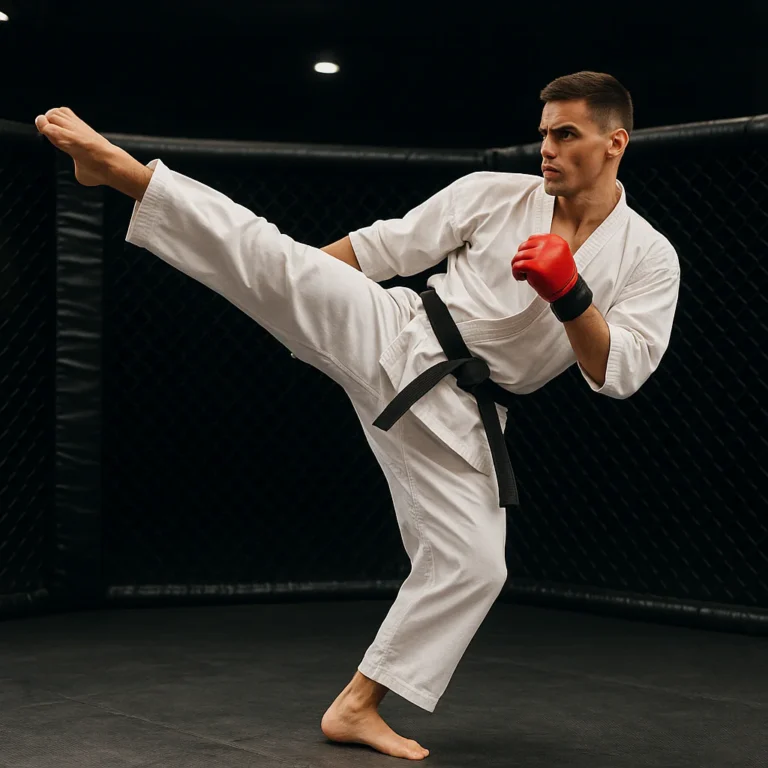
The Karate kime concept in MMA striking is about focused, coordinated impact—not freezing at the target. Move freely, organize your body briefly as the strike lands, then recover into a position where you can defend, angle out, or attack again.
That distinction matters when a punch or kick meets an opponent who can hit back, grab your leg, or change levels. In the gym, we’ve seen eager students hear “focus” and tense up from shoulder to ankle; once they relaxed between strikes and sharpened their timing, their techniques became cleaner—and their defenses didn’t vanish after contact.
So what should you keep from traditional Karate, and what should you adapt for MMA? The answer lies in treating kime as a skillful moment of focus, then testing it against movement, counters, and takedown threats.
Key Takeaways
- Kime is not a midair freeze. In MMA, focus your technique at contact and recover promptly.
- Coordinate the whole body. Balance, timing, alignment, and footwork matter more than simply tensing harder.
- Make every strike defensively responsible. Return your hands, recover your stance, and prepare for counters or takedowns.
- Adapt Karate techniques to MMA range and rules. Test punches, kicks, and blitz entries against controlled resistance.
- Borrow principles, not poses. Karate can complement boxing, Muay Thai, and wrestling; no single striking concept replaces a complete MMA skill set.
Table of Contents
- ⚡️ Quick Tips and Facts
- 🥋 What Is Karate Kime? Meaning, Mechanics, and Martial Arts Roots
- Kime in Karate: Focus, Timing, and Whole-Body Coordination
- Kime vs. Kiai, Power, Speed, and Tension
- 📜 From Traditional Karate to Modern MMA Striking
- How Karate’s Linear Attacks Entered the Cage
- What MMA Rules Change About Classical Kime
- 🥊 How Kime Works in MMA: The Science of Impact and Recovery
- Ground Reaction Force, Hip Rotation, and Kinetic Chain
- Relaxation Before Impact and Brief Bracing at Contact
- Why Fast Retraction Matters as Much as the Strike
- 🎯 9 Karate Kime Techniques That Translate to MMA
- 1. Kime on the MMA Jab: Snap, Accuracy, and Safe Return
- 2. Reverse Punch and Cross: Drive Without Overcommitting
- 3. Lead Hook and Shovel Hook: Short-Range Hip Connection
- 4. Straight Rear Kick: Distance Control and Body-Line Power
- 5. Roundhouse Kick: Karate Snap Meets Kickboxing Impact
- 6. Side Kick and Tep: Stop-Hits That Manage Range
- 7. Front-Leg Kick: Fast Interception With a Safe Exit
- 8. Backfist and Spinning Attacks: When Precision Beats Flash
- 9. Blitz Entries: Combining Kime With Footwork and Follow-Ups
- 🛡️ Kime Under MMA Pressure: Guard, Takedowns, and Cage Awareness
- Keep Your Hands Home After Every Strike
- Balance and Stance Recovery Against Takedown Attempts
- Angle Off, Frame, or Sprawl When the Counter Comes
- Using Kime to Break Clinch Entries and Create Space
- 🔄 Kime in MMA Combinations, Counters, and Cage Cutting
- Counter-Striking With Timing Rather Than Muscle
- Building Punch-to-Kick and Kick-to-Punch Sequences
- Feints, Rhythm Changes, and Intercepting Pressure
- 🏆 Karate Kime in MMA: What Elite Fighters Show Us
- Examples of Karate-Informed Distance Management and Entries
- What to Learn From Elite Fighters Without Copying Their Style Blindly
- 🏋️ A Practical Kime Training Plan for MMA Strikers
- Solo Drills for Snap, Alignment, and Retraction
- Heavy-Bag Drills for Impact Without Pushing
- Padwork and Partner Drills for Timing and Defense
- Live Sparing Progressions: From Controlled to Cage-Ready
- Strength, Mobility, and Conditioning That Support Kime
- ⚠️ Common Kime Mistakes: Why Karate Strikes Can Fail in MMA
- Staying Tense Instead of Relaxing Between Strikes
- Overcommitting, Dropping the Guard, and Admiring the Hit
- Chasing One-Punch Power Instead of Setup and Position
- Training Forms Without Pressure Testing
- ✅ Benefits and Limitations of Kime for MMA Striking
- Where Kime Gives Karate Fighters an Edge
- Where Boxing, Muay Thai, and Wrestling Adaptations Matter
- 📅 A 4-Week Kime Practice Schedule for MMA
- ❓ FAQ: Karate Kime Concept in MMA Striking
- Does Kime Make a Punch More Powerful?
- Should You Tense Your Body at Impact?
- Can Kime Work With Boxing Gloves and MMA Gloves?
- Is Kime Useful Against Wrestlers and Pressure Fighters?
- How Is Kime Different From Muay Thai or Boxing Power?
- How Long Does It Take to Develop Kime?
- 🏁 Conclusion
- 🔗 Recommended Links
- ❓ FAQ
- 📚 Reference Links
⚡️ Quick Tips and Facts
Karate kime in MMA is best understood as brief, coordinated focus at the moment a strike lands—not as freezing your arm or leg at the target. We want a strike that arrives with intent, sound mechanics, and balance, then returns quickly enough that we can defend, move, or strike again.
For context on how Karate principles translate into mixed martial arts, see our guide to Karate and MMA and browse more Karate techniques.
| Quick fact | What it means for MMA |
|---|---|
| Kime | A karate term commonly associated with focus, decisiveness, and a brief moment of coordinated action. Its meaning varies by school and context. |
| Not a midair freeze | A strike should not stop short of its intended target or linger at contact. Keep control, avoid joint lockout, and recover promptly. |
| Power is a team effort | Balance, timing, alignment, ground contact, and whole-body coordination matter more than simply tensing harder. |
| MA adds consequences | A long stance, extended arm, or slow kick recovery can invite a counter, clinch, or takedown. |
| Best takeaway | Be relaxed while moving, briefly organized at impact, and ready to move again immediately. |
Quick coaching cues
- “Loose on the way in; organized at contact; home on the way out.” This is a useful training cue, not a universal definition of kime.
- Strike through the intended target line without trying to punch through your opponent’s entire body.
- Keep a small bend in the elbow and knee at impact. Don’t ask your joints to serve as the brakes.
- After each strike, recover your stance, guard, and awareness—not just your limb.
- Train against pads, bags, and cooperative partners before adding speed or resistance. A drill can teach coordination; it cannot prove a technique works in a fight.
🥋 What Is Karate Kime? Meaning, Mechanics, and Martial Arts Roots
In Karate, kime is often explained as focus or decisiveness: the instant your intention, body alignment, and technique converge. Schools don’t all define or teach it identically. Some emphasize a crisp finish to a technique; others emphasize mental commitment and whole-body coordination.
That difference matters. In a kata, a practitioner may visibly stop at the end of a movement to demonstrate control. In MMA, stopping a limb in the air is generally not the goal. We need the quality of focus, not a theatrical freeze.
The term appears across Karate practice, but we should be cautious about turning one school’s teaching definition into a universal historical fact. For a broader look at Karate’s development and influence in fighting sports, explore our Karate techniques and history coverage.
Kime in Karate: Focus, Timing, and Whole-Body Coordination
A useful MMA interpretation of kime is well-timed coordination at the brief instant of impact. The hips, torso, shoulder, arm, and stance contribute in sequence; the striking surface arrives aligned; and the rest of the body remains balanced enough to keep working.
That does not mean every muscle should be clenched throughout the strike. Excessive tension can slow movement and make it harder to change direction. Nor does “relaxed” mean limp. The goal is to move efficiently, organize the body for contact, and recover without losing posture.
| Part of the action | Useful coaching focus | Common error |
|---|---|---|
| Before the strike | Stay loose enough to move and read your opponent | Loading up visibly or holding your breath |
| Acceleration | Coordinate the feet, hips, trunk, and limb | Trying to generate all the force with the arm |
| Contact | Keep the wrist or striking surface aligned and the body supported | Locking the elbow or twisting off balance |
| Recovery | Return to guard, stance, or angle | Leaving the limb extended or admiring the hit |
A practical reminder from our coaching floor: beginners often hear “focus” and respond by tightening their entire body. We ask them to try the same technique with relaxed shoulders, a steady base, and a clean return. The strike often looks faster—not because they became stronger in five minutes, but because they stopped fighting their own movement.
For technical breakdowns of stance, movement, and striking mechanics, see our Karate techniques library.
Kime vs. Kiai, Power, Speed, and Tension
These terms overlap in practice but are not interchangeable:
| Term | Simple distinction | What it is not |
|---|---|---|
| Kime | Focus or decisiveness expressed through a technique; interpretations differ by school | A requirement to freeze every strike |
| Kiai | A vocal expression used in some martial arts training and performance | A magical source of striking power |
| Power | The effect of a strike, influenced by mechanics, timing, target, and other factors | Just muscular effort |
| Speed | How quickly a technique moves or arrives | A guarantee of impact or accuracy |
| Tension | Muscular activity that can help stabilize a body position | Something to maximize throughout every movement |
Kime is better treated as a quality of execution than a secret power switch. A loud kiai can make training energetic, but it cannot correct poor alignment. A hard punch can be powerful without an audible shout. And a crisp finish in kata does not automatically tell us what will work against an opponent who is moving, punching back, and looking for a takedown.
📜 From Traditional Karate to Modern MMA Striking
Karate has travelled through different cultures, training environments, and rulesets. Its techniques and teaching methods have changed along the way. That history makes it tempting to claim there was one original, definitive meaning of kime. In practice, terminology and emphasis vary across styles, instructors, and training goals.
A martial arts discussion at Self Defense Tutorials takes a skeptical view of the idea that stopping at the end of a technique increases power. That is a useful challenge to consider, especially for combat sports. But “some people train a visible stop” and “all Karate teaches fighters to freeze in live exchanges” are not the same claim.
Meanwhile, writing on Karate’s influence in MMA points to the practical value of distance control, timing, and sudden entries. Those principles can help fighters manage exchanges, but they must be adapted to the opponent and rules. Our fight analysis and breakdowns look at how martial arts styles change under competition pressure.
How Karate’s Linear Attacks Entered the Cage
Karate’s straight punches, front kicks, side kicks, and rapid entries can be useful in MMA when they are paired with sound footwork and follow-up defense. A fighter may use a jab-like lead-hand strike to interrupt, a rear straight to punish a forward step, or a lead-leg side kick to manage distance.
The value is not simply “Karate technique beats another style.” It is how a fighter uses range, rhythm, and timing to create an opening. MMA fighters with Karate experience have adapted those tools alongside boxing, kickboxing, wrestling, and grapling. For fighter profiles and style breakdowns, see Karate MMA fighter profiles.
What MMA Rules Change About Classical Kime
In a Karate class, a technique may be practiced at a controlled distance, stopped before a partner, or finished in a set position. In MMA, an opponent may counter, step in, change levels, or grab a limb. That changes what a safe finish looks like.
| Training context | What can be useful | What needs adaptation |
|---|---|---|
| Kata or solo practice | Practicing posture, precision, intent, and movement patterns | A prescribed pause should not be mistaken for a live-fighting habit |
| Partner drills | Learning distance, target awareness, and controlled contact | Partners need agreed intensity and clear safety rules |
| Bag or pad work | Rehearsing mechanics and impact with a stable target | A stationary target cannot counter or wrestle |
| MMA sparing | Testing timing, recovery, defense, and choices under resistance | Techniques need to respect gloves, takedowns, and the cage |
A competing MMA overview argues that Karate principles work best as part of a wider skill set, rather than as a complete replacement for wrestling, boxing, or Muay Thai. That matches what we see in training: keep what works, adapt what doesn’t, and test your assumptions with a resisting partner under safe supervision.
🥊 How Kime Works in MMA: The Science of Impact and Recovery
It helps to separate a crisp strike from the claim that a momentary muscular freeze creates extra power. The first is a practical coaching goal. The second is too simplistic: impact depends on many interacting factors, and “tense harder” is not a reliable shortcut.
Research on punching biomechanics supports the importance of coordinated body movement and the contribution of different body segments, while individual results depend on the task and method used. For an example of peer-reviewed biomechanics research, see Lenetsky and colleagues’ review of punching in combat sports. The research does not establish “kime” as a unique force multiplier; it does support paying attention to mechanics rather than arm-only effort.
Ground Reaction Force, Hip Rotation, and Kinetic Chain
A punch or kick starts from a position of balance. The feet interact with the floor; the legs and hips help organize movement; the trunk and striking limb deliver the technique. How much each part contributes depends on the strike, stance, distance, and individual style.
Try this step by step with a light rear straight on a pad:
- Set your stance. Stand balanced, with enough room to move and defend.
- Find the target without reaching. If you need to lean or lunge excessively, adjust your distance first.
- Push and turn naturally. Let the rear foot, hip, and torso contribute without forcing an exaggerated twist.
- Keep the wrist aligned. The striking knuckles, wrist, and forearm should not buckle on contact.
- Stay able to recover. Finish balanced enough to bring the hand home or move off-line.
We avoid telling everyone to “rotate the hips as much as possible.” A huge rotation may feel powerful on a still bag, yet leave you facing the wrong way or vulnerable to a counter. Use enough rotation for the technique—not the maximum your hips can produce.
Relaxation Before Impact and Brief Bracing at Contact
A useful training model is relaxed movement, organized contact, active recovery. At impact, some muscular bracing helps the body maintain structure. But that does not mean locking the elbow, knee, or whole body rigidly.
One competing article warns that freezing at the target can reduce practical effectiveness and create bad habits. That warning is strongest when “freeze” means leaving the limb extended, stopping short, or expecting the opponent to wait politely. In contrast, Karate instructors may use “focus” to describe a brief, controlled finish rather than a prolonged pause. The apparent disagreement often comes from different meanings of the same word.
What to trust? Judge the actual movement:
- Does the strike arrive with good alignment?
- Does it make appropriate contact for the drill?
- Can the fighter recover promptly?
- Can the fighter defend or continue afterward?
- Is the movement safe for the joints?
If the answer is yes, the word used to describe it matters less than the outcome.
Why Fast Retraction Matters as Much as the Strike
A strike is not complete when it touches a pad. In MMA, the return can protect your head, prevent a grab, restore balance, or set up another attack.
The line “out at 100 mph, back at 200 mph,” used in the skeptical article, is a memorable coaching exaggeration—not a measured speed prescription. The useful idea is simpler: don’t leave a limb hanging out longer than the technique requires.
For punches:
- Strike without overextending.
- Recoil along a safe path.
- Restore your guard or use the hand to frame, pary, or continue.
- Reassess your distance before firing again.
For kicks:
- Strike at a distance that does not require a desperate lean.
- Keep the supporting foot and posture organized.
- Rechamber or step down under control.
- Be ready to defend the opponent’s counter or level change.
🎯 9 Karate Kime Techniques That Translate to MMA
These are not nine magic moves. Think of them as ways to express focused, well-timed striking while respecting MMA’s defensive demands. Start with pads or a qualified coach before adding live resistance.
1. Kime on the MMA Jab: Snap, Accuracy, and Safe Return
A jab can measure distance, interrupt rhythm, draw a reaction, or set up a stronger strike. A Karate-influenced jab need not look like a textbook boxing jab, but it still needs a safe line, active shoulder, and quick return.
Practice:
- Begin at a range where you can reach without leaning.
- Send the lead hand straight toward the target while keeping your chin protected.
- Touch the pad crisply; do not lock the elbow.
- Return to guard or move your head and feet off the center line.
- Add a step or angle only after the basic recovery stays reliable.
2. Reverse Punch and Cross: Drive Without Overcommitting
The Karate reverse punch, often called gyaku-zuki, resembles a straight rear-hand attack. In MMA, the useful principle is delivering a direct punch with coordinated movement—not insisting one rigid stance or exact form.
A straight punch can be effective when the opponent enters or reacts to a feint. But if your weight dives over your lead foot, your head and hips may become easy targets. Keep enough balance to defend a shot.
3. Lead Hook and Shovel Hook: Short-Range Hip Connection
Hooks are not exclusive to boxing, and Karate-based fighters often need them as range closes. The lead hook can turn a straight-line exchange; a shovel hook can target the body at angle.
- Keep the wrist supported and avoid swinging from too far away.
- Turn through the stance without letting your feet cross.
- Protect the opposite side of your head.
- Return the hand quickly or use the angle to exit.
4. Straight Rear Kick: Distance Control and Body-Line Power
A rear-leg front kick can interrupt a forward-moving opponent, attack the body, or create room. Karate’s snap-style front kick is often distinguished from a sustained push kick, though fighters can adapt either action to the situation.
MA adjustment: avoid kicking from a range where the opponent can catch the leg easily. Use a setup, choose the target carefully, and recover into a stance that can defend a takedown.
5. Roundhouse Kick: Karate Snap Meets Kickboxing Impact
Karate and kickboxing schools may teach different roundhouse mechanics, targets, and striking surfaces. MMA allows fighters to use different versions, but the choice should match the target, range, and risk.
| Version or goal | Potential benefit | Trade-off to manage |
|---|---|---|
| Fast body kick | Can score or disrupt rhythm | May be caught if telegraphed or poorly timed |
| Low kick | Attacks stance and movement | Requires awareness of counters and checks |
| Higher kick | Greater potential impact if clean | Higher commitment and balance demand |
| Snap-style delivery | Quick arrival and recovery potential | Needs accurate range and contact mechanics |
Don’t chase a dramatic finish at the cost of a stable landing. A kick that lands cleanly and lets you defend is often more valuable than a harder kick that leaves you sprawled like a dropped coat.
6. Side Kick and Tep: Stop-Hits That Manage Range
A Karate side kick can act as a long-range stop-hit, particularly against an opponent walking forward. A Muay Thai tep is commonly used to push, disrupt, or maintain distance. Both can manage range, but they are not identical techniques.
A comparison from an MMA-focused Karate article describes the side kick as an interrupting tool and the snap front kick as a fast attack, while highlighting Karate’s emphasis on timing and distance. See Karate in MMA: The Evolution, Techniques, and Champions Who Changed the Game.
Safety and tactics: avoid relying on the knee as a target in a way that risks injury or violates the ruleset. Check the rules of your promotion and train with an experienced coach.
7. Front-Leg Kick: Fast Interception With a Safe Exit
The lead-leg front kick can arrive quickly because it travels a shorter distance than a rear-leg kick. It may interrupt an opponent’s advance, but the lead leg can also be attacked or caught.
- Lift the knee with control rather than swinging the leg from the floor.
- Strike at a sensible target and range.
- Bring the leg back or step down in balance.
- Avoid repeatedly showing the same kick from the same rhythm.
8. Backfist and Spinning Attacks: When Precision Beats Flash
A backfist or spinning attack can catch an opponent who is focused on a predictable line. But turning away from your opponent carries real risk. Use these techniques sparingly, set them up, and make sure you can see or safely reorient afterward.
A flashy strike is not automatically a bad choice; an unearned flashy strike is. If the opponent is close enough to clinch or shoot while you turn, the risk rises sharply.
9. Blitz Entries: Combining Kime With Footwork and Follow-Ups
A Karate blitz is a sudden entry, often using straight attacks to cross distance. It can be effective when the opponent is reacting, retreating predictably, or exposed by a feint. It becomes risky when launched from too far away or without a plan for the counter.
A safer progression:
- Draw a reaction with a feint, hand touch, or rhythm change.
- Step in behind a straight punch or combination.
- Keep your head off the center line where possible.
- Finish with angle, guard recovery, or clinch frame—not a static pose.
- Have a wrestling-aware partner test whether you can defend the level change.
🛡️ Kime Under MMA Pressure: Guard, Takedowns, and Cage Awareness
In MMA, striking mechanics and grapling awareness share the same body. Your stance affects your ability to punch, sprawl, check kicks, and defend the cage. Kime that leaves you upright but unable to move is incomplete for the sport.
Keep Your Hands Home After Every Strike
“Home” does not always mean both fists glued to your cheeks. It means each hand has a job: guard, pary, frame, post, or strike. A hand that remains extended without purpose can be slapped aside, tied up, or countered.
During partner drills, ask your coach to give a light counter immediately after your strike. If your hand is still sightseeing near the pad, you’ll notice.
Balance and Stance Recovery Against Takedown Attempts
A bladed Karate stance can offer quick entries and a smaller profile, but may expose the lead leg to low kicks and make some takedown defenses harder. A more squared stance may support punching and wrestling defense but can present a larger target.
| Stance feature | Potential advantage | Potential cost in MMA |
|---|---|---|
| Bladed, side-on posture | Quick linear attacks and lateral movement | Lead-leg exposure and reduced readiness in some directions |
| More square posture | Easier access to both hands and some defensive actions | More available target area; movement may feel less specialized |
| Frequent stance switching | Can disrupt rhythm and change attack lines | Poorly timed switches can invite kicks or level changes |
There is no universally safest stance. Adjust to the opponent, your own wrestling skill, and the ruleset. For MMA news and training developments, see Karate and MMA news.
Angle Off, Frame, or Sprawl When the Counter Comes
After striking, you may need to:
- Angle off to avoid a return punch.
- Frame against the opponent’s shoulders or arms to manage a close entry.
- Sprawl if the opponent changes levels for a takedown.
- Clinching safely when retreating is no longer practical.
- Reset rather than forcing a second attack from poor balance.
No single response fits every situation. Train these choices with qualified coaching and controlled partner work. If you are new to MMA, learn basic takedown defense before trying to make a dramatic blitz your entire game plan.
Using Kime to Break Clinch Entries and Create Space
A focused strike can interrupt an opponent’s movement, but it should not replace clinch defense. If an opponent closes safely, your priority may be head position, frames, underhooks, balance, and a route to disengage—not a long-range technique that is no longer available.
A well-timed short strike can create a moment to turn or frame. Whether it is legal depends on the target and competition rules. Ask your coach to work the situation from a realistic clinch, not just a cooperative “attacker pauses after the punch” drill.
🔄 Kime in MMA Combinations, Counters, and Cage Cutting
The cleanest Karate-style strike is often not the first move of an exchange. A feint, step, angle, or counter may create the opening. Karate’s distance-management ideas are often discussed as a way to disrupt an opponent’s rhythm, while MMA specialists stress the need to remain ready for wrestling and follow-ups.
Counter-Striking With Timing Rather Than Muscle
Instead of trying to hit harder than an advancing opponent, look for the moment their balance or attention changes:
- They step into range.
- They reach for your lead hand.
- They overcommit on a jab.
- They reset their stance after a kick.
- They react to a feint.
The counter can be a straight punch, kick, or combination, depending on distance and rules. A strong counter still needs a safe exit. Timing is not magic; it is recognition plus a trained response.
Building Punch-to-Kick and Kick-to-Punch Sequences
Pairing techniques makes your attacks harder to read. Examples for pad practice:
- Jab → rear straight → angle off.
- Feint jab → rear straight → lead-leg front kick.
- Lead-leg side kick → step down → rear straight.
- Low kick → hands return to guard → exit or re-enter.
- Blitz entry → short follow-up → frame or disengage.
These are starting patterns, not scripts. If your partner moves, the combination should change. Practice with a coach who can help you keep defensive responsibility during the sequence.
Feints, Rhythm Changes, and Intercepting Pressure
A bounce, half-step, shoulder twitch, or hand feint can make an opponent react before you attack. But repeated rhythm changes become predictable too. Use variation with purpose.
One useful drill: have a partner advance at a controlled pace while you vary between a feint, a light jab, a side step, and a real counter. Your goal is not to win the drill with one perfect move. It is to recognize when not to fire.
🏆 Karate Kime in MMA: What Elite Fighters Show Us
Elite fighters do not prove that one isolated concept explains their success. They show how athletes adapt skills to their own bodies, coaching, opponents, and rules. A fighter may have Karate training and use Karate-influenced footwork without applying every traditional method unchanged.
Examples of Karate-Informed Distance Management and Entries
MA coverage often discusses Lyoto Machida, Stephen “Wonderboy” Thompson, Georges St-Pierre, and Kyoji Horiguchi in relation to Karate backgrounds or Karate-influenced movement. Their approaches differ, and each used other training systems too.
- Lyoto Machida became known for elusive counterstriking and distance management.
- Stephen Thompson is widely recognized for lateral movement and attacks from unusual ranges.
- Georges St-Pierre combined a Karate background with elite wrestling and other striking skills.
- Kyoji Horiguchi has blended striking with wrestling and other combat-sport experience.
For further reading, compare our fighter profiles with this overview of Karate’s influence on MMA striking and the article Karate in MMA: The Evolution, Techniques, and Champions Who Changed the Game.
What to Learn From Elite Fighters Without Copying Their Style Blindly
Don’t copy a fighter’s stance just because it looked brilliant in a highlight. Ask instead:
- What opponent and range was the stance designed to handle?
- How does the fighter defend low kicks and takedowns?
- What happens when the opponent cuts off the cage?
- Which other skills make the movement safe?
- Can you reproduce the timing, or only the pose?
Borrow principles, not costumes. A fighter’s style is a system shaped by years of training, physical attributes, coaching, and competition experience.
🏋️ A Practical Kime Training Plan for MMA Strikers
The goal is not to make every strike louder or more forceful. Build accuracy, balance, relaxation, alignment, and recovery first. Add speed gradually, and ask a qualified coach to correct technique before increasing impact.
Solo Drills for Snap, Alignment, and Retraction
Shadowboxing with a recovery check
- Choose one strike, such as a jab.
- Throw it at about half speed.
- Pause your feet—not your hand—to check whether you are balanced.
- Return the hand to guard and add a small angle.
- Repeat with different distances and rhythms.
Keep the pause between repetitions, not at the end of every punch. The exercise is to notice your position, not to rehearse a prolonged freeze.
Tennis-ball wall drill
A video linked in the article’s featured video section presents a tennis-ball-and-wall exercise for hand-eye coordination and controlled movement. The presenter describes kime as a decisive moment of control and suggests varying stance, angle, height, hand, and partner feeds.
Use this as a coordination drill, not a direct measure of fighting power:
- Stand at a safe distance from a clear wall.
- Toss a tennis ball gently and catch it under control.
- Change hand, height, and stance.
- Add a small step or angle while maintaining balance.
- Increase speed only if you can catch safely without twisting or lunging.
Don’t lock your elbow when catching. The point is controlled coordination, not trying to turn your arm into a steel gate.
Heavy-Bag Drills for Impact Without Pushing
On a heavy bag, alternate between crisp contacts and controlled, more committed strikes. Feel the difference between landing with alignment and shoving the bag with an extended arm.
- Use hand wraps and gloves appropriate to your training.
- Start light and keep the wrist straight.
- Avoid full-force strikes when tired or when your form is deteriorating.
- Let a coach check your range and recovery.
- Stop if you feel sharp pain, numbness, or unusual joint discomfort.
For established equipment brands, Hayabusa, Fairtex, and RDX Sports publish their own product and fit information. Brand guidance does not replace correct coaching or equipment inspection.
Padwork and Partner Drills for Timing and Defense
Use pads to rehearse target accuracy and partner drills to add decision-making. Start with predictable feeds; progress to variable but controlled movement.
| Stage | Drill | Coaching objective |
|---|---|---|
| 1 | Single punch to a held pad | Alignment and return |
| 2 | Punch then angle | Balance after contact |
| 3 | Partner changes pad position | Range adjustment |
| 4 | Strike then defend a light counter | Guard and awareness |
| 5 | Feint or strike based on a partner cue | Decision-making |
| 6 | Controlled situational sparing | Transfer under resistance |
Partner safety comes first. Agree on intensity, target areas, and whether takedowns are allowed. A drill that surprises someone with an unannounced hard counter is not “realism”; it is poor practice.
Live Sparing Progressions: From Controlled to Cage-Ready
Progress in layers rather than jumping from kata to hard sparing:
- Technical repetition: slow practice with a coach.
- Target work: pads or bag at manageable intensity.
- Coperative partner work: predictable movement and clear safety rules.
- Situational sparing: limited goals, such as entering behind a jab and exiting safely.
- Open sparing: controlled resistance with the appropriate protective equipment and supervision.
Hard sparing is not required every session to learn. If you’re preparing for competition, work with a qualified MMA coach who can combine striking, grapling, conditioning, and recovery responsibly.
Strength, Mobility, and Conditioning That Support Kime
Strength and conditioning can support the physical qualities used in striking, but no workout teaches timing by itself. Train legs, trunk, shoulders, grip, and aerobic capacity in a balanced program. Include mobility and rest rather than chasing fatigue for its own sake.
If you have a medical condition, past injury, or persistent pain, seek advice from an appropriate health professional before changing training intensity. Training should make you more capable, not turn your joints into a long-term science experiment.
⚠️ Common Kime Mistakes: Why Karate Strikes Can Fail in MMA
Kime becomes a problem when a label replaces good movement. A short, focused finish can be useful; a habit of stopping, locking, or posing can create openings.
Staying Tense Instead of Relaxing Between Strikes
Tight shoulders, clenched fists held too early, and rigid movement can reduce fluidity and make you easier to read. Stay ready without preloading every muscle. During shadowboxing, breathe normally and notice whether you can change direction at any point.
Overcommitting, Dropping the Guard, and Admiring the Hit
A heavy strike can still be a bad strike if it leaves you off balance. Common clues include:
- Your head moves far beyond your base.
- Your hand drops before or after the punch.
- Your feet cross during entry.
- You cannot defend a light follow-up.
- Your kick lands but you need several steps to recover.
Film a short round of technical work if your coach agrees. The video may reveal that the “power punch” is mostly a powerful forward lean.
Chasing One-Punch Power Instead of Setup and Position
A single hard shot is not a complete striking strategy. Setups, feints, footwork, and follow-ups help create a cleaner opportunity. The fighter who lands accurately from a good position may better served than the fighter trying to win every exchange with one swing.
Training Forms Without Pressure Testing
Forms can teach movement patterns, posture, focus, and coordination. They do not, by themselves, prove that a technique works against a moving opponent. Pair traditional practice with partner drills, padwork, sparing, and grapling-aware training.
The skeptical Self Defense Tutorials discussion of kime is valuable when it warns against mistaking a training freeze for combat effectiveness. It is less useful if interpreted to mean that all brief bracing or focus at impact is harmful. The movement’s function matters more than the argument over terminology.
✅ Benefits and Limitations of Kime for MMA Striking
Where Kime Gives Karate Fighters an Edge
When interpreted as focus and coordination rather than a literal freeze, kime may help a practitioner pay attention to:
- Accurate contact and clean alignment.
- A decisive attack rather than a hesitant reach.
- Timing and distance.
- A balanced finish and purposeful recovery.
- Mental commitment without unnecessary muscular tension.
These are not exclusive to Karate. Boxers, kickboxers, and other martial artists also train accuracy, timing, balance, and recovery—often with different terminology and methods.
Where Boxing, Muay Thai, and Wrestling Adaptations Matter
Karate can contribute valuable tools, but MMA is a mixed ruleset. Boxers may offer highly developed punching combinations and defensive habits; Muay Thai contributes kicks, knees, elbows, and clinch experience; wrestling helps determine whether a stance and strike can survive a takedown attempt.
| Training influence | Common contribution | What a Karate-influenced MMA striker should adapt |
|---|---|---|
| Karate | Distance changes, linear entries, angle variation | Adjust stance and recovery for low kicks and takedowns |
| Boxing | Punch combinations, head movement, hand defense | Blend hand activity with kick and wrestling threats |
| Muay Thai | Kicks, knees, elbows, and clinch striking | Manage range without becoming predictable |
| Wrestling | Level changes, takedowns, cage control | Strike without surrendering balance or leg position |
| MMA integration | Transitions among all ranges | Test decisions against realistic, controlled resistance |
This is why the best answer is not “freeze” or “never brace.” It is move with control, make sound contact, and remain ready for what comes next.
📅 A 4-Week Kime Practice Schedule for MMA
Adjust this outline to your experience, health, and coach’s plan. It is a skills framework, not a medical or individualized training prescription.
| Week | Main emphasis | Example practice |
|---|---|---|
| 1 | Alignment and relaxed movement | Shadowboxing, light single-strike padwork, stance recovery |
| 2 | Contact and retraction | Bag rounds with controlled impact, jab-return drills |
| 3 | Timing and choice | Partner cues, feints, angle exits, light counters |
| 4 | Integration | Situational sparing that includes strikes and takedown awareness |
Example session structure
- Warm up and move through joint-friendly mobility.
- Review one technique slowly with a coach.
- Practice it on pads or a bag at controlled intensity.
- Add a recovery or defensive response.
- Use a partner drill with agreed rules.
- Cool down and note what broke down under pressure.
Keep a simple training log: technique, range, success rate, recovery quality, and any discomfort. The best progress marker is not how loud the bag sounds. It is whether you can strike accurately, regain position, and make a good next decision.
❓ FAQ: Karate Kime Concept in MMA Striking

Does Kime Make a Punch More Powerful?
Kime is not a scientifically established power switch. A focused, coordinated punch may be more effective than a poorly aligned one, but the improvement comes from practical factors such as timing, balance, mechanics, target choice, and skill. A prolonged freeze or locked elbow does not automatically add power and may slow recovery.
Should You Tense Your Body at Impact?
Use enough muscular control to maintain alignment and balance at contact, but don’t stay rigid throughout the strike. Keep a small bend in your joints and recover under control. If your shoulders, jaw, or hands are clenched well before contact, ask your coach whether tension is interfering with speed or timing.
Can Kime Work With Boxing Gloves and MMA Gloves?
The principle of focused movement and controlled impact can be practiced with either glove type, but the equipment changes how your hands feel and how you must protect your wrists. Use properly fitted, appropriate gloves and wraps, and follow the rules of your training session. Don’t transfer bare-knuckle drills directly to hard contact without coaching.
Is Kime Useful Against Wrestlers and Pressure Fighters?
A focused strike may interrupt an opponent, but it does not replace takedown defense, clinch skills, or cage awareness. Against pressure, prioritize balance, footwork, frames, underhooks, and safe exits. Train striking with partners who can change levels under controlled conditions.
Read more about “🥋 Karate vs MMA: Who Really Wins in 2026?”
How Is Kime Different From Muay Thai or Boxing Power?
The terminology differs, but the practical goals overlap: accurate contact, effective mechanics, balance, and readiness to continue. Karate schools may use kime to describe focus or a decisive finish. Boxing and Muay Thai coaches commonly teach their own technical cues for delivering and recovering strikes. Avoid treating one label as proof that one style has a unique form of power.
How Long Does It Take to Develop Kime?
There is no reliable universal timeline. Basic coordination may improve with consistent, supervised practice, while timing under resistance takes longer and depends on experience, training frequency, coaching, and athletic background. Track improvements in accuracy, balance, recovery, and decision-making—not just impact sound.