Support our educational content for free when you purchase through links on our site. Learn more
Karate Point Fighting Adaptation for MMA: 7 Key Changes 🥋

Karate point fighting adaptation for MMA works best when you keep the speed, timing, and distance control—but rebuild your stance, defense, and follow-ups for continuous action. Point-fighting skills can sharpen an MMA striking game; they cannot replace boxing, wrestling, clinch work, or grapling.
At Karate MMA™, we’ve watched quick karate entries catch training partners flat-footed—right up until the first clean shot was followed by a clinch or a level change. That moment is the lesson: in MMA, landing first is useful, but knowing what comes next is what makes the skill hold up.
Key Takeaways
- Keep karate’s strengths: timing, feints, fast entries, range control, and angle changes.
- Adapt your movement: use balanced footwork that can handle punches, leg kicks, takedowns, and cage pressure.
- Plan beyond the first strike: recover your stance, defend counters, and prepare for clinches or takedowns.
- Train the missing links: add MMA boxing, wrestling, clinch work, and grapling with qualified coaching.
- Progress safely: build from technical drills to controlled, situation-specific sparing before full MMA rounds.
Table of Contents
- ⚡️ Quick Tips and Facts
- 🥋 What Does Karate Point Fighting Adaptation for MMA Mean?
- 📜 From Point Fighting to MMA: Rules, Roots, and Key Differences
- How Point-Fighting Rules Shape Distance and Timing
- What Changes When Strikes, Takedowns, and Groundwork Are Allowed
- ✅ What Karate Point Fighting Contributes to MMA
- Footwork, Range Control, and Angle Creation
- Explosive Entries, Counters, and Distance-Closing Attacks
- Blitzing, Side Kicks, and Unpredictable Rhythm
- ⚠️ What Must Change for the MMA Cage
- Stance and Guard Against Punches and Takedowns
- Managing Leg Kicks, Clinches, and Cage Pressure
- Recovering Safely After a Missed or Blocked Attack
- 1. Adapt Point-Fighting Footwork for MMA Range
- 2. Build a Takedown-Resistant Karate Stance
- 3. Turn Point-Scoring Attacks into MMA-Effective Strikes
- 4. Add Boxing Combinations and Defensive Layers
- 5. Connect Karate Entries to Wrestling and Clinch Defense
- 6. Make Karate Kicks Safer Against Checks and Catches
- 7. Use Feints, Counters, and Cage Angles to Set Traps
- 🎯 MMA-Ready Karate Combinations and Setups
- Punch-to-Kick and Kick-to-Punch Combinations
- Blitz Entries with Exit Angles
- Counterstriking After a Takedown Threat
- 🧠 Fight Strategy: When to Use Point-Fighting Skills
- Fighting at Long Range Versus Pocket Range
- Adapting to Southpaws, Pressure Fighters, and Wrestlers
- Using the Cage Without Giving Up Your Exit
- 🥊 Training Plan for Karate-to-MA Adaptation
- Technical Drills for Timing, Entries, and Recovery
- Partner Drills for Takedown and Clinch Awareness
- Progressive Sparing: Point Fighting to MMA Rounds
- Strength, Conditioning, and Mobility for Karate Fighters
- 🛡️ Safety, Sparing Gear, and Injury Prevention
- ❌ Common Karate-to-MA Adaptation Mistakes
- 📊 Point Fighting vs. MMA Karate: Skills at a Glance
- 🌟 Notable Karate-Inspired MMA Approaches
- Conclusion
- Recommended Links
- FAQ
- Reference Links
⚡️ Quick Tips and Facts
Karate point fighting can sharpen an MMA fighter’s timing, distance management, and ability to enter and exit striking range. But it is a toolkit, not a complete MMA style. Point-fighting habits need adjustments for continuous attacks, leg kicks, takedowns, clinches, and ground fighting. For a broader look at how karate fits into mixed martial arts, see our Karate and MMA guide.
| Quick fact | What it means for MMA |
|---|---|
| Point fighting rewards speed, accuracy, and clean scoring | Keep the precision; add follow-up strikes and defensive recovery |
| Bouncing footwork can help with range changes | Use it selectively; excessive bouncing can invite leg kicks or level changes |
| Blitzing can close distance quickly | Pair the entry with a guard, a planned exit, and awareness of takedowns |
| Long-range kicks can control space | Choose kicks you can recover from before your opponent catches the leg |
| Point fighting usually pauses after a score | MMA does not; expect counters, combinations, clinches, and takedowns to continue |
| The best adaptation is pressure-tested | Progress from technical drills to controlled MMA sparing with a qualified coach |
The short version: keep the skill, change the assumptions
- ✅ Keep: timing, feints, sharp entries, angle changes, and the ability to strike without lingering in range.
- 🔧 Adapt: stance, guard, kick selection, combinations, and recovery after an attack.
- ❌ Don’t assume: a clean point means the exchange is over, a missed blitz is harmless, or an opponent will only respond with a retreat.
- 🥋 Add: boxing, takedown defense, clinch work, and grapling. The UFC’s unified rules of MMA reflect a sport in which striking, wrestling, and ground exchanges all matter.
At Karate MMA™, we’ve seen the same pattern in the gym: karate specialists can be unusually difficult to time at long range, but their rhythm becomes more predictable when they retreat in straight lines or reset after every attack. The adaptation is not “throw karate away.” It’s learning what happens after the first clean shot.
🥋 What Does Karate Point Fighting Adaptation for MMA Mean?
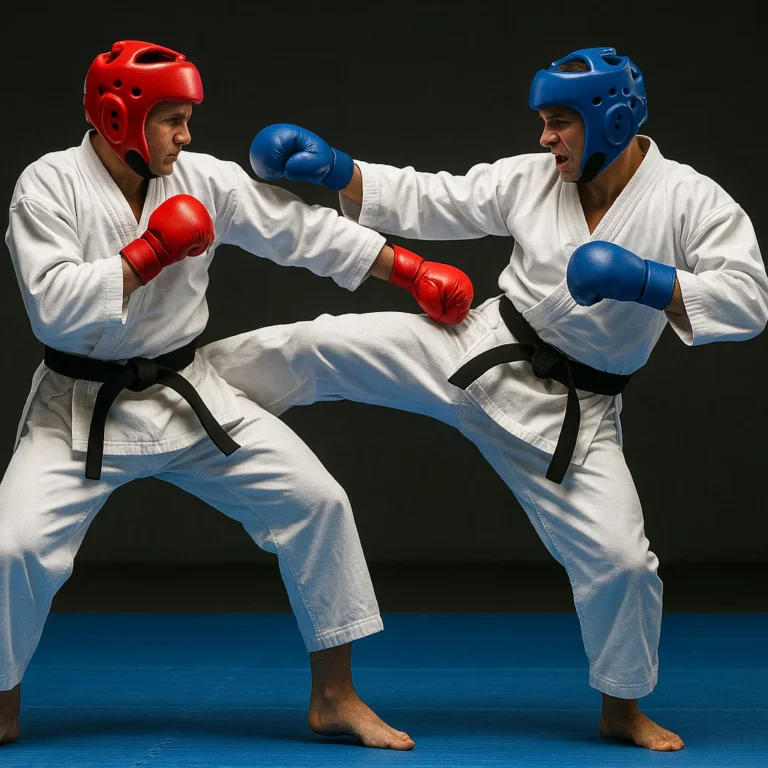
Karate point fighting—also called point sparing or semi-contact karate competition—typically emphasizes controlled, accurate techniques and brief exchanges. MMA striking is continuous: after a punch or kick lands, the opponent can counter, clinch, shoot for a takedown, or keep striking.
So adapting point fighting for MMA means transferring useful qualities while changing tactics that rely on a referee stopping the action. The goal is not to make every point-fighting technique work unchanged. It is to keep the parts that solve real problems—especially distance and timing—and build defenses for the problems point sparing may not regularly present.
What transfers well—and what needs work
| Point-fighting quality | Potential MMA benefit | Necessary adaptation |
|---|---|---|
| Fast entries | Surprise an opponent and land first | Enter behind a guard and prepare for a counter or takedown |
| Long-range control | Manage space with movement and kicks | Avoid predictable bouncing and recover the kicking leg quickly |
| Feints and rhythm changes | Draw reactions and open targets | Feint without dropping the hands or giving away a level change |
| Precise counters | Punish a committed attack | Follow through with combinations when the exchange continues |
| In-and-out movement | Reduce time spent in the pocket | Do not retreat straight toward the cage |
| Blitz attacks | Close distance explosively | Avoid running onto punches, knees, or wrestling attacks |
For technique-specific ideas, browse our Karate Techniques coverage. For MMA application, remember that a technique’s usefulness depends on the opponent, ruleset, cage position, and your ability to recover if it does not land.
A practical definition
A useful MMA adaptation preserves the intent but changes the details. A point fighter may use speed touch a target and exit. An MMA fighter may use that same speed to land, angle away, and stay ready for the opponent’s next action.
That distinction sounds small. In the cage, it can separate a clean entry from an invitation to wrestle.
📜 From Point Fighting to MMA: Rules, Roots, and Key Differences
Point karate includes different competition formats, so there is no single universal ruleset. World Karate Federation competition, for example, uses specific rules for scoring, contact, safety, and referee management. MMA uses a different framework with sustained exchanges and legal grapling techniques. Check the current World Karate Federation competition rules alongside the Unified Rules of MMA to understand what changes between formats.
Some karate schools also teach full-contact striking, kickboxing, or grapling. That experience may reduce the adjustment needed, but it should not be mistaken for MMA preparation unless training includes MMA-specific wrestling, clinch work, ground defense, and sparing.
How Point-Fighting Rules Shape Distance and Timing
In point sparing, fighters often learn to recognize an opening, burst into range, land a controlled technique, and reset. This can develop quick reactions and precise distance judgment. The downside appears when the pause becomes part of the strategy: in MMA, your opponent does not have to stop after you score.
A point-fighting athlete may also become comfortable with:
- A relatively upright or bladed stance.
- Rapid bouncing or hopping.
- Hands positioned for quick scoring attacks.
- Brief, isolated attacks rather than longer combinations.
- Retreats that reset the exchange but do not always protect against cage pressure.
None of these traits is automatically wrong. Each needs to be tested against punches, calf kicks, level changes, and the cage.
What Changes When Strikes, Takedowns, and Groundwork Are Allowed
| Situation | Point-fighting expectation | MMA reality |
|---|---|---|
| Your attack lands | The exchange may be stopped or reset | The opponent may answer immediately |
| Your kick is caught | May be uncommon or handled under specific competition rules | You may be swept, punched, or taken down |
| You retreat | Distance may reset | You can be driven to the cage or cut off |
| You enter with punches | A clean strike may decide the exchange | The opponent may counter, clinch, or wrestle |
| You lose balance | The exchange may be interrupted | You may land underneath an opponent and face strikes or submission threats |
Trust the rulebook for what is legal; trust live, supervised practice for what works. Promotional claims about being “cage proven” are not a substitute for clear explanations of training methods, safety practices, and competition rules.
✅ What Karate Point Fighting Contributes to MMA
Point fighting can provide valuable skills, especially for fighters who already have a foundation in boxing, wrestling, or MMA. The strongest transfer tends to be less about a particular flashy kick and more about how the fighter manages distance, reads reactions, and chooses the moment to attack.
Footwork, Range Control, and Angle Creation
A point fighter is often comfortable moving in and out of range. In MMA, that can help create opportunities against a forward-moving opponent. Angles are especially valuable because they can prevent you from backing up in a straight line and make it harder for an opponent to launch a clean counter or takedown.
Use footwork to:
- Enter at angle rather than charging straight down the center.
- Exit laterally after a combination.
- Keep enough stance width to sprawl or resist a body lock.
- Check your cage position before you retreat.
- Change speed and rhythm without letting your balance disappear.
The UFC’s fighter profiles and our Fighter Profiles section can help you study how different athletes use movement. Watch carefully, though: highlight clips rarely show every failed entry or defensive adjustment.
Explosive Entries, Counters, and Distance-Closing Attacks
Point fighting trains athletes to exploit brief openings. That can translate into sharp counters and fast entries—but the entry should connect to a plan. If your first strike misses, your feet should not carry you blindly into a hook, clinch, or double-leg takedown.
A useful entry has three parts:
- Read: notice the opponent’s step, guard reaction, or repeated retreat.
- Enter: attack behind a jab, feint, or angle change.
- Recover: cover, pivot, frame, or defend the takedown before resetting.
Blitzing, Side Kicks, and Unpredictable Rhythm
A traditional blitz can be adapted by using a jab-cross rather than relying on a single scoring hand strike. The footwork concept is to step forward with the rear foot as the jab lands, then bring the lead foot forward with the cross. But in MMA, the punch sequence is only one possible piece: you also need to account for counters and level changes.
The featured video presents the blitz as a way to close distance and continue moving forward if the first strike misses. Its coach’s line—“We are assuming that our opponent is going to back up when we blitz”—is useful precisely because it exposes the assumption. If the opponent does not retreat, or instead counters, circles, or shoots, the blitz needs a different finish or a safe exit.
Side kicks can also disrupt forward pressure, but they are not free real estate. A kick that extends your leg far from your body may be caught or leave you slow to defend a takedown. Work them first on pads, then in controlled partner drills where your training partner can safely practice catching or countering.
⚠️ What Must Change for the MMA Cage
The cage changes how movement works. A backward step that would create space on an open mat may run out against a fence. A long stance that helps a side kick may make a sprawl harder. And a technique that feels safe in a reset-based exchange may be risky when the opponent can continue.
Stance and Guard Against Punches and Takedowns
A very bladed stance can hide your body from straight punches, but it may expose the lead leg and complicate defense against low kicks or takedowns. A square stance can help with wrestling and checking kicks, but it may make some karate attacks less natural.
There is no universal “correct MMA stance.” Build one that lets you:
- Move in multiple directions without crossing your feet.
- Defend leg kicks and level changes.
- Punch with both hands.
- Kick without losing your balance.
- Sprawl, frame, or underhook when necessary.
Keep your hands ready to defend. A low, relaxed guard may suit certain fighters at long range, but it becomes dangerous if you use it without head movement, distance, or a reliable defensive response.
Managing Leg Kicks, Clinches, and Cage Pressure
Point-fighting footwork can include lots of light bouncing. That may make you harder to time, but repeated bouncing can also make your legs vulnerable and your movement predictable. Train stance switches and rhythm changes, but spend time grounded and balanced too.
Against cage pressure:
- Move laterally before your back reaches the fence.
- Avoid retreating along the same line repeatedly.
- Use a jab, frame, or angle to interrupt the opponent’s advance.
- Practice underhooks and cage escapes with a qualified coach.
- If you are trapped, prioritize posture, hand position, and a safe exit over a dramatic counter.
For technique and competition context, our Fight Analysis and Breakdowns section is a useful companion to watching full rounds rather than isolated knockouts.
Recovering Safely After a Missed or Blocked Attack
A miss is not just a missed point. It can leave your weight forward, your stance narrow, or your leg available to catch. Build recovery into every drill:
- Finish the strike with your balance intact.
- Bring the attacking limb back under control.
- Keep your eyes on the opponent.
- Cover, pivot, or frame as you exit.
- Be ready to sprawl or hand-fight if the opponent closes distance.
Try this with a partner who gives a realistic but controlled response. If your technique only works when the other person stands still, it is a demonstration—not yet a reliable MMA skill.
1. Adapt Point-Fighting Footwork for MMA Range
The aim is to keep the quickness of point fighting without becoming light enough to be easy to knock off balance. Think mobile, not weightless.
Step-by-step footwork adjustment
- Start in a balanced stance. Keep your knees soft and your feet far enough apart to move or defend a takedown.
- Practice short steps first. Long hops can carry you into attacks or leave you unable to change direction.
- Add an exit angle. After entering, move to the side instead of always retreating straight back.
- Work both directions. A reliable stance should not leave you helpless when the opponent circles toward your weak side.
- Add a live cue. Ask a partner to move, jab, kick, or level-change so you react rather than perform a memorized pattern.
Drill: enter, strike, exit
- Partner A gives a visual cue: a step, a reach, or a light jab.
- Partner B enters with a jab-cross or a controlled karate counter.
- Partner B exits at angle with hands up.
- Partner A gives a light follow-up cue so Partner B must recover, not admire the work.
- Swap roles and gradually vary the rhythm.
Do not increase speed before you can keep your stance and defend the return. Your coach should scale the drill to your experience and protective equipment.
2. Build a Takedown-Resistant Karate Stance
A karate stance designed for fast kicks may not be ideal when the opponent can shoot for the legs. The fix is not to stand stiffly or abandon karate movement. It is to make your stance ready to strike and ready to wrestle.
Stance checkpoints
| Checkpoint | Look for | Common problem |
|---|---|---|
| Base | Feet support forward, backward, and lateral movement | Feet too close together or crossed |
| Weight | Balanced enough to punch, kick, sprawl, or pivot | Weight stuck heavily on the rear leg |
| Head | Positioned over your base | Head leaning far past the lead knee |
| Hands | Able to defend punches and frame | Hands dropped while you bounce |
| Recovery | Kicking leg can return under your hips | Leg left extended after a kick |
Drill: strike-to-sprawl reaction
With a coach or experienced partner:
- Begin at striking range in a controlled stance.
- Throw a light, technically clean combination.
- Your partner gives a slow, predictable level change.
- Sprawl or use the coached defensive response, then regain a safe stance.
- Repeat on both sides before increasing speed.
This is a teaching drill, not a substitute for wrestling practice. Learn takedown defense from a qualified MMA or wrestling coach; ask them to correct your hips, head position, and hand placement rather than simply telling you to “sprawl harder.”
3. Turn Point-Scoring Attacks into MMA-Effective Strikes
A point-scoring technique can still work in MMA, but you may need to alter its setup, target, power, and recovery. The best choice depends on your opponent and the ruleset.
Adapt the attack, not just the uniform
- Straight punches: connect them to boxing combinations and guard recovery.
- Backfists: use only where legal and technically appropriate; don’t rely on them as a replacement for the jab.
- Round kicks: train the return and defense against checks, catches, and counters.
- Side kicks: use them to manage distance, but recover your leg quickly and protect your balance.
- Blitzes: aim to enter behind layered attacks, then angle off or clinch with purpose.
- Feints: keep enough posture and hand position to defend the reaction they provoke.
A common error is turning every fast technique into a harder technique. Power without positioning can make a miss more dangerous. Start with precision and balance, then develop impact under supervision.
Drill: one attack, three possible responses
Have a partner respond to the same attack in three controlled ways:
- Retreat.
- Hold position and counter lightly.
- Change level or move into a clinch.
Your job is to keep the attack adaptable. Against the retreat, follow or angle. Against the counter, defend and return. Against the level change, recover into your coached takedown defense.
4. Add Boxing Combinations and Defensive Layers
Karate hands can be fast and accurate. MMA boxing adds the habits needed to keep punching through an exchange: combinations, head movement, defense after punching, and awareness of the opponent’s counters.
Build beyond the single-shot mindset
Start with simple combinations:
- Jab-cross, then angle out.
- Jab to body, cross to head, then cover.
- Feint, jab, and reset behind a defensive guard.
- Cross-hook, then defend a level change.
- Jab-cross into a coached clinch entry or safe disengagement.
Do not force long combinations when the opening is not there. The point is to have more than one answer, not to throw five punches because the drill says so.
Defensive layers to practice
| Threat | Practice response |
|---|---|
| Straight punches | Guard, pary, slip, or step off-line under coaching |
| Hooks | Cover, pivot, or use appropriate head movement |
| Low kicks | Check, evade, or return with balance |
| Level changes | Sprawl, frame, underhook, or disengage as coached |
| Clinch pressure | Hand-fight, establish posture, and work a safe exit |
Use controlled sparing and appropriate protective equipment. Hard sparing is not a shortcut to expertise; poor-quality rounds can teach flinching and bad habits just as quickly as good ones teach composure.
5. Connect Karate Entries to Wrestling and Clinch Defense
Every entry has a wrestling question attached: what happens if the opponent grabs you? Karate specialists do not need to become wrestlers overnight, but they do need the basic responses that let them keep using their striking safely.
A practical training sequence
- Learn stance and level changes from a qualified wrestling or MMA coach.
- Practice hand-fighting so you understand grips, frames, and underhooks.
- Add wall or cage drills for defending pressure and regaining space.
- Connect strikes to defense: jab, opponent shoots, defend, then reset.
- Add positional grapling so a failed defense does not become panic on the ground.
The Unified Rules of MMA explain the competition context, but rules alone cannot teach you how to defend. That comes from coached repetition with a partner and progressive resistance.
What a good coach should make clear
Ask your coach:
- Are these drills designed for point sparing, kickboxing, or MMA?
- What is the defensive response if the attack misses?
- How do you modify the drill for beginners?
- What protective gear and contact level are expected?
- Are wrestling and grapling taught by qualified instructors?
A gym’s marketing may describe its methods as “octagon proven,” but you should still look for transparent coaching, safe training progressions, and instruction in the full MMA ruleset.
6. Make Karate Kicks Safer Against Checks and Catches
Kicks are a major part of karate’s appeal, but an MMA opponent can check, catch, counter, or use a kick to close distance. Work on the kick’s setup and return, not just how it looks on a pad.
Kick adaptation checklist
- Set up kicks with punches, feints, or changes of rhythm.
- Avoid repeatedly throwing the same kick from the same distance.
- Retract quickly and return to a stable stance.
- Learn how to respond when the kick is blocked or caught.
- Practice kick defense, including checks and evasions, with a qualified coach.
- Do not throw hard kicks in partner drills without clear control and agreed rules.
The risk-reward question
A kick may score or interrupt an opponent, but it can also sacrifice balance or expose the leg. Beginners should prioritize control, timing, and recovery. Experienced athletes can build power and complexity gradually through coached pad work, partner drills, and appropriately paced sparing.
7. Use Feints, Counters, and Cage Angles to Set Traps
Point fighters often become skilled at making an opponent react. In MMA, a feint is useful when it encourages a predictable response that you are prepared to exploit. If you feint low and drop your hands, you may simply be inviting a punch.
Set a trap in four steps
- Observe: identify a repeated reaction—retreating, reaching, checking, or countering.
- Trigger: use a small feint, step, or rhythm change.
- Respond: attack the opening the opponent actually gives you.
- Exit or continue: angle away, defend the counter, or connect to a planned follow-up.
Use cage positioning thoughtfully. If the opponent is backing toward the fence, you can cut off the exit rather than chase in a straight line. If you are the one near the fence, prioritize lateral movement and a safe route out.
For tactical examples, compare full-round footage in our Fight Analysis and Breakdowns section with the official rules. A highlight may show a clever trap; the full round shows whether the fighter could repeat it safely.
🎯 MMA-Ready Karate Combinations and Setups
These are training examples, not guaranteed fight recipes. Use them at a controlled pace, and ask your coach to adjust them for your stance, skill level, ruleset, and partner.
Punch-to-Kick and Kick-to-Punch Combinations
| Setup | Training focus | Safety question |
|---|---|---|
| Jab-cross, rear kick, angle out | Combination flow and recovery | Can you return to stance without being countered? |
| Feint jab, body kick, guard reset | Drawing a reaction | Are your hands protecting your head during the kick? |
| Jab, front or side kick, lateral exit | Managing forward pressure | Can you recover the leg if the partner catches it? |
| Low kick after a hand feint | Concealing the kick | Are you balanced enough to defend a counter or level change? |
Start slowly. Work the sequence on pads, then against a partner offering a predictable response, and only later add varied reactions.
Blitz Entries with Exit Angles
Use the blitz as an entry, not a commitment to run through whatever happens next.
- Begin outside punching range.
- Use a small feint to draw a reaction.
- Enter with a jab-cross, keeping your head protected.
- If the opponent retreats, angle and continue only if the opening remains.
- If the opponent holds position or counters, cover and exit.
- If the opponent changes level, use your coached takedown defense.
The adapted jab-cross blitz described in the featured video reflects a useful principle: continuous forward movement may help the second strike if the first misses. But movement alone does not solve a counter or takedown. The safe follow-up is part of the technique.
Counterstriking After a Takedown Threat
Do not counter a takedown attempt by swinging wildly. A coach may teach you to use posture, frames, underhooks, or a specific strike depending on the situation. Practice the defensive action first, then connect it to striking once you can maintain balance.
A simple progression:
- Partner shows a slow level change.
- You defend with the response your coach teaches.
- You regain stance and create safe distance.
- You add a light, controlled counter only if the position allows it.
This keeps the drill focused on recognition and recovery, not on pretending every takedown threat creates a free punch.
🧠 Fight Strategy: When to Use Point-Fighting Skills
Point-fighting skills tend to be most useful when they help you control the terms of an exchange. They are less useful when you use them as a rigid script.
Fighting at Long Range Versus Pocket Range
At long range, use feints, footwork, and selective kicks to make the opponent reach or move. As the distance closes, the priorities change: protect your head, keep your hands active, and be ready to defend the clinch or takedown.
| Range | Useful focus | Common danger |
|---|---|---|
| Long | Feints, distance, side steps, measured kicks | Predictable bouncing or overeaching |
| Mid | Jab-cross, counters, combination exits | Single-shot attacks with no recovery |
| Guard, short combinations, frames, clinch awareness | Turning away or retreating blindly | |
| Clinch | Posture, hand-fighting, underhooks, safe exits | Trying to strike without controlling position |
Adapting to Southpaws, Pressure Fighters, and Wrestlers
- Against a southpaw: work with your coach on lead-foot position, straight-punch lanes, and safe exits. Do not chase foot position so intently that you stop seeing the opponent’s hands.
- Against a pressure fighter: use lateral movement, jabs, and intercepting attacks rather than retreating down a straight line.
- Against a wrestler: keep attacks recoverable, limit reckless long-range commitments, and practice defending entries under pressure.
- Against a counterstriker: vary rhythm and avoid repeating the same blitz or kick from the same distance.
Our Fighter Profiles and fight breakdowns can help you compare styles. Treat any fighter example as a case study, not proof that one tactic works for everyone.
Using the Cage Without Giving Up Your Exit
The cage is not merely a boundary; it changes your available angles. Learn to move laterally before you are trapped, use your stance to avoid crossing your feet, and practice escapes with a coach. When cutting off an opponent, do not rush so far forward that you fall into a counter or takedown.
🥊 Training Plan for Karate-to-MA Adaptation
A useful plan develops skills in layers. You do not need to spar hard every session to become adaptable. In fact, technical practice, controlled resistance, and recovery all have a place.
Technical Drills for Timing, Entries, and Recovery
Include focused rounds for:
- Feints and visual reactions.
- Jab-cross entries with balanced exits.
- Kicks with quick recovery.
- Defensive responses after a miss.
- Angle changes from both sides.
- Striking immediately followed by a coached sprawl or clinch defense.
Keep the purpose of each round clear. If you are training footwork, do not turn every repetition into a power contest.
Partner Drills for Takedown and Clinch Awareness
Work with partners who understand the agreed intensity and rules. Practice reactions in stages:
- Predictable: partner gives one known response.
- Choice-based: partner selects from two or three responses.
- Light resistance: partner attempts the response at controlled speed.
- Situational sparing: begin near the cage, in striking range, or after a kick catch.
- Coach review: identify what worked and what broke down.
If your gym does not offer wrestling or grapling instruction, seek qualified coaching rather than trying to learn takedown defense from unstructured sparing.
Progressive Sparing: Point Fighting to MMA Rounds
Move from constrained drills to broader sparing gradually:
| Stage | Format | Main objective |
|---|---|---|
| 1 | Technical point-style movement | Timing and distance |
| 2 | Continuous kickboxing-style striking | Follow-ups and defensive recovery |
| 3 | Striking with light takedown threats | Awareness of level changes and clinches |
| 4 | Positional MMA rounds | Cage movement, clinch, or ground scenarios |
| 5 | Full MMA sparing under qualified supervision | Integration and decision-making |
This is a general progression, not a universal schedule. Your coach should adjust it to your experience, health, and competition goals. The Association of Ringside Physicians provides medical resources for combat sports; athletes should follow qualified medical guidance and gym safety policies.
Strength, Conditioning, and Mobility for Karate Fighters
Karate athletes may already have speed and flexibility. MMA preparation also calls for strength, aerobic and anaerobic conditioning, balance, and recovery. Use a program designed around your training load rather than stacking extra workouts until you are exhausted.
Prioritize:
- General strength and joint-friendly movement.
- Conditioning that supports repeated efforts and recovery.
- Hip and ankle mobility without forcing painful ranges.
- Neck and shoulder preparation under qualified guidance.
- Sleep, hydration, and rest days.
- Medical assessment for injuries or concussion symptoms.
No conditioning program can guarantee injury prevention. If pain changes your movement or persists, stop and consult a qualified healthcare professional.
🛡️ Safety, Sparing Gear, and Injury Prevention
Safe practice is a shared responsibility. Set the rules before a round, use appropriate equipment, and match contact to the drill. The right gear depends on the ruleset and coach; it does not make uncontrolled sparing safe.
Safety checklist for adapted karate training
- Agree on the drill, intensity, legal targets, and stopping signal.
- Use properly fitted gloves, mouthguard, shin guards, and other required protection.
- Avoid hard head contact during technical drills.
- Do not practice dangerous throws, submissions, or neck techniques without qualified supervision.
- Stop if you feel dizzy, confused, unusually nauseated, or experience a headache after impact; seek medical guidance.
- Keep training areas clear and inspect equipment for damage.
- Follow your gym’s concussion and return-to-training policies.
The Association of Ringside Physicians’ resources can help athletes and coaches find combat-sports medical guidance. For belt systems and rank terminology, see our Karate Belts and Rankings section; rank alone does not establish MMA readiness.
❌ Common Karate-to-MA Adaptation Mistakes
| Mistake | Why it causes trouble | Better adjustment |
|---|---|---|
| Treating a clean strike as the end of the exchange | MMA continues after contact | Recover, defend, and prepare to follow up |
| Bouncing constantly | Can make stance and leg defense less reliable | Vary rhythm and include grounded movement |
| Blitzing without an exit | Can run into counters, clinches, or takedowns | Pair entries with cover, angle, and recovery |
| Using a very bladed stance in every situation | May expose the lead leg or complicate wrestling defense | Adapt stance to opponent and range |
| Throwing kicks without practicing the return | Leaves balance and leg vulnerable | Rehearse recovery, catches, and defensive responses |
| Learning takedown defense only through hard sparing | Encourages panic and poor technique | Use coached, progressive wrestling drills |
| Copying a famous fighter’s highlight | Ignores the setup, opponent, and training context | Study full rounds and test ideas safely |
| Assuming a karate background equals MMA experience | Leaves grapling and cage skills untested | Add qualified MMA, wrestling, and grapling coaching |
Marketing language can overstate what a style or class can do. A local school may describe training as “OCTAGON proven,” as Fontana Karate’s combat-sports page does, but that phrase is not independent evidence of competitive outcomes. Ask what the class trains, how it handles sparing, and whether wrestling and ground skills are included.
📊 Point Fighting vs. MMA Karate: Skills at a Glance
| Skill area | Point fighting emphasis | MMA adaptation |
|---|---|---|
| Scoring | Accurate, controlled contact under a competition ruleset | Effective strikes within MMA rules, with defense after contact |
| Distance | Quick entries and exits | Range changes while accounting for punches, kicks, and takedowns |
| Footwork | Fast movement, often with bouncing | Balanced movement that works near the cage and against level changes |
| Combinations | Brief attacks may be enough to score | Follow-ups, defensive layers, and planned exits |
| Kicking | Speed and reach | Setup, leg-kick defense, recovery, and catch awareness |
| Defense | Avoiding clean scoring attacks | Protecting against continuous striking, clinches, takedowns, and ground attacks |
| Training | Rule-specific sparing and competition practice | Integrated striking, wrestling, clinch, and grapling under MMA rules |
What the comparison does—and does not—tell you
A table can organize the differences, but it cannot decide whether a particular fighter should use a blitz, side kick, or low stance. That depends on attributes, opponent, ruleset, and coaching. The reliable takeaway is simpler: point fighting can improve parts of an MMA game, but it cannot replace MMA practice.
🌟 Notable Karate-Inspired MMA Approaches
MA audiences often point to athletes such as Lyoto Machida and Stephen “Wonderboy” Thompson when discussing karate-influenced movement, timing, and long-range striking. Jorge Masvidal has also used a fast advancing combination in a famous UFC exchange with Darren Till. These examples show that karate-derived movement and entries can appear in high-level MMA; they do not prove that every point-fighting technique transfers unchanged.
Watch with questions, not just admiration:
- What stance does the fighter use at each range?
- How do they exit after striking?
- What happens when an opponent pressures or shoots?
- Which attacks are set up by feints or reactions?
- How often does the fighter repeat the same pattern?
The UFC’s athlete pages and our Fighter Profiles can help you explore individual athletes. For another viewpoint, Fontana Karate’s combat-sports article describes point fighting as a source of “smart strategy and pin point striking accuracy.” That is a useful description of potential strengths, but broad claims about damage control or career records should be checked against authoritative fight records and full-event footage rather than repeated as established fact.
The supplied Facebook page titled The Effectiveness of Shotokan Karate in Modern Martial Arts does not expose its post text publicly without login, so its claims cannot be independently verified from the accessible page: view the Facebook post. That limitation is a reminder to separate a source’s title from evidence contained in the source.