Support our educational content for free when you purchase through links on our site. Learn more
Karate In and Out Movement in MMA: The Footwork Edge 🥋


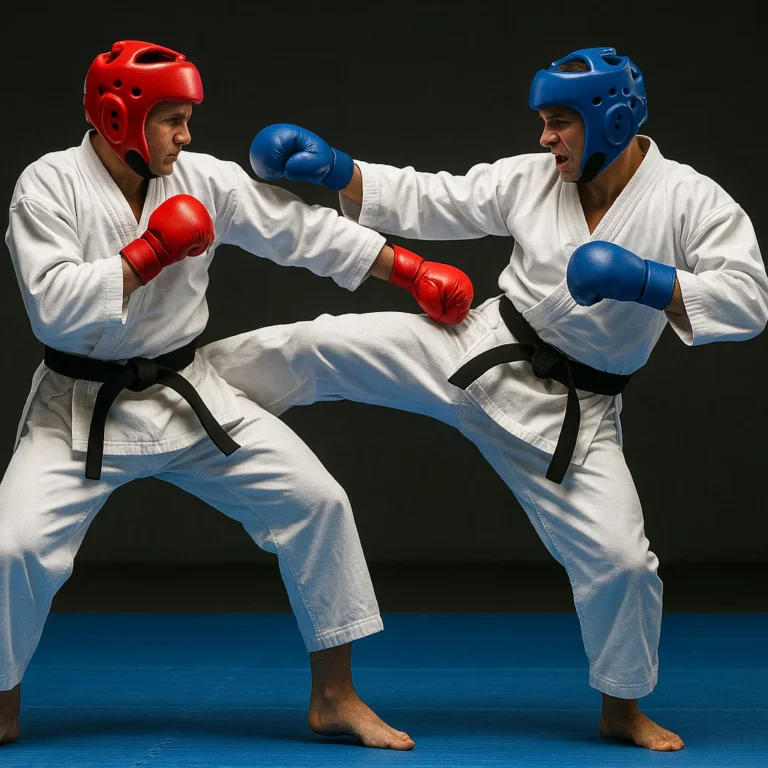
Karate in and out movement in MMA can help you land quick attacks and avoid return fire—but it works best when every entry has a planned exit, angle, or takedown defense. The skill isn’t simply darting forward and back; it’s controlling distance without letting the cage, a leg kick, or a wrestler turn your footwork against you.
We’ve seen how tempting it is to admire a fast blitz and forget the step afterward. Against a cooperative partner, that looks slick; against someone cutting off the cage, that same straight-line retreat can run out of road in a hurry.
The fighters who use karate-influenced movement well—such as Lyoto Machida, Stephen Thompson, Georges St-Pierre, and Kyoji Horiguchi—show different ways to blend timing, angles, and explosive entries with a complete MMA game. Here’s what you can learn from their movement, what needs adapting, and how to train it safely.
Key Takeaways
- Enter with a purpose: Use a feint, opponent’s movement, or strike to create a safe opening.
- Make the exit part of the attack: Recover your stance, angle off, or prepare to defend a takedown.
- Treat the bladed stance as a tool, not a rule: It may aid mobility and reach, but can expose the lead leg or complicate wrestling defense.
- Don’t retreat on autopilot: Straight-line movement can take you to the fence, where your options shrink.
- Build a complete MMA skill set: Karate footwork works best alongside boxing defense, kick defense, wrestling, and clinch skills.
- Train against resistance gradually: Start with footwork and partner drills, then add counters, cage pressure, and takedown reactions.
Table of Contents
- ⚡️ Quick Tips and Facts
- 🥋 What Is Karate In-and-Out Movement in MMA?
- 📜 Karate’s Path from Traditional Dojo to MMA Cage
- 🎯 The Karate Footwork System: Range, Timing, and Angles
- The Bladed Stance: Mobility, Reach, and Its Trade-Offs
- The Sniper Range: Staying Just Outside the Opponent’s Reach
- The In-and-Out Step: Draw, Enter, Strike, Exit
- The Blitz: Explosive Entries Without Becoming Predictable
- Angles, Lateral Movement, and Cage Positioning
- 🥊 Effective Karate Techniques in the Octagon
- Reverse Punches, Straight Leads, and Counterstriking
- Side Kicks, Front Kicks, and Tep-Like Intercepts
- Roundhouse Kicks, Head Kicks, and Body Attacks
- Karate Entries into Clinches, Takedowns, and Combinations
- 🧠 Reading Opponents: Feints, Rhythm Changes, and Counters
- 🛡️ Defending Against Wrestling, Leg Kicks, and Pressure
- 🏆 Karate Legends Who Shaped MMA Striking
- Lyoto Machida: The Dragon’s Counterstriking Blueprint
- Stephen “Wonderboy” Thompson: Side-On Movement and Shot Selection
- Georges St-Pierre: Karate Footwork Meets Wrestling
- Kyoji Horiguchi: Speed, Angles, and In-and-Out Attacks
- 🥋 Karate vs. Muay Thai in MMA: Stance, Range, and Trade-Offs
- ✅ Is Karate Still Effective in Modern MMA?
- 🏋️ How to Train Karate In-and-Out Movement for MMA
- Solo Footwork Drills and Shadowboxing
- Partner Drills, Pad Work, and Controlled Sparing
- Conditioning, Balance, and Injury Prevention
- Common Footwork Mistakes and How to Fix Them
- 📋 Building a Complete MMA Game Around Karate Movement
- 🔗 Recommended Links
- ❓ FAQ: Karate In-and-Out Movement in MMA
- What does in-and-out movement mean in MMA?
- Which karate styles are most useful for MMA?
- Does a bladed stance make takedowns easier?
- How do karate fighters defend against leg kicks?
- Can beginners learn karate footwork for MMA?
- How is karate movement different from boxing footwork?
- 📚 Reference Links
⚡️ Quick Tips and Facts
Karate in-and-out movement in MMA is a way to manage distance, attack in short bursts, then exit or angle away before the opponent can answer. It is not simply bouncing backward and hoping the cage is behind you. The best versions combine footwork with punch-and-kick threats, defensive wrestling, and awareness of the fence.
For a broader overview of how karate connects with MMA, start with our Karate and MMA guide.
| Quick fact | What it means in the cage |
|---|---|
| In-and-out movement | Enter striking range on a cue, attack, then leave range or move to angle. |
| Bladed stance | A side-on stance can reduce the available target and support quick linear movement, but may expose the lead leg. |
| Sniper range | A practical coaching phrase for staying near the edge of an opponent’s effective range, ready to intercept or counter. It is not a standardized scientific measurement. |
| The blitz | A fast, committed entry, often using straight punches, intended to cover distance before the opponent can reset. |
| The trade-off | Mobility can help a fighter avoid clean exchanges, but a predictable retreat can surrender cage position or invite a takedown. |
| The MMA requirement | Karate movement works best when paired with boxing defense, kick checks, wrestling, and cage escapes. |
Our quick coaching cues:
- ✅ Enter behind a cue: a feint, opponent’s step, jab, or level change.
- ✅ Exit with purpose: angle off, reset stance, or defend a takedown.
- ✅ Keep the rear hand home while the lead hand probes or frames.
- ❌ Do not hop straight backward repeatedly. The fence eventually wins that argument.
- ❌ Do not admire the strike. Finish the attack, recover your stance, and make the next defensive decision.
The central question is not whether karate footwork looks unusual. It is whether you can use it against a resisting opponent without giving up position. That comes down to the mechanics—and the trade-offs.
🥋 What Is Karate In-and-Out Movement in MMA?
In-and-out movement is a strike-and-reposition strategy: a fighter crosses into range quickly, attacks, and then exits, pivots, or changes level before the opponent launches a return attack. Karate schools use different terminology and methods, but this general pattern appears across many point-fighting and full-contact backgrounds.
In MMA, the movement must account for more than punches and kicks. An opponent can counter, clinch, wrestle, or push you toward the cage. That is why we describe effective movement as enter, score, recover, and read, not “rush in, rush out.”
The four-part movement cycle
| Stage | Fighter’s job | Common error |
|---|---|---|
| 1. Read | Notice the opponent’s stance, weight shift, reach, and habits. | Moving before there is a useful cue. |
| 2. Enter | Step or burst into range behind a feint, jab, or intercepting kick. | Reaching with the head or crossing the feet. |
| 3. Score | Land a clean strike or create a meaningful reaction. | Throwing a long combination without a defensive plan. |
| 4. Exit or angle | Leave the return-fire lane, pivot, frame, or prepare to sprawl. | Retreating in a straight line with the feet square. |
Karate-inspired movement is often described as linear and explosive, but that is only half the picture. A useful entry can be straight; a safe exit often needs angle. On a large open mat, a straight retreat may seem endless. In a cage, the fence is a very persuasive reminder that space has limits.
For technique examples and foundational movement ideas, see our Karate Techniques section.
What “in and out” does—and does not—mean
- It does mean: changing range on purpose, taking short opportunities, and reducing the time spent in an opponent’s preferred striking distance.
- It may mean: using a bladed stance, stance switches, feints, long kicks, or a sudden straight-punch combination.
- It does not mean: staying permanently out of reach, avoiding every exchange, or assuming a fast retreat will stop a wrestler.
- It does not guarantee: a clean escape after every attack. The opponent can pressure, cut off the cage, or time the entry.
This distinction matters because “hit without being hit” is a useful aim, but controlling the exchange is the more complete goal. A fighter who lands once and backs into the fence has not necessarily won the position.
📜 Karate’s Path from Traditional Dojo to MMA Cage
Karate is not one uniform fighting system. Shotokan, Kyokushin, Goju-ryu, and other styles differ in stance, rules, contact, and training habits. MMA fighters have drawn from karate in different ways, often mixing it with boxing, kickboxing, wrestling, and Brazilian jiu-jitsu rather than reproducing a traditional syllabus intact.
The modern MMA lesson is practical: keep what works against resistance, adapt what does not, and fill the gaps the ruleset exposes. A long stance may help a fighter dart in and out, for example, but its usefulness changes when calf kicks and takedowns are live threats.
From point-fighting distance to MMA distance
Some karate competition formats reward clean, decisive attacks and quick resets. MMA exchanges are different: fighters can continue striking after the first touch, attack the legs, clinch, and take the fight to the floor. As a result, karate’s quick entries need an MMA-specific defensive layer.
| Traditional habit or strength | MMA adaptation |
|---|---|
| Explosive entry to score first | Enter behind a feint, jab, or kick that also protects against counters |
| Long, side-on stance | Adjust stance width and angle when facing leg kicks or wrestling |
| Fast reset after an attack | Exit with a pivot, frame, or defensive hand position |
| Countering an opponent’s advance | Add checks, sprawl reactions, underhooks, and cage awareness |
| Rhythmic bounce or stance switch | Vary rhythm without becoming easy to time |
The cited FightBook MMA overview describes karate’s MMA value through distance management, explosive entries, timing, and unexpected angles. That perspective aligns with our coaching experience, with one important caveat: those qualities are advantages only when a fighter can defend the likely response.
For fighter histories and style breakdowns, browse Fighter Profiles and Fight Analysis and Breakdowns.
Why karate does not look the same in every fighter
A karate background does not automatically produce a bladed stance or a point-fighting rhythm. Fighters adapt to their body type, opponent, rules, and strongest secondary skills. Georges St-Pierre, for instance, used karate-influenced movement as part of a larger game that included elite wrestling; Stephen Thompson’s striking identity is much more visibly tied to a side-on, long-range style.
The art supplies options; the athlete and the MMA rules decide which options survive.
🎯 The Karate Footwork System: Range, Timing, and Angles
Karate-style movement is most useful when we treat it as a range-management system, not a stance you must hold at all times. A fighter should be able to shorten the stance, turn more square, switch stance, or plant briefly when the situation demands it.
One video perspective referenced for this article emphasizes that a deeper stance may offer more mobility and power, while also making kick checks harder from certain positions. That is a useful coaching observation, not a universal rule: stance depth, balance, mobility, and kick defense depend on the individual fighter and the opponent’s attack. The video also compares aspects of athletic movement with pitching mechanics; that analogy can prompt questions about force transfer, but it does not prove that a particular karate stance is superior in MMA. See the discussion at #featured-video.
The Bladed Stance: Mobility, Reach, and Its Trade-Offs
A bladed stance turns the lead shoulder and hip toward the opponent, making the body appear narrower. It can support quick linear entries and keep a long lead leg available for side kicks or intercepting attacks.
| Potential benefit | Potential cost |
|---|---|
| Presents a smaller frontal target | Can expose the lead calf and thigh |
| Keeps the lead hand and leg close to the opponent | May make checking kicks slower or less natural |
| Supports sudden forward or backward movement | Can complicate defense against level changes if posture is too upright |
| Encourages long-range attacks | May leave the rear hand farther from immediate use |
Our coaching view: use the bladed stance as a tool, not a permanent pose. Narrow or square up when checking kicks, wrestling, or trading in the pocket. If an opponent is repeatedly attacking your lead leg, refusing to adjust is not “traditional”; it is simply stubborn.
The Sniper Range: Staying Just Outside the Opponent’s Reach
“Sniper range” is a popular coaching label for the distance where a fighter is close enough to attack quickly but not yet inside the opponent’s easiest punching range. The phrase is useful, but it is not a fixed measurement. Reach, stance, speed, and weapon choice all change the distance.
To manage this range:
- Measure with low-risk tools. Use a feint, lead-hand touch, or controlled front kick rather than lunging with a naked power shot.
- Watch the opponent’s feet and shoulders. A step, weight shift, or shoulder twitch may signal the attack before the punch arrives.
- Keep your own stance recoverable. If your weight is stranded on the lead leg, your “safe” range may not be safe at all.
- Make the opponent act first when appropriate. A reach or overstep can create a counter window.
- Do not drift into the fence. Range control includes knowing where you are in the cage.
A good measure is not “I’m outside the jab.” It is “I can react to the opponent’s likely attack and still keep a usable exit.”
The In-and-Out Step: Draw, Enter, Strike, Exit
Here is a practical progression we use for teaching the movement. Begin slowly, then increase speed only when posture and defense remain intact.
Step-by-step drill
- Set your stance. Keep your feet under you, knees soft, hands in a position that protects the head.
- Draw a reaction. Use a small hand feint, shoulder feint, or half-step. The goal is to make the partner jab, reach, or shift—not to dance for decoration.
- Enter behind a weapon. Step with a straight punch or lead-leg kick. Avoid leaning your head past your base.
- Recover immediately. Bring the striking hand back and restore balance before adding another attack.
- Exit off-line. Take a short angle step or pivot. If the partner presses, use a frame or circle rather than backing up blindly.
- Read the response. Add a sprawl or clinch-defense reaction if the partner changes levels.
- Reset at a new angle. Do not automatically return to the exact same spot; predictable exits are easy to trap.
Start with a cooperative partner, then add a single counter, then allow controlled open reactions. The point is not to win the drill by being faster. It is to keep a sound position while the problem gets harder.
The Blitz: Explosive Entries Without Becoming Predictable
The blitz is a sudden forward attack that covers distance quickly, often with straight punches. It can punish an opponent who relaxes just outside range, but a committed rush also gives the opponent a chance to counter, clinch, or shoot.
A safer blitz has three pieces:
- A setup: feint, hand touch, stance switch, or opponent’s forward step.
- A direct attack: straight punches or a punch-to-kick sequence with the head protected.
- A planned finish: angle off, frame, clinch, or defend the takedown instead of standing still.
Common errors include launching from too far away, crossing the feet, dropping the rear hand, and repeating the same entry until the opponent has its timing. In MMA, a blitz should be an occasional surprise, not your entire personality.
Angles, Lateral Movement, and Cage Positioning
Straight-line movement is valuable for entering and exiting, but lateral movement helps prevent an opponent from lining up a second attack. A fighter should think in terms of where the next step leads, not just where the current punch lands.
| Situation | Useful movement choice |
|---|---|
| Opponent advances in a straight line | Pivot or circle away from the power-hand side when safe |
| Opponent cuts off the cage | Change direction before your back touches the fence |
| You finish a long entry | Step off the return-fire lane, then reset |
| Opponent threatens a shot | Keep hips under you, widen only as needed, and prepare to sprawl or frame |
| You are already near the fence | Prioritize a lateral escape or tie-up over a long backward retreat |
Cage awareness separates open-mat footwork from MMA footwork. The fence is not a neutral background: it can limit exits, help a wrestler secure pressure, or give you a surface to stand back up. For broader fight-context analysis, see Fight Analysis and Breakdowns.
🥊 Effective Karate Techniques in the Octagon
Karate techniques become more reliable in MMA when they are adapted for gloves, stance changes, wrestling threats, and sustained combinations. We favor attacks that can score while preserving balance. Flash is welcome; being planted in front of a wrestler afterward is less welcome.
Reverse Punches, Straight Leads, and Counterstriking
The reverse punch, often called gyaku-zuki, is a straight rear-hand attack driven by coordinated movement through the legs and hips. In MMA, it can resemble a sharp cross or become the leading punch in a blitz.
- Use it after a cue: opponent steps in, reaches, or retreats toward the fence.
- Keep the chin protected: the shoulder rises, the opposite hand stays home.
- Avoid overeaching: if the punch misses, the head and hips should remain recoverable.
- Build a follow-up: add a lead hand, kick, angle, or defensive tie-up based on the reaction.
A counter is not simply a punch thrown after the opponent moves. It is a strike launched when you have identified a likely lane and retained a way to defend the next action.
Side Kicks, Front Kicks, and Intercepting Attacks
A lead-leg side kick can act as a long-range stop-hit against forward pressure. A front kick can intercept the body or disrupt an opponent’s advance. Both can help maintain distance, but they also leave the kicking leg temporarily unavailable for stance recovery and may be caught or countered.
| Technique | Best use | Main caution |
|---|---|---|
| Lead-leg side kick | Intercepting forward movement; disrupting rhythm | Recover the leg quickly; avoid repeatedly targeting the same level |
| Front kick | Checking a rush or attacking the body | A missed kick can leave you off-balance or open to a catch |
| Rear-leg front kick | Longer, more forceful body attack | Takes more time to launch and recover |
| Roundhouse kick | Attacking body or head after a setup | Can expose the leg to a catch or leave you vulnerable during recovery |
The kick should not be treated as an invisible fence. A committed opponent can absorb or catch a strike, and a skilled wrestler may use the kicking moment to change levels. Practice the kick and the recovery, not just the impact.
Roundhouse Kicks, Head Kicks, and Body Attacks
Karate-influenced fighters may use roundhouse kicks from unusual rhythms or ranges. The surprise can be valuable, but a head kick is a high-risk weapon if it is thrown without setup.
A sensible progression:
- Show the opponent a hand attack or body kick.
- Observe whether the guard drops or the opponent leans away.
- Land the kick without sacrificing posture.
- Recover the leg to stance—or use a deliberate follow-up if the opponent closes.
- Defend the counter before admiring the result.
✅ Good targets and timing depend on the opponent’s guard and stance.
❌ Do not assume a flashy kick is automatically a high-percentage kick.
Karate Entries into Clinches, Takedowns, and Combinations
In MMA, a striking entry can also create a grapling opportunity. A straight-punch blitz may force a high guard; a kick may make the opponent plant; a feint may draw a reaction that opens a level change. The reverse is also true: a threat of wrestling can make an opponent hesitate before entering.
| Entry or attack | Possible follow-up | Defensive consideration |
|---|---|---|
| Straight punches | Angle exit, body lock, or level change | Keep head off the center line; watch for counters |
| Side kick to the body or hip line | Reset, switch stance, or follow with hands | Recover the kicking leg; anticipate a catch |
| Feint to draw a guard | Body shot, low kick, or takedown entry | Avoid telegraphing the real attack |
| Punch-to-level-change sequence | Double leg, single leg, or clinch | Do not drop posture without controlling distance |
| Opponent counters your exit | Frame, pivot, or tie up | Do not turn away and run |
This is where karate’s rhythm changes become more than a striking trick. They can help set up wrestling—but only if the fighter has trained the transition under live resistance.
🧠 Reading Opponents: Feints, Rhythm Changes, and Counters
Karate fighters are often described as “rhythm-breakers.” That phrase captures a useful idea: changing pace and timing can make an opponent hesitate or commit at the wrong moment. But rhythm changes work best when they are linked to an actual attack or defensive decision.
Practical ways to disrupt rhythm
- Vary the pause: do not enter at the same beat after every bounce.
- Use small feints: move the hand, shoulder, or front foot to prompt a reaction.
- Change stance with a reason: switch to create a new angle, load a weapon, or answer a matchup problem.
- Punish predictable pressure: time an intercepting kick or counter punch as the opponent steps in.
- Change the exit: alternate between angle steps, pivots, frames, and defensive resets.
A useful partner drill is to have one person advance with light pressure while the other may only feint, intercept, or exit. Then reverse roles. Keep the intensity low enough to recognize patterns; speed without observation is just noise with footwork.
The MA AIL article on karate’s evolution and techniques describes karate fighters as rhythm-breakers who may attack on the “half-beat.” We like the coaching idea, but it should not be treated as a technical law. Fighters do not need to strike on a mathematically exact beat; they need to interrupt the opponent’s expectation and maintain a safe position.
🛡️ Defending Against Wrestling, Leg Kicks, and Pressure
An in-and-out style can fail when an opponent attacks the movement rather than the strike. A wrestler may follow the retreat and change levels; a kickboxer may attack the lead leg; a pressure fighter may cut off the cage instead of chasing you.
| Threat | What can go wrong | Useful adjustment |
|---|---|---|
| Takedown entry | Long stance or upright posture makes hips harder to defend | Keep posture ready, recognize level changes, and drill sprawl, underhooks, and frames |
| Calf or thigh kick | Bladed stance gives the lead leg repeated exposure | Check, withdraw, switch stance, or narrow the stance based on the situation |
| Cage pressure | Straight retreats remove your escape space | Circle early, pivot before reaching the fence, or use a clinch to turn the opponent |
| Caught kick | Slow recovery lets the opponent sweep or counter | Rehearse retracting the leg and responding to a catch |
| Combination pressure | One exit step is not enough against follow-up punches | Exit off-line, keep guard active, and avoid resetting in the same lane |
A simple anti-wrestling check after every entry
After each striking combination, ask:
- Are my hips under me?
- Can I see the opponent’s chest and hands?
- Is my stance wide enough to defend a shot, but not so wide that I cannot move?
- Do I have a clear exit that is not the fence?
- If the opponent clinches, do I know whether to frame, pummel, turn, or disengage?
This is not a substitute for coaching or live grapling practice. It is a way to make footwork training honest. A movement pattern that only works when nobody wrestles is a demonstration, not an MMA solution.
🏆 Karate Legends Who Shaped MMA Striking
These fighters illustrate different ways karate-influenced movement can appear in MMA. Their styles should not be reduced to a single label: each built a broader game around individual strengths.
Lyoto Machida: The Dragon’s Counterstriking Blueprint
Lyoto Machida became known for patient counterstriking, unusual distance, and sudden attacks. Rather than simply advancing behind conventional boxing pressure, he often encouraged opponents to step into a countering opportunity. His MMA success also depended on skills beyond footwork, including defensive awareness and the ability to adapt his tactics.
What to study: how a fighter can use space to make an opponent initiate, then attack the opening.
What not to copy blindly: waiting at long range without a plan, especially when the cage is behind you.
For more fighter breakdowns, visit Fighter Profiles.
Stephen “Wonderboy” Thompson: Side-On Movement and Shot Selection
Stephen “Wonderboy” Thompson is a prominent example of a side-on stance, long-range attacks, and unusual entries. His karate and kickboxing experience contribute to a style built around distance, angles, and quick strikes. But his success is not just “a stance”: it also reflects timing, defensive reactions, conditioning, and years of high-level training.
What to study: how stance, lead-leg weapons, and range changes can make an opponent hesitate.
What to adapt: the need to defend the lead leg and avoid being pressured into the fence.
Georges St-Pierre: Karate Footwork Meets Wrestling
Georges St-Pierre showed how karate-influenced movement can complement an elite wrestling game. His footwork and explosive entries helped him manage distance and create openings, while his wrestling gave opponents another problem to solve. The takeaway is not that karate alone produced his success; it is that movement can become more dangerous when paired with a credible takedown threat.
Kyoji Horiguchi: Speed, Angles, and In-and-Out Attacks
Kyoji Horiguchi has displayed fast entries, sharp combinations, and movement that reflects a blend of karate, boxing, and wrestling influences. His style underscores an important point: modern MMA athletes rarely keep their skills in separate boxes. Footwork, combinations, and grapling transitions support one another.
| Fighter | Visible movement lesson | Wider MMA lesson |
|---|---|---|
| Lyoto Machida | Patient distance and counters | Make opponents reveal their attacks |
| Stephen Thompson | Long-range, side-on striking | Protect the lead leg and manage cage position |
| Georges St-Pierre | Explosive movement linked to wrestling | A takedown threat changes striking reactions |
| Kyoji Horiguchi | Speed, angles, and rapid entries | Blend striking with transitions rather than relying one tool |
For context on these fighters and other martial artists, see our Fighter Profiles and Fight Analysis and Breakdowns.
🥋 Karate vs. Muay Thai in MMA: Stance, Range, and Trade-Offs
Karate and Muay Thai are not opposites, and neither has one fixed MMA stance. A simplified comparison can still help explain why certain matchups feel different: karate-influenced movement often prioritizes distance changes and sudden entries, while Muay Thai commonly emphasizes balanced striking, kicks, checks, knees, and clinch offense.
| Feature | Karate-influenced approach | Muay Thai-influenced approach |
|---|---|---|
| Typical emphasis | Timing, rapid entries, distance changes, counters | Stable striking base, kicks, knees, checks, clinch |
| Possible strength | Makes attacks harder to time through rhythm and range | Supports sustained offense and close-range weapons |
| Possible vulnerability | Long or bladed stance may expose lead leg; retreat can reach fence | A more upright or planted moment may be vulnerable to rapid angle changes |
| MA adjustment | Add kick defense, wrestling, and cage movement | Adapt stance and defense for punches, takedowns, and MMA clinches |
These are tendencies, not rules. Fighters cross-train, and elite athletes alter their stance by opponent and moment. A karate-style side kick can be effective against a forward-pressure fighter; a Muay Thai check can punish a predictable lead-leg kick. The right question is which position solves this matchup while preserving your next action?
The MA AIL comparison frames the contrast as “Mobility vs. Stability.” That shorthand is useful for a first look, but it oversimplifies both arts. Muay Thai fighters move, and karate fighters can stand and trade. What matters is how the fighter applies those tools under MMA rules.
✅ Is Karate Still Effective in Modern MMA?
Yes—when it is trained as part of MMA, not treated as a complete replacement for MMA training. Karate’s distance control, timing, long-range kicks, fast entries, and rhythm changes can offer real tactical value. The same habits can become liabilities when they are predictable or unsupported by wrestling and cage defense.
What tends to transfer well
- Explosive straight-punch entries
- Intercepting front and side kicks
- Counterstriking against predictable forward pressure
- Distance changes and stance variation
- Coordination, balance, and rapid attack recovery
What needs adaptation
- Deep or very bladed stances against leg kicks
- Linear retreats near the fence
- Long-range attacks without kick recovery or takedown defense
- Point-fighting habits that stop after the first clean strike
- Repeated timing patterns that an opponent can scout
The FightBook MMA article makes the broader point that the cage rewards techniques that work against a resisting opponent, not tradition by itself. We agree. Karate can be a strong ingredient; the finished recipe still needs boxing, wrestling, grapling, and live MMA rounds.
Our verdict
| Question | Our answer |
|---|---|
| Can karate-style movement help an MMA fighter? | Yes, especially for range management, counters, and sudden entries. |
| Is a bladed stance always better? | No. It can help in one exchange and create leg-kick or wrestling risks in another. |
| Can footwork alone stop a wrestler? | No. Positioning helps, but takedown defense must be trained directly. |
| Should a karateka abandon karate to do MMA? | No. Keep useful strengths, adapt the stance and tactics, and build the missing skills. |
The best modern karate-influenced fighter is not the one who looks most like a textbook photograph. It is the one who can change stance, strike, defend, and grapple without losing the thread of the exchange.
🏋️ How to Train Karate In-and-Out Movement for MMA
Train movement from low-risk coordination drills toward live, unpredictable practice. Footwork should be tested against a partner who can move, counter, and wrestle—not only against floor markings.
Solo Footwork Drills and Shadowboxing
1. Entry-and-exit line drill
Place two markers a short distance apart.
- Start outside imagined punching range.
- Step in behind a straight punch or controlled front kick.
- Recover the striking limb and return to stance.
- Exit diagonally rather than retreating straight back every time.
- Repeat from both stances.
Keep your steps short enough to maintain balance. If you are jumping so far that your feet need a meeting afterward, reduce the distance.
2. Shadowboxing with decision cues
Use a timer and respond to imagined prompts:
- Opponent steps in → intercept, counter, or angle off.
- Opponent waits → feint, draw a reaction, or change range.
- Opponent cuts off the cage → pivot or change direction.
- Opponent shoots → lower your base and prepare a defensive response.
Shadowboxing is most valuable when it rehearses decisions, not just a highlight reel.
Partner Drills, Pad Work, and Controlled Sparing
| Drill | How to run it | What it teaches |
|---|---|---|
| Mirror footwork | One partner leads movement; the other mirrors without crossing feet | Balance and visual tracking |
| Entry-counter-exit | Attacker enters with one strike; partner gives a light counter; attacker exits or defends | Recovery and response |
| Kicking-distance drill | Partner advances; striker uses a controlled intercepting kick and returns to stance | Timing and kick recovery |
| Cage-circle drill | One partner pressures gently while the other circles off the fence | Position awareness |
| Striking-to-shot reaction | Partner mixes a light punch entry with occasional level changes | Connecting footwork to wrestling defense |
| Pad callouts | Coach varies punch, kick, angle, and exit cues | Adaptability under simple pressure |
Start with technical intensity. Increase speed only when both partners can control the action and understand the rules. Hard sparing is not a substitute for good drilling; it is a test of preparation, not a shortcut to it.
Conditioning, Balance, and Injury Prevention
Footwork training should support repeatable movement without sacrificing posture. Include:
- Single-leg balance and controlled pivots to improve stance recovery.
- Hip and ankle mobility work appropriate to your coach’s guidance.
- Strength and conditioning for legs, trunk, and upper body.
- Progressive kick volume rather than suddenly adding hundreds of hard kicks.
- Technical rest periods so fatigue does not turn every step into a stumble.
If you feel sharp pain, unusual swelling, or a persistent injury, stop the drill and seek qualified medical advice. Training through pain is not a secret technique.
Common Footwork Mistakes and How to Fix Them
| Mistake | Why it causes trouble | Fix |
|---|---|---|
| Hopping straight backward | Can lead to the fence and invite pressure | Add pivots, lateral exits, and cage-position drills |
| Crossing feet during a rush | Compromises balance and takedown defense | Shorten the step and rehearse foot placement slowly |
| Staying bladed in every exchange | Makes stance changes and kick checks difficult | Practice narrowing or squaring up when needed |
| Leaning forward on entry | Places the head ahead of the base | Enter behind a strike while keeping posture stacked |
| Dropping the rear hand during a blitz | Opens a counter lane | Rehearse punch recovery and opposite-hand protection |
| Kicking without recovering | Leaves the stance exposed | Treat landing and reset as part of the kick |
| Repeating the same rhythm | Makes entries predictable | Vary the pause, setup, strike, and exit |
📋 Building a Complete MMA Game Around Karate Movement
Karate footwork becomes more useful when each movement has a purpose in a complete game. We recommend building around four connected layers:
- Range layer: know when you are outside, at the edge of, or inside striking range.
- Striking layer: choose attacks that fit your stance, target, and opponent’s reaction.
- Defense layer: recover the guard, defend kicks, and recognize wrestling entries.
- Position layer: manage the cage, clinch, and exits so movement does not become a retreat trap.
A sample tactical framework
| Opponent behavior | Karate-informed response | MMA follow-up to train |
|---|---|---|
| Charges forward predictably | Intercepting front or side kick, then angle away | Defend the rush or enter a clinch safely |
| Waits at long range | Feint, draw a reaction, then blitz or kick | Exit before the counter and reset |
| Attacks the lead leg | Check, withdraw, switch stance, or use hands to discourage entry | Reposition and avoid predictable kick exchanges |
| Shots after punches | Keep hips ready and defend the level change | Sprawl, frame, underhook, or turn off the cage |
| Pressures toward the fence | Circle early or pivot before space disappears | Clinch and turn the opponent if the escape is closed |
That is the answer to the lingering question from the opening: in-and-out movement is effective when the exit is as well trained as the entry. The karate strike may start the exchange, but the stance recovery, angle, and wrestling response decide whether you remain in control.
For more training topics, explore Karate Techniques and Karate Belts and Rankings.