Support our educational content for free when you purchase through links on our site. Learn more
🥋 15 Karate-Based MMA Fighters Beyond Machida & Thompson (2026)


Karate-based MMA fighter analysis (beyond Machida/Thompson) points to one clear answer: karate works best in MMA when its timing, angles, and long-range kicks are fused with wrestling, clinch control, and Brazilian jiu-jitsu. The winning formula is not a “pure” stance; it is a flexible system that survives contact when the cage gets crowded.
We see that lesson in Georges St-Pierre’s karate-informed footwork paired with elite wrestling, Holly Holm’s side kicks blended with boxing, Kyoji Horiguchi’s rapid angles, and Valentina Shevchenko’s striking-to-grapling transitions. The familiar Machida and Stephen “Wonderboy” Thompson examples are only the opening act.
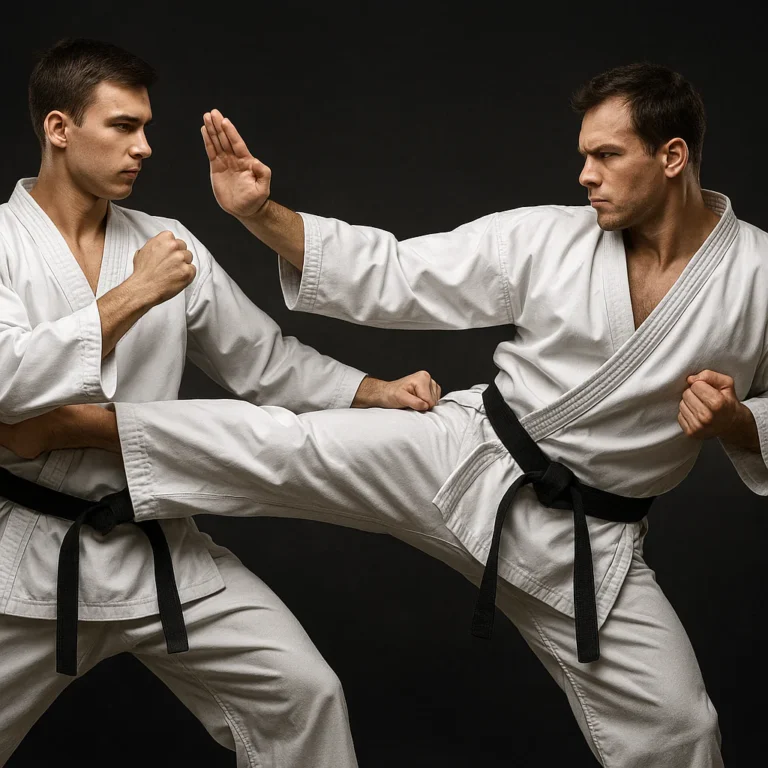
One training-room moment tells the story. A karate athlete may land a beautiful side kick repeatedly on a partner standing at range, then freeze when that partner catches the leg and drives toward the fence. Add an underhook, a frame, and a clean angle out, and the same kick becomes an MMA weapon instead of a risky flourish. 🥊
So which fighters reveal karate’s deeper potential, and which habits collapse under wrestling pressure? The answer appears in the details: stance adjustments, exit routes, kick recovery, counter timing, and the ability to turn a takedown threat into a striking opportunity.
Key Takeaways
- Karate is effective in MMA when it is integrated, not used as a standalone striking system.
- Georges St-Pierre, Bas Ruten, Kyoji Horiguchi, Giga Chikadze, Holly Holm, Valentina Shevchenko, and Robert Whittaker offer valuable lessons beyond Machida and Thompson.
- Distance management and explosive angles are karate’s biggest advantages.
- Wrestling, cage defense, clinch work, and ground survival are essential adaptations.
- Side kicks, front kicks, back kicks, stance switches, and straight counters work best when paired with feints and reliable exits.
- A bladed stance must change against takedown threats; staying too narrow or exposed can invite singles and body locks.
- Film study should track reactions, not just highlight-rel techniques.
- The best karate-based MMA fighters force dilemas: strike when opponents defend takedowns, wrestle when opponents brace for kicks, and angle away before pressure reaches the fence.
Table of Contents
-
📊 How Karate Influences Stance, Distance, Timing, and Takedown Defense
-
🥋 Karate’s Evolution from Traditional Dojo Training to MMA Competition
-
Shotokan, Kyokushin, Goju-Ryu, Shito-Ryu, and Kempo: Which Styles Matter?
-
From Lyoto Machida and Stephen “Wonderboy” Thompson to the Next Generation
-
🏆 15 Karate-Based MMA Fighters Worth Studying Beyond Machida and Thompson
-
1. Georges St-Pierre: Karate Footwork Blended with Elite Wrestling
-
2. Bas Ruten: Kyokushin Pressure, Clinch Striking, and Adaptation
-
4. Giga Chikadze: Karate Kicking and Modern MMA Range Control
-
6. Kyoji Horiguchi: Karate Angles, Speed, and Pocket Exchanges
-
7. Zabit Magomedsharipov: Unorthodox Kicks and Transitional Attacks
-
8. Michal Oleksiejczuk: Kyokushin Pressure in the MMA Pocket
-
9. Valentina Shevchenko: Karate Kicks Combined with Elite Grapling
-
11. Conor McGregor: Karate-Inspired Stance and Distance Traps
-
12. Anderson Silva: Point-Fighting Timing with Muay Thai Clinch Skill
-
13. Robert Whittaker: Karate Movement and Pressure Counterstriking
-
14. Wonderboy’s Successors: Modern Karate Combat and MMA Standouts
-
15. Lesser-Known Karate Specialists and Regional Prospects to Watch
-
📋 Fighter Comparison Table: Style, Best Weapons, and MMA Adaptations
-
Who Excels at Range, Pressure, Wrestling, and Counter Fighting?
-
🎯 The Karate MMA Game Plan: Offense, Defense, and Tactical Adjustments
-
Using Side Kicks and Front Kicks Without Giving Up Takedowns
-
The Best Cross-Training Schedule for a Karate-Based MMA Athlete
-
🥊 Karate Combat, UFC, ONE Championship, and the Modern Striking Landscape
-
Georges St-Pierre and Stephen “Wonderboy” Thompson’s Influence on Karate-Based MMA
-
Analytics, Motion Tracking, and Data-Driven Fight Preparation
-
Youth Development, Amateur Competition, and Talent Identification
-
The Five Skills Every Karate-Based MMA Fighter Should Prioritize
-
Who Is the Best Karate-Based MMA Fighter Beyond Machida and Thompson?
-
What Should I Study First When Analyzing a Karate MMA Fighter?
If you’re new to Karate MMA, here’s the short version: karate can be an excellent striking base for mixed martial arts, but it must be welded to wrestling, Brazilian jiu-jitsu, clinch work, and MMA-specific defense. A sharp side kick is wonderful. A sharp side kick while an opponent is shooting underneath it? That is where the paperwork begins.
| Question | Expert answer |
|---|---|
| Is karate effective in MMA? | Yes, especially for distance control, timing, kicking, angles, and counterstriking. |
| Is traditional karate alone enough? | No. MMA adds takedowns, fence wrestling, ground fighting, and strikes from unusual positions. |
| What makes karate distinctive? | Bladed stances, explosive entries, linear kicks, stance switches, deceptive rhythm, and rapid exits. |
| Which fighters should you study beyond Machida and Thompson? | Georges St-Pierre, Bas Ruten, Kyoji Horiguchi, Giga Chikadze, Holly Holm, Valentina Shevchenko, Robert Whittaker, Conor McGregor, and others. |
| What is the biggest weakness? | A stance or kicking habit that exposes the hips, legs, or back to wrestling attacks. |
| What separates elite karate-based MMA? | The fighter can attack at range, defend the shot, survive the clinch, and stand back up. |
Our advice from years of cross-training is simple:
- ✅ Keep the karate timing.
- ✅ Keep the angle changes.
- ✅ Keep the kicking variety.
- ❌ Do not assume a traditional stance automatically works against a cage.
- ❌ Do not throw kicks without an exit, frame, or underhook plan.
- ✅ Build every striking combination around a wrestling reaction.
A useful starting point is our Karate Techniques section, but remember that a clean dojo technique and a reliable MMA technique are cousins, not twins.
🥋 What “Karate-Based MMA Fighter” Really Means
The phrase karate-based MMA fighter describes an athlete whose striking identity was significantly shaped by karate, even if their complete competition style includes boxing, wrestling, kickboxing, judo, Muay Thai, or Brazilian jiu-jitsu.
That distinction matters. Fighters rarely remain “pure” representatives of one martial art once they reach elite MMA. Georges St-Pierre’s official UFC profile reflects an athlete known for championship-level wrestling, striking, and tactical adaptation, while his Kyokushin background helped shape his movement and distance decisions. Valentina Shevchenko’s approach similarly cannot be reduced to one label.
Karate base versus karate-only style
| Description | What it usually means | MMA value |
|---|---|---|
| Traditional karate practitioner | Primarily trained in a karate curriculum | Timing and technique, but potentially limited grapling exposure |
| Karate striker | Uses karate-derived attacks and movement in competition | Strong range control and counterstriking |
| Karate-based MMA fighter | Karate is a major influence within a complete MMA game | Most useful category for serious analysis |
| Karate specialist | Deliberately builds a recognizable karate tactical identity | High stylistic clarity, but possible matchup vulnerabilities |
| Hybrid striker | Blends karate with boxing, kickboxing, taekwondo, or Muay Thai | Often harder to read and game-plan against |
When we analyze a fighter, we look for repeatable behaviors, not simply a black belt certificate:
- How does the fighter enter?
- What distance do they prefer?
- What happens after a missed kick?
- How do they respond to pressure?
- Can they stop a takedown without abandoning their striking?
- What do they do when pinned to the fence?
- Can they create damage while moving laterally?
A fighter may hold a karate rank and still compete with a mostly boxing-based style. Another may have no formal karate title but use unmistakably karate-like angles, side kicks, and distance traps. The tape decides.
✅ The Biggest Strengths and ❌ Most Common Weaknesses
Karate’s strengths are highly visible when the rules reward open space and clean timing. Its weaknesses appear when the opponent collapses distance, attacks the legs, or forces prolonged grapling.
Karate’s main strengths
- Long-range control: Front kicks, side kicks, and back kicks make the approach expensive.
- Explosive entries: Karate often trains sudden movement from a relatively quiet stance.
- Angle creation: Fighters can attack from outside the opponent’s expected line.
- Rhythm disruption: Stop-start movement makes conventional boxing combinations harder to time.
- Counterstriking: A karate fighter often waits for the opponent to overeach.
- Kicking diversity: The lead leg can become a jab, frame, spear, or feint.
- Visual deception: Stance switches and small hip movements conceal the final attack.
Karate’s common weaknesses
- Open hips: A strongly bladed stance can make single-leg attacks easier if the lead leg is left unprotected.
- Limited pocket comfort: Some traditional approaches do not prepare athletes for sustained boxing exchanges.
- Retreating in straight lines: A fighter who only backs away eventually meets the cage.
- Overcommitted kicks: A missed kick can become a takedown invitation.
- Insufficient clinch training: Karate distance disappears when an opponent gets chest-to-chest.
- Rule-set confusion: Point-fighting habits, such as stopping after a clean touch, do not automatically translate to MMA.
- Hands too low: A relaxed karate guard can be useful, but only with excellent head movement, timing, and shot awareness.
The Association of Boxing Comissions and Combative Sports unified rules help explain why MMA tactics differ from point karate. Takedowns, ground strikes, cage positioning, and sustained grapling change the cost of every striking decision.
The practical solution
We do not tell karate athletes to abandon their stance. We teach them to modify it according to the opponent’s threat:
- Against a pure striker: stay longer and more bladed.
- Against a wrestler: narrow the stance slightly, protect the lead leg, and keep the hips ready.
- Against a pressure fighter: angle off before the fence, then counter.
- Against a clinch specialist: frame, underhook, pivot, and strike on separation.
That adaptability is theme running through the rest of this analysis.
📊 How Karate Influences Stance, Distance, Timing, and Takedown Defense
Karate’s MMA value is easiest to understand by separating four connected skills: stance, distance, timing, and defensive transition.
Stance
A karate stance often places the body at angle, reducing the target available to straight punches. The lead leg can remain light and ready to kick, while the rear leg provides explosive drive.
However, MMA requires the stance to answer two questions at once:
- Can I strike from here?
- Can I defend a level change from here?
A stance that answers only the first question is an expensive lesson.
Distance
Karate fighters often prefer a distance just outside ordinary boxing range. From there, they can:
- Touch with a lead-leg kick.
- Draw a punch.
- Step off-line.
- Fire a rear straight.
- Attack the body.
- Reset before the opponent establishes a clinch.
The UFC statistics database is useful for checking whether a fighter’s distance strategy produces actual significant-strike success rather than merely attractive movement.
Timing
Karate timing is not simply “being fast.” It is the ability to move when the opponent commits. We watch for:
- A rear heel lifting before a cross.
- The opponent’s head drifting over the lead knee.
- A predictable jab rhythm.
- A stance switch before a kick.
- A pressure step that leaves the opponent square.
- Hands dropping after a failed entry.
The first video’s perspective on Stephen “Wonderboy” Thompson emphasizes this exact quality: his effectiveness comes not merely from diverse kicks, but from how he uses angles and capitalizes on mistakes.
Takedown defense
A karate-based fighter should connect every long-range attack to a defensive reaction:
| Offensive action | Likely opponent response | Recommended karate-MA answer |
|---|---|---|
| Lead-leg side kick | Catch or single-leg attempt | Retract quickly, frame, circle, or crossface |
| Rear round kick | Body lock or back take | Pivot out, post, and recover stance |
| Blitzing punches | Level change underneath | Sprawl, underhook, or angle off |
| Long stance at range | Low kick | Check, withdraw, or counter with a straight |
| Retreat toward fence | Cage pressure | Lateral pivot, frame, or intercepting knee |
| Spinning technique | Back exposure | Finish with an exit step, not a statue pose |
The central lesson is technical continuity. Your kick, punch, and takedown defense should not be separate chapters. They should be one sentence with better punctuation.
Karate’s path into MMA is not a straight line. It runs through traditional dojo training, full-contact competition, kickboxing, early mixed-rules contests, and modern organizations such as Karate Combat.
Different karate systems developed different competitive habits. That is why calling every karate fighter “the same” is like calling every vehicle “a car” and then trying tow a mountain with a go-kart.
Shotokan, Kyokushin, Goju-Ryu, Shito-Ryu, and Kempo: Which Styles Matter?
No single style guarantees MMA success. The transfer depends on contact level, sparing culture, coaching quality, athleticism, and grapling integration.
| Karate style or system | Common training features | Potential MMA advantages | Adaptation required |
|---|---|---|---|
| Shotokan | Long stance, linear attacks, explosive reverse punch | Distance, entry timing, straight-line power | More clinch, low-kick defense, and wrestling |
| Kyokushin | Full-contact body striking, hard conditioning, kicking | Durability, body attacks, pressure, leg kicks | Head-punch defense and submission grapling |
| Goju-Ryu | Close-range striking, body conditioning, circular movement | Clinch range, toughness, short power | MMA wrestling and cage-specific work |
| Shito-Ryu | Broad technical curriculum and kata influence | Variety, coordination, kicking | Pressure-tested sparing and ground defense |
| Kempo | Fast combinations, movement, hand techniques | Rhythm changes, combination striking | Rules adaptation and defensive wrestling |
| Enshin or Sabaki-based systems | Off-balancing, angles, circular evasion | Lateral movement and counter angles | Cage awareness and takedown chains |
The World Karate Federation provides a useful reference for sport-karate competition, while Kyokushin-kan illustrates the full-contact tradition. Neither rule set is identical to MMA, and that difference is precisely why cross-training matters.
What transfers best?
The most transferable qualities are:
- Distance judgment
- Explosive footwork
- Body mechanics
- Kicking confidence
- Discipline under pressure
- Ability to attack from unusual rhythm
The least transferable habits are those created by a ruleset that stops action after a clean touch, discourages prolonged clinching, or excludes ground fighting.
Point Karate, Knockdown Karate, and Full-Contact Rules
Rules shape behavior. A point fighter may develop extraordinary entry speed but less experience sustaining an exchange. A knockdown karate athlete may be comfortable absorbing body shots but less prepared for repeated head punches. An MMA fighter must combine both qualities with grapling.
| Rule environment | Athlete often learns to prioritize | Possible gap in MMA |
|---|---|---|
| Point karate | First-touch speed, distance, explosive exits | Sustained combinations and damage management |
| Knockdown karate | Body attacks, toughness, pressure, low kicks | Head-punch defense and ground transitions |
| Karate kickboxing | Punch-kick combinations and ring movement | Cage wrestling and submission defense |
| Karate Combat | Fast exchanges, kicks, takedowns under promotion-specific rules | Transfer to full MMA ground complexity |
| MMA | Striking, takedowns, cage work, submissions, ground strikes | Requires broader preparation and energy management |
Karate Combat’s own description of its format presents it as a platform where different karate styles meet. In its announcement about Georges St-Pierre and Thompson becoming Sensei, the organization quoted St-Pierre saying that “all the karate styles [can] meet each other.” That is a valuable promotional perspective, but it should not be confused with a claim that Karate Combat and UFC MMA demand identical skills.
The conflict between sources is easy to resolve:
- Karate Combat sources are best for official roles, format, and promotional goals.
- UFC Stats is best for recorded fight metrics.
- Independent fight footage is best for tactical behavior.
- Facebook posts with inaccessible content should not be treated as evidence. The supplied Facebook page is login-gated and exposes no verifiable analysis.
How Karate Footwork Became a Modern MMA Weapon
Traditional karate movement often emphasizes sudden acceleration, controlled distance, and angle changes. MMA adds a fence, takedowns, leg kicks, and the possibility of being attacked during recovery.
The strongest modern adaptation follows this sequence:
- Start outside the opponent’s preferred range.
- Use a feint to provoke a response.
- Enter behind a straight punch or linear kick.
- Exit diagonally rather than straight backward.
- Rebuild stance with the hips ready to defend a shot.
- Repeat until the opponent begins reaching.
- Counter the reach with a committed strike or takedown.
This is why footwork should be evaluated by outcomes, not aesthetics. A fighter who glides beautifully but repeatedly gives up the fence is not controlling space. They are renting it.
Our Fight Analysis and Breakdowns category applies this lens to real bouts: identify the intended range, observe the opponent’s response, then ask whether the fighter maintained options after each exchange.
From Lyoto Machida and Stephen “Wonderboy” Thompson to the Next Generation
Machida and Thompson are essential reference points, but they can dominate the conversation so completely that other styles disappear.
Machida demonstrated how karate timing, stance discipline, and counterstriking could succeed at the highest UFC level. Thompson showed how a karate-informed fighter could create unusual range problems with side kicks, stance switches, blitzes, and spinning attacks.
The supplied first video’s analysis describes Thompson as a technician whose style transcends traditional karate by integrating effective MMA methods. That is the correct direction of analysis. We should not ask, “Does this look like a karate tournament?” We should ask, “Which karate-derived decisions survive when wrestling, cage pressure, and fatigue enter the room?”
That question leads us beyond familiar names to fighters who reveal different branches of the same tactical tree.
A good analysis does not begin with a highlight reel. It begins with a repeatable framework.
We recommend watching at least three fights:
- One against a striker.
- One against a pressure fighter.
- One against a wrestler or clinch-heavy opponent.
Then record what happens during the first 90 seconds, after the first hard exchange, and whenever the fighter is forced to the fence.
Stance, Bladed Hips, and Lead-Leg Positioning
A bladed stance narows the front-facing target and may make the lead leg an active weapon. But it also changes the defensive geometry.
What to inspect
- Is the lead foot pointed toward the opponent or turned outward?
- Does the lead heel remain light?
- Can the fighter sprawl without first squaring up?
- Does the rear hand protect the jaw during lead-leg attacks?
- Does the fighter switch stance before or after attacking?
- Is the torso leaning away, forward, or centered?
A useful visual model is:
Opponent
 ↓
[Lead foot] — [Rear foot]
 ↘ hips angled away
``

The more the hips turn away, the harder it may be to present a clean target. But the more exposed the lead leg becomes to catches, low kicks, and singles.

We like a **dynamic stance**, not a rigid one:

- Long and bladed at kicking range.
- Slightly narrower during wrestling exchanges.
- Squared enough to defend the fence.
- Mobile enough to reset after contact.

## [Distance Management, Angles, and Exit Routes](#distance-management-angles-and-exit-routes)

Distance management is the heart of karate-based MMA. The fighter is not merely trying to remain far away; they are trying to force the opponent to enter through a predictable corridor.

### The three-range test

| Range | Preferred karate tools | Main danger |
|---|---|---|
| Long range | Side kick, front kick, back kick, long straight | Kick catch or leg attack |
| Mid range | Blitz, rear straight, hook-cross, round kick | Pocket boxing and counters |
| Clinch range | Frames, knees, short elbows, underhooks | Body lock, fence control, takedown |

When studying footage, draw imaginary lines from the fighter’s feet to the cage. Ask:

- Does the fighter exit at 45 degrees?
- Do they circle toward the opponent’s power side?
- Do they cross their feet under pressure?
- Do they reset after every attack or remain in a vulnerable stance?
- Do they use the cage as a boundary or accidentally as a second opponent?

The best karate-based fighters create **multiple exit routes before they attack**. They know where the next step is going before the first punch lands.

## [Timing, Rhythm Changes, and Counterstriking](#timing-rhythm-changes-and-counterstriking)

Karate timing often looks mysterious until you chart the rhythm. A fighter may use:

- Stillness, then explosion.
- Small bounce, pause, then entry.
- Half-step feint, full-step attack.
- Repeated lead-leg lift without committing.
- Fast first attack followed by a delayed second attack.

This disrupts opponents who are trained to read ordinary boxing cadence.

### A simple timing chart

| Fighter behavior | Opponent reaction | Opportunity |
|---|---|---|
| Repeated lead-leg feint | Opponent reaches to pary | Rear straight or body kick |
| Suden retreat | Opponent rushes forward | Check hook, side kick, or intercepting knee |
| Stance switch | Opponent pauses | Angle entry or low kick |
| Long pause | Opponent initiates | Counter cross or lateral exit |
| Fast blitz | Opponent shells | Exit, re-enter, or level change |

The danger is becoming too reactive. A fighter who waits for a perfect mistake may surrender rounds to a disciplined pressure fighter. Elite karate-based MMA blends **initiative with counterstriking**.

## [Hand Fighting, Feints, and Deceptive Entries](#hand-fighting-feints-and-deceptive-entries)

Karate is sometimes stereotyped as kick-heavy, but modern MMA success requires the hands to create the openings.

Effective tools include:

- Lead-hand pawing.
- Wrist control.
- Shoulder feints.
- Level changes without commitment.
- Rear-hand threats.
- Hand traps before a side kick.
- Posting on the collarbone or shoulder.
- Touching the guard to hide the body attack.

A side kick thrown from a dead hand position is easier to read. A side kick after a jab feint, hand trap, or level change becomes a tactical problem.

Our [Karate Techniques](https://www.karatemma.org/category/karate-techniques/) resources emphasize this principle: **the setup is often more important than the technique’s name**.

## [Kicks, Side Kicks, Back Kicks, and Linear Attacks](#kicks-side-kicks-back-kicks-and-linear-attacks)

Karate’s linear attacks are especially useful in MMA because they interrupt forward pressure without requiring a wide swing.

### High-value karate-derived kicks

| Technique | Best target | Main benefit | Main risk |
|---|---|---|---|
| Front kick | Body, hip, thigh | Stops pressure and disturbs posture | Catch or counter straight |
| Side kick | Body, hip, thigh | Creates distance and damages the body | Single-leg if left extended |
| Back kick | Body, liver, midsection | High power from an unexpected line | Back exposure |
| Round kick | Leg, body, head | Familiar damage tool with varied rhythm | Catch, check, or takedown |
| Hook kick | Head or guard | Unusual angle and surprise | Low percentage if telegraphed |
| Oblique-style kick | Knee line or thigh | Disrupts stance and advance | Rule-set limitations and balance |
| Spinning hook kick | Head or guard | High-impact surprise | Missed rotation and back exposure |

We recommend building each kick into a three-part chain:

1. **Threaten** with the hands or a feint.
2. **Strike** with the kick.
3. **Exit or grapple** immediately.

For example:

- Jab feint → side kick → lateral exit.
- Lead-leg lift → rear straight → rear round kick.
- Cross → lead hook → back kick as the opponent chases.
- Front kick → frame → angle off → counter cross.

## [Clinch Work, Wall Wrestling, and Anti-Takedown Mechanics](#clinch-work-wall-wrestling-and-anti-takedown-mechanics)

The cage changes karate more than almost any other MMA feature. In open space, a fighter can retreat. Against the fence, the retreat disappears and the bladed stance becomes harder to maintain.

### Essential defensive layers

1. **Early recognition:** See the level change before the hands connect.
2. **Hips back:** Sprawl or widen the base.
3. **Underhook:** Secure inside control on at least one side.
4. **Head position:** Put the forehead under the opponent’s jaw or against the temple.
5. **Frame:** Create space with the forearm or shoulder.
6. **Wall walk:** Build a base, post, and stand rather than accepting bottom position.
7. **Exit strike:** Use a knee, short punch, or kick after separation.

The [UFC Performance Institute](https://www.ufcpi.com/) highlights integrated athletic preparation, but the technical principle is universal: strength and conditioning support defensive mechanics; they do not replace them.

## [Ground-and-Pound, Scrambles, and Submission Defense](#ground-and-pound-scrambles-and-submission-defense)

A karate-based fighter does not need to become a world-class submission grapler to succeed. They do need enough ground skill to:

- Avoid giving up the back.
- Frame against the hips.
- Recover guard.
- Stand safely.
- Recognize guillotines, rear-naked chokes, arm triangles, and leg entanglements.
- Strike without exposing the neck.
- Scramble immediately after a failed takedown.

We tell athletes to build a **minimum viable ground game** first:

- Defensive posture.
- Hip escapes.
- Technical stand-up.
- Underhook recovery.
- Wall stand-up.
- Takedown reversal.
- Submission awareness.
- Top-control striking.

Then add offensive submissions and advanced positional work. Karate’s speed is much more useful when the fighter can return to the feet instead of treating the canvas like an unexpected vacation.

# [🏆 15 Karate-Based MMA Fighters Worth Studying Beyond Machida and Thompson](#15-karate-based-ma-fighters-worth-studying-beyond-machida-and-thompson)

The following list is not a claim that every athlete used karate identically or competed as a single-style specialist. It identifies fighters whose karate background or karate-influenced movement offers meaningful lessons for MMA analysis.

## [1. Georges St-Pierre: Karate Footwork Blended with Elite Wrestling](#1-georges-st-pierre-karate-footwork-blended-with-elite-wrestling)

St-Pierre is arguably the clearest example of karate principles becoming more dangerous through wrestling.

His Kyokushin background contributed to:

- Long-range kicking.
- Explosive linear entries.
- A mobile stance.
- Distance traps.
- Suden changes in rhythm.

His wrestling made those tools safer. Opponents had to respect the takedown, which made them hesitate against his jab and kick. Then his jab made them raise their guard, which opened the level change. That is a tactical loop, not a collection of isolated techniques.

The [UFC Hall of Fame](https://www.ufc.com/ufc-hall-of-fame) provides official context for his championship legacy. The Karate Combat announcement about his Sensei role also records his view that martial arts teaching involves life lessons beyond the gym: “You teach guys about life, not only what's in the gym.”

**Study:** jab-to-double-leg, side kick to level change, and how he exited after failed takedowns.

## [2. Bas Ruten: Kyokushin Pressure, Clinch Striking, and Adaptation](#2-bas-ruten-kyokushin-pressure-clinch-striking-and-adaptation)

Bas Ruten demonstrates how a full-contact karate background can evolve into brutal clinch offense. His game was not built around dancing at long range. Instead, he used:

- Body attacks.
- Knes.
- Palm strikes and punches.
- Clinch control.
- Positional awareness.
- Opportunistic submissions.

His success is especially useful for correcting the idea that karate must look light, long, and evasive. Kyokushin-derived toughness can support pressure, but MMA pressure needs grapling structure.

**Study:** how striking changes after contact, how he attacks the body, and how he makes the clinch an offensive station rather than a defensive emergency.

## [3. Semy Schilt: Karate Distance at Heavyweight](#3-semy-schilt-karate-distance-at-heavyweight)

Semy Schilt’s size and karate background created a distinctive long-range problem. At heavyweight, even a modest step can cover enormous distance, and a front kick or straight punch can make the opponent pay for entering.

His lessons include:

- Using reach without standing stationary.
- Maintaining posture during long attacks.
- Targeting the body to slow explosive opponents.
- Making the opponent cross a dangerous space before clinching.

Large athletes often struggle to move efficiently. Schilt showed how karate structure can help a heavyweight remain organized.

**Study:** front-kick placement, long straight punches, and how he prevented shorter fighters from establishing inside position.

## [4. Giga Chikadze: Karate Kicking and Modern MMA Range Control](#4-giga-chikadze-karate-kicking-and-modern-ma-range-control)

Giga Chikadze is associated with a sophisticated kicking game shaped by karate and kickboxing. His attacks show how a karate-based striker can use:

- Body kicks from unusual angles.
- Long-range hand entries.
- Stance changes.
- Counter kicks.
- A high threat level at the edge of range.

His success also shows the limits of kicking-heavy systems when opponents pressure, wrestle, or force extended pocket exchanges.

**Study:** how he sets up the body kick, what happens when opponents crowd him, and whether the kick creates positional control or merely momentary impact.

## [5. Uriah Hall: Explosive Kicks and Counterstriking Threats](#5-uriah-hall-explosive-kicks-and-counterstriking-threats)

Uriah Hall’s karate background contributed to explosive, visually deceptive attacks. His highlight-rel finishes can tempt viewers to focus only on athleticism, but the deeper lesson is **threat layering**.

He could make opponents hesitate with:

- Fast lead-leg attacks.
- Suden counters.
- Spinning techniques.
- Head-body changes.
- Explosive bursts from outside range.

The challenge for a fighter with this profile is maintaining output when the opponent refuses to overcommit.

**Study:** what Hall does when the first explosive counter does not land, and how opponents reduce his space.

## [6. Kyoji Horiguchi: Karate Angles, Speed, and Pocket Exchanges](#6-kyoji-horiguchi-karate-angles-speed-and-pocket-exchanges)

Horiguchi illustrates a compact, high-speed interpretation of karate movement. Rather than relying exclusively on long kicks, he uses:

- Rapid entries.
- Angle changes.
- Short combinations.
- Stance mobility.
- Takedown threats.
- Pressure with controlled exits.

His style is a useful reminder that karate-based MMA can operate in the pocket if the fighter understands when to leave.

**Study:** entry angle, combination length, and whether he finishes exchanges square or already moving toward a new line.

## [7. Zabit Magomedsharipov: Unorthodox Kicks and Transitional Attacks](#7-zabit-magomedsharipov-unorthodox-kicks-and-transitional-attacks)

Zabit Magomedsharipov was not simply a karate fighter, but his movement and kicking variety provide valuable study material for anyone interested in unorthodox striking.

His game featured:

- Spinning attacks.
- Switch kicks.
- Long knees.
- Scrambles.
- Creative transitions.
- Attacks that connected striking to grapling.

The lesson is not “throw more spinning kicks.” It is **make unusual techniques part of a coherent positional system**.

**Study:** whether a spinning attack improves position, causes a reaction, or merely produces applause.

## [8. Michal Oleksiejczuk: Kyokushin Pressure in the MMA Pocket](#8-michal-oleksiejczuk-kyokushin-pressure-in-the-ma-pocket)

Michal Oleksiejczuk offers a more pressure-oriented look at Kyokushin influence. His fights help analysts study:

- Forward pressure.
- Body punching.
- Low-kick exchanges.
- Durability.
- Short-range combinations.
- The trade-off between aggression and defensive responsibility.

For karate athletes who feel uncomfortable entering the pocket, his footage offers a reminder that a karate base can support pressure if the fighter develops compact boxing and clinch defense.

**Study:** how pressure changes when the opponent has a strong counterpunch and how the fighter protects the head while attacking the body.

## [9. Valentina Shevchenko: Karate Kicks Combined with Elite Grapling](#9-valentina-shevchenko-karate-kicks-combined-with-elite-grapling)

Valentina Shevchenko’s striking identity blends multiple systems, including karate-influenced kicking, Muay Thai, boxing, and a highly developed grapling game.

Her value as a study subject lies integration:

- Kicks that lead to clinches.
- Clinches that lead to trips.
- Trips that lead to control.
- Striking threats that force predictable reactions.
- Balanced stance adjustments against takedowns.

The [UFC athlete profile](https://www.ufc.com/athlete/valentina-shevchenko) provides official career context, while fight footage reveals how her style changes according to opponent.

**Study:** how she remains dangerous after a kick is caught and how she turns defensive grapling into offensive position.

## [10. Holly Holm: Side Kicks, Angles, and Long-Range Boxing](#10-holly-holm-side-kicks-angles-and-long-range-boxing)

Holly Holm’s background in karate and boxing makes her particularly valuable for comparing long-range striking systems.

She uses:

- Side kicks.
- Front kicks.
- Long boxing combinations.
- Lateral movement.
- Angle exits.
- Counter left hands.
- Distance disruption against aggressive opponents.

Holm shows how boxing can give karate-derived movement a stronger pocket framework, while karate-style kicks can prevent a boxer from becoming predictable.

**Study:** how she connects a side kick to boxing, and how she manages opponents who refuse to chase.

## [11. Conor McGregor: Karate-Inspired Stance and Distance Traps](#11-conor-mcgregor-karate-inspired-stance-and-distance-traps)

Conor McGregor is not usually categorized as a traditional karate specialist, but his stance, movement, and kicking choices contain clear karate-influenced elements:

- Bladed positioning.
- Lead-leg control.
- Side kicks and front kicks.
- Long straight counters.
- Stance switching.
- Intercepting attacks.

His best performances demonstrate how a fighter can weaponize distance and anticipation. His more difficult performances reveal the risks of stance exposure, fatigue, pressure, and wrestling.

**Study:** the relationship between his lead hand, lead leg, and rear straight, then compare that structure against opponents who pressure rather than chase.

## [12. Anderson Silva: Point-Fighting Timing with Muay Thai Clinch Skill](#12-anderson-silva-point-fighting-timing-with-muay-thai-clinch-skill)

Anderson Silva’s movement drew from several martial arts, including karate-like timing, taekwondo-style kicks, boxing, and Muay Thai clinch work.

He teaches analysts to separate:

- Timing from stance.
- Evasion from showmanship.
- Range control from retreat.
- Creativity from randomness.

His ability to make opponents miss and punish the recovery phase remains a master class. His clinch offense also demonstrates why a karate-based athlete should not treat close range as forbidden territory.

**Study:** his head movement under pressure, front-kick setups, and clinch knees after opponents overcommit.

## [13. Robert Whittaker: Karate Movement and Pressure Counterstriking](#13-robert-whittaker-karate-movement-and-pressure-counterstriking)

Robert Whittaker’s karate background is often discussed alongside his boxing and MMA evolution. His style combines:

- In-and-out footwork.
- Stance switching.
- Fast straight punches.
- Lateral movement.
- Counterstriking.
- Rapid reset after combinations.

Whittaker is especially useful for studying how a karate-informed fighter can deal with elite pressure without becoming a pure retreating counterpuncher.

**Study:** how he changes direction after punching, how he uses the lead hand, and how he avoids being trapped along the fence.

## [14. Wonderboy’s Successors: Modern Karate Combat and MMA Standouts](#14-wonderboys-successors-modern-karate-combat-and-ma-standouts)

Karate Combat’s official announcement about GSP and Thompson expanded its Sensei concept beyond the earlier involvement of Lyoto Machida. The promotion described Thompson as a Kempo Karate practitioner and highlighted his role in giving viewers technical breakdowns and practical advice.

Thompson said, “I'm here to give fans the breakdown of what's going on and also give some hints and tips to the fighters as well.” That dual role matters: elite fighters often see details that standard statistics miss.

Karate Combat also quoted Thompson saying that earlier generations lacked a professional pathway for karate athletes, while “now Karate Combat is here.” That is a promotional statement, but it reflects a real structural change: modern athletes have more opportunities to pressure-test karate-specific skills in a professional setting.

**Study:** current Karate Combat athletes alongside UFC fighters. Compare:

- Pit movement versus cage movement.
- Permitted takedown duration.
- Clinch rules.
- Ground striking.
- How quickly fighters reset after contact.

## [15. Lesser-Known Karate Specialists and Regional Prospects to Watch](#15-lesser-known-karate-specialists-and-regional-prospects-to-watch)

The next important karate-based MMA fighter may not yet have a famous highlight reel. When scouting regional athletes, look for:

- A strong amateur record against varied opposition.
- Consistent lead-leg use.
- Takedown defense that remains functional under fatigue.
- Ability to fight backward without crossing the feet.
- Clinch competence.
- A second and third attack after the first kick is blocked.
- Good coaching and willingness to adapt.

Do not scout only for spectacular kicks. A prospect who lands fewer flashy techniques but consistently wins the **position after the exchange** may have the higher ceiling.

# [📋 Fighter Comparison Table: Style, Best Weapons, and MMA Adaptations](#fighter-comparison-table-style-best-weapons-and-ma-adaptations)

The table below summarizes the technical lessons rather than ranking the athletes. MMA success is opponent-dependent, and style labels are imperfect shorthand.

| Fighter | Karate influence | Signature strengths | Main adaptation lesson |
|---|---|---|---|
| Georges St-Pierre | Kyokushin | Jab, wrestling, kicks, control | Wrestling magnifies karate distance |
| Bas Ruten | Kyokushin | Clinch, body attacks, knees | Karate can support pressure |
| Semy Schilt | Karate background | Reach, front kicks, long punches | Large fighters can use linear control |
| Giga Chikadze | Karate and kickboxing influence | Kicking, distance, body attacks | Kicks need answers for pressure |
| Uriah Hall | Karate background | Explosiveness, counters | Athletic attacks need sustained output |
| Kyoji Horiguchi | Karate influence | Angles, speed, entries | Compact movement can work in the pocket |
| Zabit Magomedsharipov | Mixed striking with karate-like elements | Creativity, transitions | Unorthodox attacks need positional logic |
| Michal Oleksiejczuk | Kyokushin influence | Pressure, body work | Pocket striking requires head defense |
| Valentina Shevchenko | Karate and Muay Thai influence | Kicks, clinch, grapling | Striking becomes safer with takedowns |
| Holly Holm | Karate and boxing | Side kicks, angles, long boxing | Boxing and karate can reinforce each other |
| Conor McGregor | Karate-inspired movement | Counter left, range traps | Bladed stance must survive pressure |
| Anderson Silva | Mixed striking | Timing, evasion, clinch | Creativity works best with structure |
| Robert Whittaker | Karate and boxing influence | Footwork, counters, volume | Movement must create offense, not only escape |

## [Karate Base Versus Actual Competitive Skill Set](#karate-base-versus-actual-competitive-skill-set)

A fighter’s style should be described using at least five layers:

1. **Background:** What did they train first?
2. **Primary weapons:** What do they throw most effectively?
3. **Preferred range:** Where do they win exchanges?
4. **Defensive answer:** How do they react to counters and takedowns?
5. **Competitive identity:** How do they win rounds or finishes?

For example, “Kyokushin fighter” tells us something about conditioning and body striking, but not whether the athlete prefers pressure, countering, clinch work, or takedown-heavy control.

## [Who Excels at Range, Pressure, Wrestling, and Counter Fighting?](#who-excels-at-range-pressure-wrestling-and-counter-fighting)

| Tactical category | Strong examples | What to study |
|---|---|---|
| Long-range control | Thompson, Holm, Schilt | Kicks, exits, distance traps |
| Wrestling integration | St-Pierre, Shevchenko | How takedowns amplify striking |
| Pressure karate | Ruten, Oleksiejczuk | Body attacks and clinch entries |
| Counterstriking | Machida, McGregor, Whittaker | Reading commitment and punishing recovery |
| Creative transitions | Zabit, Silva | Moving from strikes to clinch or ground |
| Compact angles | Horiguchi | Pocket entries and lateral exits |

## [What Fight Footage Reveals That Statistics Miss](#what-fight-footage-reveals-that-statistics-miss)

Statistics may show significant-strike accuracy, takedown percentage, or control time. They do not always show:

- Who dictated the range.
- Who forced the opponent to reset.
- Whether a kick caused a defensive reaction.
- How often a fighter abandoned a preferred stance.
- Whether a takedown came from a striking threat.
- How much the cage changed the exchange.
- Whether a missed attack created a future opening.

Use [UFC Stats](http://ufcstats.com/) to establish the factual baseline, then watch the tape to understand the mechanism.

# [⚔️ Karate Versus Other Striking Styles in MMA](#karate-versus-other-striking-styles-in-ma)

Style comparisons are useful only when they identify specific behaviors. “Which martial art is best?” is usually a less productive question than “Which skills does this style make easier to develop, and which skills require extra work?”

## [Karate vs. Muay Thai](#karate-vs-muay-thai)

| Area | Karate tendency | Muay Thai tendency |
|---|---|---|
| Stance | Often bladed and mobile | More square and balanced for checks and clinch |
| Distance | Long and outside | Mid-range, kicking, and clinch |
| Kicks | Linear, fast, angle-based | Round kicks, body kicks, low kicks |
| Clinch | Variable depending on school | Usually central to the curriculum |
| Defense | Evasion and distance | Checks, blocks, frames, clinch control |
| MMA adaptation | Needs clinch and low-kick integration | Needs cage movement and takedown awareness |

Karate can frustrate Muay Thai fighters at long range. Muay Thai can punish a karate fighter who remains in the pocket or allows clinch control.

## [Karate vs. Boxing](#karate-vs-boxing)

Boxing generally offers superior hand combinations, pocket defense, and head movement. Karate often offers superior kicking variety, linear control, and unusual timing.

A karate-boxing hybrid can be extremely difficult to read:

- The kick keeps the boxer outside.
- The jab hides the kick.
- The angle prevents the boxing combination.
- The counter straight punishes the entry.

The weakness appears when the karate fighter’s stance is too narrow for sustained boxing or when the boxer attacks the lead leg.

## [Karate vs. Taekwondo](#karate-vs-taekwondo)

Both systems may produce dynamic kicking, but their tactical emphases differ by school and athlete.

- Karate often emphasizes linear attacks, stance changes, and explosive entries.
- Taekwondo often emphasizes speed, chambered kicks, and high kicking variety.
- MMA requires both athletes to defend catches, low attacks, and takedowns.

The best lesson is not to compare uniforms. Compare **recovery mechanics**: after the kick, can the fighter land balanced, defend a shot, and continue?

## [Karate vs. Kickboxing](#karate-vs-kickboxing)

Kickboxing typically provides more continuous striking exchanges, while karate may provide more disruptive rhythm and distance changes.

Karate athletes transitioning to kickboxing often need to improve:

- Low-kick defense.
- Pocket combinations.
- Guard recovery.
- Sustained output.
- Comfort exchanging after getting hit.

Kickboxers transitioning to MMA may need to improve:

- Cage exits.
- Takedown defense.
- Stance adaptation.
- Kicks that do not expose the hips.
- Striking from grapling threats.

## [Karate vs. Sanda and Dutch-Style Kickboxing](#karate-vs-sanda-and-dutch-style-kickboxing)

Sanda adds throws and aggressive entries, making it a useful bridge between striking and MMA. Dutch-style kickboxing offers combination pressure, low kicks, and structured pad work.

Karate’s advantage is often **unpredictability**. Sanda’s advantage is **transitional aggression**. Dutch kickboxing’s advantage is **combination volume**.

A complete MMA striker borows the best lesson from each:

- Karate: distance and timing.
- Sanda: entries and off-balancing.
- Dutch kickboxing: combinations and pressure.
- Muay Thai: clinch and knees.
- Boxing: hands and defense.
- Wrestling: positional control.

## [Why Cross-Training Decides the Highest-Level MMA Fights](#why-cross-training-decides-the-highest-level-ma-fights)

At elite level, opponents eventually solve isolated weapons. A side kick alone becomes readable. A blitz alone becomes sprawlable. A bladed stance alone becomes a wrestling target.

Cross-training creates dilemas:

- If the opponent reaches for the kick, punch.
- If they shell against the punch, kick.
- If they stand tall against the kick, wrestle.
- If they widen against the shot, strike.
- If they pressure the fence, pivot or clinch.

That is the real meaning of mixed martial arts: **not collecting techniques, but forcing incompatible defensive choices**.

# [🎯 The Karate MMA Game Plan: Offense, Defense, and Tactical Adjustments](#the-karate-ma-game-plan-offense-defense-and-tactical-adjustments)

A practical karate-MA game plan should answer three questions:

1. How do I make the opponent enter?
2. What do I do when they enter?
3. Where do I go after the exchange?

## [Building Attacks Behind Feints and Level Changes](#building-attacks-behind-feints-and-level-changes)

Use a layered sequence rather than a single attack:

### Step 1: Establish the lead leg

Touch the thigh or body with a light front kick. The aim is not always damage. It may be to make the opponent lift their guard or hesitate.

### Step 2: Add a hand threat

Use a jab, shoulder feint, or level change. The opponent now has more than one problem.

### Step 3: Attack the new reaction

- Hands rise: attack the body.
- Weight shifts back: side kick or front kick.
- Lead leg becomes heavy: low kick or angle entry.
- Hips drop: punch upstairs or frame out.

### Step 4: Exit intelligently

Do not admire the technique. Pivot, frame, clinch, or change level.

## [Using Side Kicks and Front Kicks Without Giving Up Takedowns](#using-side-kicks-and-front-kicks-without-giving-up-takedowns)

Long kicks are safest when:

- The supporting foot remains stable.
- The hands stay active.
- The hips retract quickly.
- The kick is aimed at a target that disrupts posture.
- The fighter knows whether to circle or sprawl afterward.

A useful drill:

1. Partner pressures forward.
2. Fighter uses a front kick.
3. Partner catches or paries.
4. Fighter immediately posts on the shoulder.
5. Fighter circles toward the underhook side.
6. Fighter returns with a straight punch or exits fully.

This drill teaches the kick to remain connected to grapling defense.

## [Creating Knockouts with Straight-Line Counters](#creating-knockouts-with-straight-line-counters)

Karate’s straight punches can become powerful MMA counters when the fighter manages the opponent’s line.

High-percentage examples:

- Opponent jabs → slip outside → rear straight.
- Opponent low kicks → check or withdraw → cross.
- Opponent rushes → side step → straight punch.
- Opponent reaches for lead leg → retract → rear straight.
- Opponent exits square → intercepting cross or body kick.

Power comes from timing, stance, and target selection. We prefer **clean contact over theatrical loading**. The opponent’s momentum supplies part of the impact.

## [Breaking Down Pressure Fighters and Cage Cuters](#breaking-down-pressure-fighters-and-cage-cuters)

Pressure fighters want to remove your exits. Do not simply run backward.

Use this sequence:

1. Circle early, before your back reaches the fence.
2. Touch the body to slow the feet.
3. Attack the lead leg when they step.
4. Use a side kick to interrupt the advance.
5. Frame if their shoulders cross your centerline.
6. Pivot after contact.
7. Counter as they turn.

The fighter should create a **triangle of movement**, not a straight retreat:

```text
 Counter angle
 ▲
 |
Opponent ◄── Fighter ─► Lateral exit
 |
 Fence danger
``

## [Handling Southpaws, Switch Hiters, and Open Stances](#handling-southpaws-switch-hitters-and-open-stances)

Stance matchups change the available lines.

### Against a southpaw

- Control the outside foot.
- Protect the lead leg.
- Attack the body with the rear kick.
- Watch the rear left hand.
- Use the lead side kick to interrupt entry.
- Avoid circling blindly into the power hand.

### Against a switch hitter

- Identify which stance produces the opponent’s best attack.
- Do not overeact to every switch.
- Attack during the transition if safe.
- Force them to switch while retreating.
- Keep your defensive habits consistent.

### In open stance

Both fighters may attack the lead leg, body, and outside angle. The athlete who wins the foot battle often wins the line for the straight punch.

## [Adapting When the Opponent Takes Away Space](#adapting-when-the-oponent-takes-away-space)

This is where many karate specialists discover whether their style is a system or merely a preferred environment.

If space disappears:

- Shorten the stance.
- Frame before punching.
- Use elbows or knees if rules permit.
- Clinch proactively.
- Underhook instead of reaching.
- Wall-walk if taken down.
- Attack the body to slow pressure.
- Pivot off the fence rather than accepting a stationary exchange.

The goal is not to remain at “perfect karate distance.” The goal is to **create a new workable distance**.

# [🤼 Karate and Grapling: The Missing Half of the MMA Equation](#karate-and-grapling-the-missing-half-of-the-ma-equation)

Karate gives an athlete excellent tools for deciding when contact begins. Grapling determines what happens after contact begins.

## [Why Traditional Karate Alone Is Not Enough for MMA](#why-traditional-karate-alone-is-not-enough-for-ma)

Traditional karate can develop timing, discipline, coordination, and technical precision. But unless training includes live grapling and sustained resistance, it may not prepare an athlete for:

- A chain wrestling attack.
- A body lock against the fence.
- Ground strikes.
- Submission threats.
- Scrambles under fatigue.
- Striking while controlling posture.
- The tactical cost of giving up bottom position.

This is not an insult to karate. It is a ruleset observation. A pianist can have superb finger control and still need to learn the drums before joining a metal band.

## [Essential Wrestling Skills for Karate Fighters](#essential-wrestling-skills-for-karate-fighters)

Prioritize these skills:

1. **Sprawl and crossface**
2. **Underhook recovery**
3. **Whizzer defense**
4. **Single-leg finishing defense**
5. **Body-lock separation**
6. **Cage pummeling**
7. **Front-headlock awareness**
8. **Wall stand-ups**
9. **Hip-heist and technical stand-up**
10. **Takedown entries behind strikes**

The most important transition is learning to strike without allowing the opponent’s hands to settle on the hips.

## [Brazilian Jiu-Jitsu, Wall Work, and Stand-Up Recovery](#brazilian-jiu-jitsu-wall-work-and-stand-up-recovery)

Brazilian jiu-jitsu helps karate fighters understand positional danger, but MMA grapling has additional priorities:

- Protect the head from strikes.
- Avoid giving the back during stand-ups.
- Use the fence as a technical aid.
- Finish scrambles on top or standing.
- Avoid accepting guard when a wall walk is available.
- Strike from top position without losing balance.

Our [MA Training](https://www.karatemma.org/category/ma-training/) resources emphasize a progression from technical repetition to live resistance. If the athlete can perform a wall walk in a calm drill but cannot do it while being punched with controlled contact, the skill is not competition-ready yet.

## [Clinch Striking, Underhooks, Frames, and Knes](#clinch-striking-underhooks-frames-and-knees)

Karate athletes often need to become comfortable with a middle distance between striking and wrestling.

Key skills include:

- Collar ties without pulling posture forward.
- Inside biceps control.
- Double underhooks.
- Overhook and whizzer defense.
- Shoulder frames.
- Short punches.
- Knes to the body.
- Turns against the fence.
- Breaks that end with angle, not a square stance.

The clinch should not be treated as failure. It is a **temporary range** where position, damage, and escape can all be won.

## [The Best Cross-Training Schedule for a Karate-Based MMA Athlete](#the-best-cross-training-schedule-for-a-karate-based-ma-athlete)

A balanced weekly structure might look like this:

| Day | Primary focus | Secondary work |
|---|---|---|
| Monday | Wrestling and cage defense | Mobility and neck strength |
| Tuesday | Karate striking and pad work | Aerobic conditioning |
| Wednesday | Brazilian jiu-jitsu and wall escapes | Technical shadowboxing |
| Thursday | Boxing and counterstriking | Low-impact recovery |
| Friday | MMA integration sparing | Core and grip work |
| Saturday | Live grapling or controlled striking | Film study |
| Sunday | Rest | Walking, mobility, recovery |

Training volume must match age, experience, injuries, and competition schedule. The [American College of Sports Medicine](https://www.acsm.org/) offers broad exercise guidance, but fight preparation should be individualized by qualified coaches and medical professionals.

# [🧠 Fight IQ and Performance Analysis](#fight-iq-and-performance-analysis)

A karate-based fighter often wins through information: reading the opponent, identifying habits, and acting before the opponent realizes the pattern has been exposed.

## [Reading Opponent Habits Before the First Exchange](#reading-oponent-habits-before-the-first-exchange)

During the opening minute, record:

- Does the opponent step heavily onto the lead leg?
- Do they jab before every combination?
- Do they reach for kicks?
- Do they react to feints?
- Do they circle toward or away from power?
- Do they shoot after missing?
- Do they raise the guard when the lead leg lifts?
- Do they panic when backed toward the fence?

The first clean attack may be less valuable than the information it produces.

## [Measuring Distance, Pace, Accuracy, and Damage](#measuring-distance-pace-accuracy-and-damage)

Use both objective and subjective measures.

| Metric | What it tells you | Limitation |
|---|---|---|
| Significant-strike accuracy | Efficiency of recorded strikes | Does not show threat or deterrence |
| Total strikes | Volume | Can reward low-impact activity |
| Takedown accuracy | Offensive grapling success | Does not show failed attempts that shaped striking |
| Control time | Positional dominance | Can hide lack of damage |
| Knockdowns | Major impact | Rare and context-dependent |
| Cage position | Space control | Requires video interpretation |
| Forced reactions | Tactical influence | Harder to quantify but highly valuable |

A side kick that lands lightly but prevents three entries may be tactically important even if it produces little visible damage.

## [Recognizing Effective Karate Versus Cosmetic Movement](#recognizing-effective-karate-versus-cosmetic-movement)

Ask three questions:

1. Does the movement create a better angle?
2. Does it make the opponent miss or hesitate?
3. Does it lead to damage, control, or a safer position?

If the answer is “none,” the movement may be decorative rather than functional.

This is where fan analysis often goes wrong. A fighter can bounce, spin, switch stances, and look wonderfully mysterious while losing the geography of the cage.

## [Film-Study Questions for Coaches, Fighters, and Fans](#film-study-questions-for-coaches-fighters-and-fans)

Use these prompts:

- What does the fighter do after landing the lead-leg kick?
- What happens after the opponent blocks the side kick?
- Does the fighter attack the body enough to slow pursuit?
- Can they counter without retreating?
- Are they comfortable in open stance?
- Do they defend the first takedown or the entire chain?
- How often do they give up the fence?
- Do they recover their hands after kicking?
- Can they create offense while tired?
- Does their style still work when hurt?

## [A Round-by-Round Fight Analysis Template](#a-round-by-round-fight-analysis-template)

| Round | Range won by | Best weapon | Defensive issue | Key adjustment |
|---|---|---|---|---|
| 1 | | | | |
| 2 | | | | |
| 3 | | | | |
| 4 | | | | |
| 5 | | | | |

For each round, write one sentence answering:

> **Who forced the other fighter to fight in an uncomfortable range, and how?**

That sentence usually reveals more than a pile of disconnected highlights.

# [🏋️ Training a Karate-Based MMA Fighter](#training-a-karate-based-ma-fighter)

Training should preserve karate’s distinctive strengths while repairing the gaps created by non-MA rules.

## [Footwork Drills for Angles, Entries, and Exits](#footwork-drills-for-angles-entries-and-exits)

### Drill 1: Four-corner exit

1. Mark a square on the floor.
2. Start in karate stance at one corner.
3. Partner gives a visual pressure cue.
4. Enter with a straight punch or side kick.
5. Exit diagonally to the next corner.
6. Reset with hands active and hips ready.

### Drill 2: Fence alarm

1. Place a line two steps from the wall.
2. Move laterally while shadowboxing.
3. On the alarm, pivot before touching the wall.
4. Add a frame and counter.
5. Repeat from both stances.

### Drill 3: Stance-switch reaction

1. Partner calls “left,” “right,” or “switch.”
2. Change stance without crossing the feet.
3. Immediately defend a simulated shot.
4. Return with a straight punch or front kick.

Footwork must be trained under fatigue. Otherwise, it is choreography, not a fight skill.

## [Pad Work for Karate Combinations and Counterstrikes](#pad-work-for-karate-combinations-and-counterstrikes)

Good pad work includes reactions, not only memorized combinations.

Examples:

- Lead-leg side kick → rear straight → angle exit.
- Jab feint → body kick → sprawl.
- Front kick → cross → lead hook → pivot.
- Opponent jab cue → slip → rear straight → low kick.
- Blitz → frame → knee → underhook turn.
- Spinning back kick → immediate stance recovery.

The pad holder should sometimes block, catch, pressure, or counter. Otherwise, the striker learns to perform attacks in a cooperative universe where nobody has received the memo about violence.

## [Heavy-Bag Drills for Linear Kicks and Combination Finishing](#heavy-bag-drills-for-linear-kicks-and-combination-finishing)

Use the bag to develop:

- Hip retraction.
- Balance after impact.
- Body targeting.
- Combination endings.
- Stance recovery.
- Power without overextension.

A simple five-round structure:

| Round | Focus |
|---|---|
| 1 | Light front kicks and side kicks |
| 2 | Punch-to-kick combinations |
| 3 | Kick-to-punch counters |
| 4 | Sprawl or frame reaction after every kick |
| 5 | Open freestyle with strict exits |

Do not measure success only by bag movement. A bag that swings dramatically may simply be receiving wide, pushing shots rather than clean strikes.

## [Sparing Progressions That Preserve Timing and Safety](#sparing-progressions-that-preserve-timing-and-safety)

A safe progression:

1. Shadowboxing with movement constraints.
2. Technical partner drills.
3. Light sparing with limited weapons.
4. Situational sparing from the fence.
5. Controlled MMA rounds.
6. Hard rounds only under qualified supervision.

The [Association of Ringside Physicians](https://ringsidearp.org/) provides medical guidance relevant to combat-sports safety. Protective equipment, medical clearance, honest communication, and appropriate supervision are not optional accessories.

## [Strength, Conditioning, Mobility, and Explosive Power](#strength-conditioning-mobility-and-explosive-power)

Karate-based MMA athletes benefit from:

- Single-leg strength.
- Posterior-chain power.
- Rotational core control.
- Neck and upper-back strength.
- Hip mobility.
- Ankle stiffness and stability.
- Aerobic base.
- Repeated sprint ability.
- Grip endurance for clinches and scrambles.

A strong fighter who cannot repeat explosive entries becomes a one-round puzzle. Conditioning turns the technique into a five-round argument.

## [Protective Equipment and Training-Safety Essentials](#protective-equipment-and-training-safety-essentials)

Useful equipment includes:

- **[Hayabusa T3 MMA gloves](https://www.amazon.com/s?k=Hayabusa+T3+MA+gloves&tag=bestbrands0a9-20&tag=bestbrands0a9-20)** for controlled striking and bag work.
- **[Fairtex shin guards](https://www.amazon.com/s?k=Fairtex+shin+guards&tag=bestbrands0a9-20&tag=bestbrands0a9-20)** for kick training.
- **[RDX headgear](https://www.amazon.com/s?k=RDX+boxing+headgear&tag=bestbrands0a9-20)** for appropriate technical sparing.
- **[Venum mouthguards](https://www.amazon.com/s?k=Venum+mouthguard&tag=bestbrands0a9-20&tag=bestbrands0a9-20)** for impact protection.
- **[Fairtex belly pads](https://www.amazon.com/s?k=Fairtex+bely+pad&tag=bestbrands0a9-20)** for body-kick drills.
- **[Revgear wall pads and coaching equipment](https://www.revgear.com/)** for gym setup.

### Equipment selection principles

- ✅ Use gloves appropriate to the drill.
- ✅ Replace damaged padding.
- ✅ Keep mouthguards fitted correctly.
- ✅ Use shin guards during technical kicking.
- ❌ Do not use headgear as permission to spar recklessly.
- ❌ Do not train hard through concussion symptoms.
- ✅ Follow medical advice after head impacts.

👉 **CHECK PRICE on:**

- **Hayabusa T3 MMA Gloves:** [Amazon](https://www.amazon.com/s?k=Hayabusa+T3+MA+gloves&tag=bestbrands0a9-20&tag=bestbrands0a9-20) | [Hayabusa Official](https://www.hayabusafight.com/)
- **Fairtex Shin Guards:** [Amazon](https://www.amazon.com/s?k=Fairtex+shin+guards&tag=bestbrands0a9-20&tag=bestbrands0a9-20) | [Fairtex Official](https://www.fairtex.com/)
- **Venum Mouthguards:** [Amazon](https://www.amazon.com/s?k=Venum+mouthguard&tag=bestbrands0a9-20&tag=bestbrands0a9-20) | [Venum Official](https://www.venum.com/)
- **Revgear Training Equipment:** [Revgear Official](https://www.revgear.com/)

# [🚫 Common Mistakes Karate Fighters Make in MMA](#common-mistakes-karate-fighters-make-in-ma)

## [Standing Too Bladed Against Wrestling Attacks](#standing-too-bladed-against-wrestling-attacks)

A bladed stance is not automatically bad. The mistake is failing to adjust it when the opponent demonstrates a real takedown threat.

Fixes:

- Keep the lead leg retractable.
- Use hands to frame the head and shoulders.
- Practice stance narrowing under pressure.
- Drill sprawls from striking range.
- Attack the opponent’s posture before they reach the hips.

## [Throwing Naked Kicks and Leaving the Hips Exposed](#throwing-naked-kicks-and-leaving-the-hips-exposed)

A naked kick is one thrown without a setup, disguise, or recovery plan.

Better options:

- Jab before the kick.
- Feint the kick, then punch.
- Kick after the opponent’s weight shifts.
- Aim at the hip or body to disrupt posture.
- Retract immediately if the opponent catches.

## [Overusing Retreating Footwork](#overusing-retreating-footwork)

Retreating can win a moment and lose a round. If every exchange ends backward, the opponent learns that pressure works.

Add:

- Lateral pivots.
- Check hooks.
- Body attacks.
- Intercepting kicks.
- Clinch turns.
- Short counters after the exit.

## [Confusing Speed with Effective Fight Control](#confusing-speed-with-effective-fight-control)

Fast movement matters only if it changes the opponent’s behavior. We look for:

- Missed attacks.
- Forced resets.
- Lost balance.
- Guard reactions.
- Cage displacement.
- Damage or positional improvement.

If the opponent remains comfortable, the movement may be athletic but tactically empty.

## [Neglecting the Clinch and Ground Game](#neglecting-the-clinch-and-ground-game)

This is the most expensive mistake. A fighter can have championship-level kicks and still lose because they cannot stand up from the fence.

Minimum standard:

- Defend the first shot.
- Fight for underhooks.
- Protect the neck.
- Stand safely.
- Return to striking range with posture.

## [Copying Famous Fighters Without Understanding Their Systems](#copying-famous-fighters-without-understanding-their-systems)

Do not copy Thompson’s side kick without his distance judgment. Do not copy GSP’s stance without his wrestling. Do not copy Machida’s countering without his patience and cage awareness.

Borrow principles:

- **Create hesitation.**
- **Attack the recovery.**
- **Leave on angle.**
- **Connect striking to wrestling.**
- **Make the opponent solve more than one problem.**

# [🥊 Karate Combat, UFC, ONE Championship, and the Modern Striking Landscape](#karate-combat-ufc-one-championship-and-the-modern-striking-landscape)

Different promotions reward different habits. Comparing them without accounting for rules produces sloppy conclusions.

## [How Karate Combat’s Rules Shape Stance and Tactics](#how-karate-combats-rules-shape-stance-and-tactics)

Karate Combat’s Pit, fast pace, and striking-centered presentation encourage:

- Aggressive movement.
- Quick entries.
- Kicks and counters.
- Angled exits.
- Rapid engagement after knockdowns or exchanges.

Its professional platform gives karate athletes a visible competitive pathway, a point emphasized in the organization’s Sensei announcement. However, MMA analysts should avoid transferring every Karate Combat success directly to UFC or ONE Championship predictions.

## [Why UFC and ONE Championship Demand Broader Skill Sets](#why-ufc-and-one-championship-demand-broader-skill-sets)

UFC MMA and ONE Championship’s MMA bouts demand competence across:

- Striking.
- Takedowns.
- Cage wrestling.
- Ground control.
- Submission defense.
- Ground striking.
- Round management.

ONE’s broader combat-sports ecosystem also includes different rules for kickboxing and Muay Thai, so viewers should verify which discipline they are watching through [ONE Championship](https://www.onefc.com/).

## [Georges St-Pierre and Stephen “Wonderboy” Thompson’s Influence on Karate-Based MMA](#georges-st-pierre-and-stephen-wonderboy-thompsons-influence-on-karate-based-ma)

The Karate Combat announcement positioned St-Pierre and Thompson as Sensei figures whose roles extended beyond appearances. St-Pierre brought championship-level MMA strategy and Kyokushin experience. Thompson brought Kempo Karate, elite kickboxing experience, and a technician’s eye for distance and angles.

The organization described Thompson’s job as breaking down fights and offering “hints and tips” to athletes. That matters because karate’s value is often easier to understand when an elite practitioner explains **why the opponent was forced to react**, not merely which kick landed.

Their influence is best used as a starting point, not a finishing point. The next generation must answer harder questions:

- Can the stance survive sustained wrestling?
- Can the fighter attack while trapped?
- Can the kick return quickly enough against elite catchers?
- Can the athlete maintain timing in the championship rounds?

## [Comparing Karate Combat, Kickboxing, and MMA Rule Sets](#comparing-karate-combat-kickboxing-and-ma-rule-sets)

| Feature | Karate Combat | Kickboxing | MMA |
|---|---|---|---|
| Primary emphasis | Karate striking competition | Continuous stand-up striking | Complete mixed combat |
| Takedowns | Promotion-specific | Usually limited or prohibited | Central strategic option |
| Ground fighting | Limited or absent compared with MMA | Absent | Major component |
| Cage or arena | The Pit | Ring or promotion-specific | Cage commonly used |
| Clinch | Rule-dependent | Often restricted | Extensive |
| Best transferable skill | Distance and striking timing | Combinations and conditioning | Integrated decision-making |

Always consult the promotion’s current rules. Rules can change, and a fighter’s style may look different under each environment.

## [What the Next Generation Can Learn from Elite Karate Icons](#what-the-next-generation-can-learn-from-elite-karate-icons)

The shared lesson from GSP, Thompson, Ruten, Holm, Whittaker, and others is not a uniform stance. It is **adaptable distance control**.

The next generation should:

- Train karate technique with live resistance.
- Add wrestling before bad habits harden.
- Treat the fence as a skill environment.
- Build kick recovery into every repetition.
- Study opponents rather than memorizing combinations.
- Develop a reliable pocket game.
- Use karate’s unpredictability without becoming reckless.

# [📈 The Future of Karate in Professional MMA](#the-future-of-karate-in-professional-ma)

Karate’s future in MMA will probably look less like a single recognizable style and more like a set of transferable principles distributed across hybrid athletes.

## [Analytics, Motion Tracking, and Data-Driven Fight Preparation](#analytics-motion-tracking-and-data-driven-fight-preparation)

Technology can help measure:

- Strike location.
- Distance at impact.
- Entry success.
- Exit direction.
- Time spent near the fence.
- Takedown attempts after kicks.
- Stance-switch frequency.
- Pace decline by round.

These metrics become valuable when coaches connect them to footage. A number cannot explain why a kick failed. Video can show that the supporting foot slipped, the hand dropped, or the opponent timed the hip.

## [Hybrid Stance Systems and Positionless Striking](#hybrid-stance-systems-and-positionless-striking)

Modern fighters increasingly switch between:

- Bladed karate stance.
- Squared wrestling stance.
- Boxing stance.
- Southpaw stance.
- Clinch posture.

This is not “positionless” in the literal sense. It is **multi-position competence**. The athlete changes stance according to the threat while preserving balance and awareness.

## [Youth Development, Amateur Competition, and Talent Identification](#youth-development-amateur-competition-and-talent-identification)

Young athletes should not be rushed into hard head-contact training. Strong foundations include:

- Technical karate.
- Safe movement games.
- Wrestling fundamentals.
- Controlled grapling.
- Athletic development.
- Respectful coaching.
- Gradual competitive exposure.

Look for prospects with curiosity and adaptability, not only knockout power. A coachable athlete who learns to wrestle may outgrow a naturally explosive striker who refuses to change.

## [Will Karate Become More Visible in Championship-Level MMA?](#will-karate-become-more-visible-in-championship-level-ma)

Yes, but perhaps not under a single label. Karate-derived skills will continue appearing in:

- Kicking entries.
- Side-kick systems.
- Stance switches.
- Intercepting attacks.
- Angle-based defense.
- Counterstriking.
- Hybrid wrestling-striking games.

As more athletes cross-train from childhood, the public may notice less “pure karate” and more **MA fighters whose movement is quietly karate-informed**.

# [✅ Practical Takeaways for Fighters, Coaches, and Fans](#practical-takeaways-for-fighters-coaches-and-fans)

## [The Five Skills Every Karate-Based MMA Fighter Should Prioritize](#the-five-skills-every-karate-based-ma-fighter-should-prioritize)

1. **Distance management**
2. **Kick recovery**
3. **Takedown defense**
4. **Fence escapes**
5. **Counterstriking after forced reactions**

If those five skills are reliable, the athlete can build a much larger game safely.

## [A Beginner-to-Advanced Development Roadmap](#a-beginer-to-advanced-development-roadmap)

| Stage | Main objective | Training priority |
|---|---|---|
| Beginner | Balance and technical accuracy | Karate basics, safe stance, movement |
| Developing | Live timing | Controlled sparing, pad reactions, wrestling basics |
| Intermediate | Integration | MMA rounds, cage defense, clinch work |
| Advanced | Tactical specialization | Opponent-specific game plans, five-round conditioning |
| Professional | Repeatable performance | Camp planning, recovery, analytics, elite coaching |

## [How Fans Can Watch Fights Like a Technical Analyst](#how-fans-can-watch-fights-like-a-technical-analyst)

Instead of asking only “Who landed harder?”, ask:

- Who controlled the range?
- Who forced the first meaningful reaction?
- Who owned the exits?
- Who made the opponent hesitate?
- Who recovered fastest after missing?
- Who won the fence exchanges?
- Did the karate movement create damage or merely distance?

That shift turns a highlight reel into a tactical case study.

## [The Best Karate MMA Lessons to Steal Without Copying Anyone](#the-best-karate-ma-lessons-to-steal-without-copying-anyone)

Steal principles, not costumes:

- From GSP: connect striking to wrestling.
- From Thompson: make range unpredictable.
- From Ruten: become dangerous in the clinch.
- From Holm: blend kicks with boxing.
- From Whittaker: move with purpose.
- From Shevchenko: make every range connected.
- From Horiguchi: enter fast and leave clean.
- From Silva: use timing without losing structure.
- From Chikadze: make the body a strategic target.

The mystery is now less mysterious: **karate succeeds in MMA when its timing and distance tools remain connected to wrestling, clinch control, and ground survival**. The belt, stance, or highlight is only the beginning.