Support our educational content for free when you purchase through links on our site. Learn more
Is Judo the Toughest Sport? 🥋 The Ultimate Test of Grit (2025)


Ever wondered which sport truly pushes human toughness to its limits? If you think boxing or marathon running takes the crown, think again. Judo, often called “the gentle way,” is anything but gentle when it comes to testing your body, mind, and spirit. From explosive throws that launch opponents through the air to the mental chess match fought in every grip and counter, judo demands a unique blend of power, endurance, and strategy.
In this deep dive, we’ll unpack why judo stands out as one of the toughest sports on Earth. We’ll explore its rich history, dissect the physical and mental challenges it poses, compare it to other combat sports, and reveal how its lessons extend far beyond the mat. Plus, we’ll share insider insights from our Karate MMA™ experts and real stories from judokas who’ve faced the ultimate tests of toughness. Ready to find out if judo deserves the title of the toughest sport? Let’s grapple with the facts!
Key Takeaways
- Judo combines explosive power, endurance, and strategic thinking, creating a uniquely demanding sport.
- Its physical intensity includes high-impact throws, grip fighting, and anaerobic bursts that test every muscle.
- Mental toughness in judo is forged through constant pressure, resilience, and the need for split-second decisions.
- Compared to other combat sports, judo’s blend of stand-up throws and groundwork offers a distinct challenge.
- Beyond competition, judo builds character, humility, and life skills that extend well beyond the dojo.
Table of Contents
- ⚡️ Quick Tips and Facts: Your Judo Snapshot!
- 🥋 The Roots of Resilience: A Brief History of Judo
- 🤔 What Does ‘Tough’ Even Mean? Our Criteria for the Ultimate Challenge
- 💪 The Physical Gauntlet: Why Judo Pushes Your Body to the Limit
- 🧠 The Mental Crucible: Forging Grit and Strategic Acumen
- 🥊 Judo vs. The World: How It Stacks Up Against Other Combat Sports
- 🌟 Judo’s Unique Edge: Why It Demands a Special Kind of Toughness
- 🌱 Beyond the Mat: Life-Altering Lessons from Judo Training
- 🤔 Is Judo for YOU? Assessing Accessibility and the Commitment Required
- 🏆 Our Verdict: Is Judo Truly The Toughest Sport?
- Conclusion
- Recommended Links
- FAQ
- Reference Links
⚡️ Quick Tips and Facts: Your Judo Snapshot!
Welcome, martial arts fanatics, to the Karate MMA™ dojo! Today, we’re tackling a question that sparks fiery debates in gyms worldwide: Is judo the toughest sport on the planet? Before we dive deep, here’s a rapid-fire rundown of what makes judo a beast of a discipline. And if you’re curious about how it stacks up against similar arts, check out our breakdown of What’s the REAL Difference Between Judo and Aikido? 10 Key Insights You Need to Know 2024 🥋.
- Full-Body Beatdown: Judo isn’t just about arm strength; it’s a symphony of power engaging nearly every muscle you have, from your gripping fingers to your pushing toes.
- Mental Chess at 100 MPH: Forget just brawn. Judo is a high-stakes “physical chess match” where you need to outthink and outmaneuver your opponent in fractions of a second.
- The “Gentle Way” is Deceptively Brutal: The name “Judo” (柔道) translates to “the gentle way,” but don’t let that fool you. It’s about using an opponent’s force against them, which requires incredible skill, timing, and, yes, toughness.
- Grip Strength of a Gorilla: Seriously. Judokas are renowned for having some of the most formidable grip strength in the athletic world, a skill that’s absolutely essential for controlling your rival.
- It’s an Olympic Grind: Judo has been a staple of the Summer Olympics since 1964 for men and 1992 for women, showcasing its global recognition as a top-tier, demanding sport.
- Fall Down Seven Times, Get Up Eight: The Japanese proverb perfectly captures the judo spirit. You spend a lot of time learning how to fall safely (Ukemi) before you master throwing. This builds incredible resilience.
- MMA’s Secret Weapon: Many MMA legends, like Ronda Rousey and Khabib Nurmagomedov, have strong judo backgrounds, proving its effectiveness in the ultimate combat arena.
So, is it the absolute toughest? Stick with us as we throw this question to the mat and grapple with the evidence!
🥋 The Roots of Resilience: A Brief History of Judo

To understand judo’s toughness, you have to look at its roots. This isn’t some ancient, mystical art lost to time. Judo is a relatively modern martial art, born in Japan in 1882. Its founder, a brilliant educator named Jigoro Kano, wasn’t just trying to create another fighting system. He wanted to create a do (道), a “way” or a path to self-improvement.
Kano was a student of various schools of jujutsu, the old-school battlefield grappling arts of the samurai. While he respected their effectiveness, he saw them as often dangerously rough and focused solely on combat. He envisioned something more: a system that could be practiced safely as a sport (Randori or free practice) while still retaining its combat effectiveness and, most importantly, building character.
He stripped away the most dangerous techniques of jujutsu (like certain joint locks and all striking in sparring) and refined the rest. He then organized them into a systematic method founded on two core principles:
- Seiryoku-Zenyo (精力善用): Maximum efficient use of energy. In other words, don’t just use brute force. Use leverage, timing, and momentum to overcome a bigger, stronger opponent. This is the “science” of judo.
- Jita-Kyoei (自他共栄): Mutual welfare and benefit. This is the soul of judo. The idea is that through practice, you and your partners help each other improve, fostering a community of respect and shared growth.
This philosophy is the bedrock of judo’s unique brand of toughness. It’s not just about being able to physically dominate someone; it’s about having the resilience to train day in and day out, the intelligence to apply principles of physics under pressure, and the humility to respect your training partners. For more on the evolution of martial arts, explore our Martial Arts History section.
🤔 What Does ‘Tough’ Even Mean? Our Criteria for the Ultimate Challenge
Before we crown a champion, we need to set the rules. “Tough” is a slippery word. Is a marathon runner tougher than a powerlifter? Is a chess grandmaster tougher than a boxer? As the folks at JudoShop.com point out, the answer is subjective and depends on your criteria. So, here at Karate MMA™, we’ve broken down “toughness” into three core categories.
Defining Physical Toughness in Combat Sports
This is the most obvious one. It’s the raw, gritty, physical output required. We’re talking about:
- Strength & Power: The explosive force needed to execute a technique.
- Cardiovascular Endurance: The gas tank to keep going round after round.
- Muscular Stamina: The ability of your muscles to perform repeatedly without gassing out.
- Durability & Chin: The capacity to absorb impact and keep fighting.
- Flexibility & Mobility: The range of motion to prevent injury and perform complex movements.
The Mental Game: Beyond Brute Strength
This is where many sports are separated. Mental toughness is the ability to perform under immense pressure and adversity. It includes:
- Strategic Thinking: Analyzing, adapting, and executing a game plan.
- Resilience & Grit: Bouncing back from setbacks, both in a match and in training.
- Discipline & Focus: The dedication to master a craft over years.
- Courage: Facing down fear, pain, and the possibility of defeat.
Skill, Strategy, and Technical Mastery
This is the “art” in martial arts. It’s the sheer difficulty and complexity of the techniques themselves.
- Technical Ceiling: How long does it take to become proficient? How high is the mountain of knowledge?
- Coordination & Timing: The fine motor skills and timing required to make techniques work against a resisting opponent.
- Adaptability: The need to apply techniques in a dynamic, unpredictable environment.
Now that we have our scorecard, let’s see how judo measures up.
💪 The Physical Gauntlet: Why Judo Pushes Your Body to the Limit
Let’s get one thing straight: judo is a brutal physical test. It’s a full-body workout that combines the explosive power of sprinting, the grinding strength of wrestling, and the endurance of a middle-distance run, all rolled into one.
Explosive Power & Dynamic Strength: Throwing Your Opponent
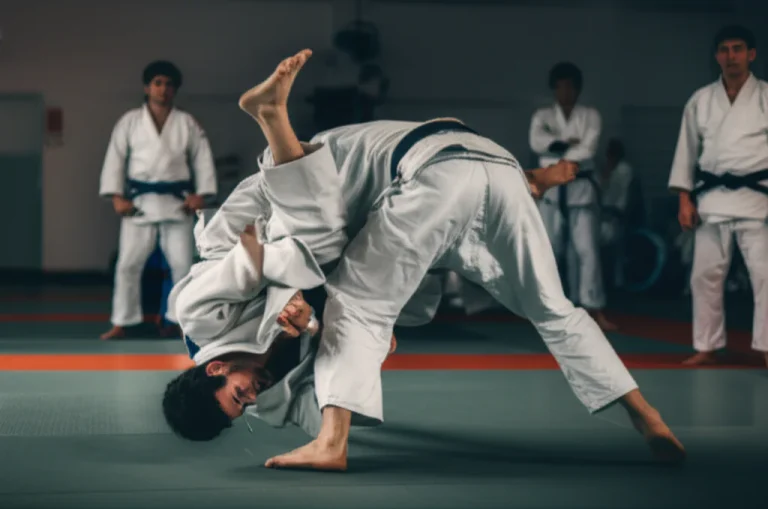
The heart of judo is Nage-waza (throwing techniques). Launching a fully resisting human being through the air requires an incredible amount of explosive, full-body power. It’s not just arm strength; it’s a coordinated blast from your legs, hips, and core, channeled through your grips. Think of it like an Olympic lift, but your barbell is actively trying to throw you. This develops a type of functional, dynamic strength that’s hard to replicate.
Endurance & Stamina: The Marathon of a Match
A competitive judo match (Shiai) might only be a few minutes long, but it’s an all-out anaerobic sprint. You’re constantly pushing, pulling, and jockeying for position. There are no rest periods, no coasting. Your heart rate will be red-lining from the first “Hajime!” (Begin!) to the final “Sore made!” (That’s all!). This requires elite cardiovascular fitness and muscular endurance, especially in the grips, which are under constant tension.
Flexibility & Agility: The Art of the Breakfall
Here’s a fun fact: a huge part of judo is learning how to get thrown. Ukemi, or break-falling, is the first and most important skill you learn. It requires agility, body awareness, and the flexibility to absorb the impact of hitting the mat from height without getting injured. This constant practice of falling and getting back up builds a unique physical resilience that athletes in many other sports never develop.
Injury Risk & Resilience: Bouncing Back from the Mat
We have to be honest: judo, like any high-impact combat sport, carries a significant risk of injury. Fingers get jammed, knees get twisted, and shoulders can take a beating. However, the culture of judo is one of perseverance. You learn to manage pain, rehabilitate injuries, and adapt your style. This process forges a deep physical and mental resilience. It teaches you to listen to your body and respect its limits while simultaneously pushing them.
🧠 The Mental Crucible: Forging Grit and Strategic Acumen
If the physical demands of judo are a furnace, the mental challenges are the hammer and anvil that shape a judoka. As one source aptly puts it, “Judo is a physical chess match.” It’s a battle of wits as much as a battle of wills.
Strategic Chess Match: Outthinking Your Opponent
From the moment you grip up, you’re in a high-speed negotiation of force and balance. Every move you make is a question, and every reaction your opponent gives is an answer.
- You’re constantly analyzing their posture, balance, and grip.
- You’re setting up combinations, feinting one throw to open them up for another.
- You have to make split-second decisions under extreme physical duress.
This isn’t about mindlessly charging forward. It’s about using the principle of Seiryoku-Zenyo (maximum efficiency) to outsmart your opponent, using their strength and momentum against them. Our team’s Fight Analysis and Breakdowns often highlight this strategic element in high-level matches.
Discipline & Perseverance: The Path to Black Belt
Getting a black belt in judo is a monumental achievement that takes, on average, several years of consistent, dedicated training. There are no shortcuts. You will be thrown thousands of times. You will be pinned, and you will be submitted. You will face opponents who are stronger, faster, and more skilled.
The discipline required to show up to the dojo day after day, to drill the same techniques over and over, and to keep going even when progress feels slow is immense. It’s this long, arduous journey that builds the unshakeable grit that judokas are known for.
Pressure Cooker: Performing Under Intense Scrutiny
Competition (Shiai) adds another layer of mental pressure. You’re out there, one-on-one, with a referee, judges, and a crowd watching your every move. A single mistake, a momentary lapse in concentration, can lead to you being spectacularly thrown for Ippon (a match-ending score). Learning to perform complex, powerful movements under this intense pressure is one of the toughest mental challenges in any sport.
Coping with Defeat: Learning from Every Loss
In judo, you will lose. A lot. It’s an integral part of the learning process. You get thrown, you tap out, you get up, you bow, and you learn. The ego gets checked at the door. This constant cycle of trial, error, and refinement builds a profound sense of humility and a growth mindset. You learn to see every loss not as a failure, but as a data point—a lesson on how to be better next time.
🥊 Judo vs. The World: How It Stacks Up Against Other Combat Sports
Alright, time for the main event! How does judo’s toughness compare to other fighting disciplines? As experts in a variety of arts, we at Karate MMA™ have some strong opinions on this.
Judo vs. Brazilian Jiu-Jitsu (BJJ): Stand-Up vs. Ground Dominance
This is a classic matchup. BJJ, a derivative of judo, focuses almost exclusively on ground fighting (Ne-waza).
| Feature | Judo | Brazilian Jiu-Jitsu (BJJ) |
|---|---|---|
| Primary Focus | Throws and Takedowns (Nage-waza) | Ground Grappling & Submissions |
| Pacing | Explosive, high-intensity bursts | Slower, more methodical “grinding” pace |
| Toughness Factor | High-impact throws, anaerobic intensity | Relentless pressure, claustrophobic positions |
| Our Take | The sheer explosive power and impact of being thrown repeatedly gives judo a slight edge in raw, athletic toughness. BJJ’s toughness is more of a slow, crushing burn. |
✅ Judo’s Edge: The anaerobic cardio and high-impact nature of constant throwing is arguably more physically demanding moment-to-moment. ❌ BJJ’s Edge: The mental game of navigating complex submission chains on the ground is incredibly taxing.
Judo vs. Wrestling: Takedowns and Pinning Prowess
Wrestling (Freestyle/Greco-Roman) is perhaps judo’s closest cousin in terms of athletic demands. Both are Olympic sports focused on takedowns and control.
| Feature | Judo | Wrestling |
|---|---|---|
| Key Difference | Use of the Judogi (uniform) for grips | No-gi, direct body contact |
| Toughness Factor | Grip fighting, leverage-based throws | Relentless pace, grinding pressure, “scrambles” |
| Our Take | This is an incredibly close call. The conditioning for elite wrestling is legendary. However, the technical aspect of using the gi in judo adds a layer of complexity, and the finality of an Ippon throw adds a unique pressure. |
✅ Judo’s Edge: The constant threat of a match-ending throw from a variety of grips. ❌ Wrestling’s Edge: The non-stop, grinding pace and conditioning are arguably unmatched.
Judo vs. Striking Arts (Boxing/Kickboxing): Different Kinds of Impact
Here, we’re comparing apples and oranges, but it’s a crucial part of the “toughest sport” debate.
- Striking Toughness: This is about taking direct, concussive impact to the head and body. It requires a specific kind of durability and courage to stand in the pocket and trade blows.
- Grappling Toughness: This is about enduring immense pressure, muscular exhaustion, and the violent impact of being slammed onto the ground.
One of our senseis, a former kickboxer, puts it this way: “Getting punched in the face is a unique kind of tough. But the full-body exhaustion and the feeling of helplessness when a skilled judoka gets their grips on you is a different kind of hell.” There’s no right answer, just different flavors of pain and perseverance. For more on striking, check out our Karate Techniques library.
Judo’s Role in MMA: The Ultimate Hybrid Challenge
The rise of Mixed Martial Arts has been the ultimate testing ground for martial arts, and judo has proven its mettle. Fighters like the legendary Fedor Emelianenko and the dominant Ronda Rousey used their world-class judo to devastating effect. Their ability to control the clinch, execute powerful throws onto a hard canvas (not a soft tatami mat!), and transition to submissions showed the world just how tough judo is. Seeing these Fighter Profiles in action proves the point.
🌟 Judo’s Unique Edge: Why It Demands a Special Kind of Toughness
So, what makes judo’s toughness unique? It’s the specific combination of skills and pressures that you won’t find anywhere else.
The Art of the Throw: Precision, Power, and Perfect Timing
A judo throw (Ippon) is a thing of beauty and brutality. It’s the culmination of breaking an opponent’s balance (Kuzushi), fitting your body into position (Tsukuri), and executing the throw (Kake). To do this against a resisting opponent who is trying to do the same to you requires a level of timing, precision, and explosive power that is arguably unmatched. The feeling of being completely airborne, with no control, is a humbling experience that every judoka knows well.
Groundwork Mastery: Pins, Chokes, and Joint Locks
While throws are the main event, judo’s ground game (Katame-waza) is viciously effective. The goal is to control and submit.
- Osaekomi-waza (Pins): Imagine having a 200-pound opponent using every ounce of their strength and technique to crush the air out of your lungs for 20 seconds. It’s a test of pure will and physical endurance.
- Shime-waza (Chokes): These techniques attack the blood flow to the brain and can render an opponent unconscious in seconds. They require immense technical precision.
- Kansetsu-waza (Joint Locks): In competition, these are limited to the elbow joint (armbars), but they are brutally effective, forcing a submission under the threat of serious injury.
The Constant Threat: Always Ready for the Takedown
In judo, the fight can end in an instant. From the second the match starts, you are in danger. A single mistake in posture or a lapse in grip fighting can lead to you being launched for Ippon. This creates a constant, underlying mental tension that is exhausting to maintain. You can’t afford to switch off for even a second.
The ‘Shiai’ Intensity: Every Second Counts
The scoring system in judo adds to its toughness. A Waza-ari is a significant score, but it doesn’t end the match. The ultimate goal is the perfect Ippon. This “all or nothing” element means that even if you’re down on the scoreboard, you’re always just one big throw away from victory. Conversely, even if you’re winning, you’re one mistake away from losing. This dynamic makes for incredibly intense and mentally draining competitions.
🌱 Beyond the Mat: Life-Altering Lessons from Judo Training
The toughness forged in the dojo doesn’t stay on the mat. The lessons learned through the grind of judo practice have a profound impact on your character and daily life. This is the essence of Jigoro Kano’s vision: judo as a tool for personal development.
Humility & Respect: The Core Tenets of Judo
You can’t have a big ego in judo. It will get thrown, pinned, and choked out of you. The simple act of bowing before and after every practice and with every partner instills a deep sense of respect. You learn to respect your instructors (Sensei), your training partners, and the art itself. You quickly realize that there’s always someone better and always more to learn. This humility is a strength, not a weakness.
Practical Self-Defense: More Than Just Sport
While judo is an Olympic sport, its roots are in jujutsu, a combat art. The skills you learn—how to break grips, control an opponent’s balance, and take them to the ground—are incredibly effective for self-defense. You learn to control a situation without necessarily having to resort to striking, which is a valuable and responsible skill to have.
Character Building: Forging Better Humans
This is the ultimate goal of Jita-Kyoei (mutual welfare and benefit). Through the shared struggle of training, you build camaraderie and learn to support your partners. You develop:
- Confidence: From mastering difficult techniques.
- Resilience: From getting up after being thrown down, literally and figuratively.
- Problem-Solving Skills: From the “physical chess” of randori.
Judo doesn’t just build tough athletes; it builds tough, disciplined, and respectful people.
🤔 Is Judo for YOU? Assessing Accessibility and the Commitment Required
Feeling inspired? Thinking of trading your couch for a judogi? Hold on a second, warrior. While judo is an incredible journey, it’s not a casual hobby. It demands commitment. Let’s break down what it takes to step onto the mat.
Starting Your Journey: Age, Fitness, and First Steps
The good news? Judo is for almost everyone. We’ve seen kids as young as five and adults in their sixties start their journey. You don’t need to be a super-athlete to begin. A good dojo will start you with the basics:
- Ukemi (Break-falls): You’ll spend hours learning to fall safely. This is non-negotiable.
- Basic Grips (Kumi-kata): How to hold the judogi.
- Balance Breaking (Kuzushi): The key to all throws.
- First Throws: Simple, foundational throws like O Goshi (major hip throw).
Your fitness will improve as you train. The most important thing is to start slow, listen to your body, and be patient.
The Time Commitment: Dedication to the Dojo
To make real progress in judo, you need consistency.
- Beginner: Aim for 2 classes per week. This allows your body to recover while still building muscle memory.
- Intermediate/Competitor: 3-5+ classes per week is common, often supplemented with strength and conditioning.
Remember, judo is a marathon, not a sprint. The skills are complex and take years to master. It’s a significant investment of your time and energy.
Finding Your Tribe: Choosing the Right Judo Club
This is the most crucial step. A good club can make or break your experience. Look for:
- Qualified Instructors: Check for credentials from organizations like USA Judo or the USJA.
- Safety-First Culture: Is there a strong emphasis on controlled training and learning ukemi?
- Welcoming Environment: Do higher-ranked belts help beginners? Is the atmosphere positive and supportive?
- Good Facilities: Look for clean, high-quality mats (tatami).
Don’t be afraid to watch a class or take a trial lesson before committing. Finding the right fit is everything.
Ready to gear up? A good quality judogi is your first and most important purchase. It’s built to withstand the intense pulling and gripping of practice.
- 👉 Shop Judogi on: Amazon | JudoShop.com
🏆 Our Verdict: Is Judo Truly The Toughest Sport?
After grappling with all the evidence, what’s the final call from the Karate MMA™ team? Is judo the undisputed king of toughness?
The answer is… it’s a definite contender for the throne.
While “toughest” will always be subjective, judo presents one of the most complete and demanding challenges in the world of sports. It combines:
- The explosive power of weightlifting.
- The cardiovascular endurance of wrestling.
- The strategic depth of chess.
- The mental grit required to face fear and failure on a daily basis.
- The technical complexity that takes a lifetime to master.
Unlike striking arts where you can sometimes get a lucky punch, a decisive judo throw (Ippon) is the result of a perfect storm of timing, balance, and power that leaves no room for doubt. Unlike pure endurance sports, judo involves a thinking, resisting opponent whose sole goal is to impose their will on you.
So, while a boxer who goes 12 rounds, a Tour de France cyclist, or a free solo rock climber can all lay a legitimate claim to the title, judo’s unique blend of physical, mental, and technical demands makes it, in our expert opinion, one of the most profoundly tough activities a human can pursue. It doesn’t just test your body; it tests your spirit. And for that, it earns our ultimate respect.
Conclusion

So, after throwing down all the facts, stories, and expert insights, what’s the final word? Is judo the toughest sport? While “toughest” is a subjective crown that depends on your criteria, judo undeniably earns a spot at the top table of the world’s most demanding sports.
Its unique blend of explosive physicality, relentless cardiovascular and muscular endurance, razor-sharp mental strategy, and technical mastery creates a challenge that few other sports can match. The constant threat of a match-ending throw, the need to think like a chess grandmaster while under extreme pressure, and the resilience built from countless falls and recoveries forge athletes who are tough in every sense of the word.
If you’re considering stepping onto the tatami, prepare for a journey that will test your body, mind, and spirit. But it’s a journey that rewards with profound personal growth, lifelong friendships, and a skill set that transcends the dojo.
For those wondering about gear, a quality judogi is your first investment. Brands like Mizuno, Adidas Judo, and Fuji Sports offer durable, competition-ready gis that stand up to the rigors of training and competition. We recommend starting with a mid-weight gi that balances durability and comfort.
In short: Judo is not just a sport; it’s a way of life that demands and builds toughness like few others. Ready to take the plunge? The mat awaits.
Recommended Links
Ready to gear up or dive deeper? Check out these top picks from our Karate MMA™ experts:
-
Mizuno Judo Gi:
Amazon | Mizuno Official Website -
Adidas Judo Gi:
Amazon | Adidas Official Website -
Fuji Sports Judo Gi:
Amazon | Fuji Sports Official Website -
Books on Judo Mastery:
-
What Every Athlete Can Learn From Judokas — Volt Performance:
Volt Athletics Blog
Frequently Asked Questions (FAQ)

What is the weakness of judo?
Judo’s primary weakness lies in its limited striking component. Unlike MMA or striking arts like karate and boxing, judo does not train punches or kicks in competition, which can leave practitioners less prepared for stand-up striking exchanges. Additionally, judo’s heavy reliance on the gi (uniform) for grips can be a disadvantage in no-gi or street self-defense scenarios where clothing grips aren’t available. However, many judokas cross-train in striking arts or no-gi grappling to address these gaps.
Read more about “🥋 Top 13 Best Karate Fighters in UFC History (2025 Edition)”
Does judo make you tougher?
Absolutely! Judo builds toughness on multiple levels:
- Physically: Through rigorous conditioning, explosive throws, and endurance training.
- Mentally: By teaching resilience, strategic thinking, and discipline.
- Emotionally: By fostering humility and the ability to learn from failure.
Our Karate MMA™ team has seen countless students transform their mindset and physical capabilities through consistent judo practice.
What is stronger, judo or jiu-jitsu?
“Stronger” depends on context. Judo excels in explosive takedowns and stand-up grappling, while Brazilian Jiu-Jitsu (BJJ) specializes in ground control and submissions. In a pure grappling contest, judo’s explosive throws can end matches quickly, but BJJ’s ground game offers longer control and submission options. Many fighters combine both arts to maximize their grappling arsenal. The key is understanding their complementary strengths rather than declaring one “stronger.”
Read more about “Who Is the Father of Martial Arts? 🥋 6 Legends Who Shaped the Fight (2025)”
Is judo the most difficult sport?
Judo is certainly among the most difficult sports due to its combination of physical intensity, technical complexity, and mental demands. However, “most difficult” is subjective. Sports like gymnastics, boxing, or ultra-endurance events also demand extraordinary skill and toughness. What sets judo apart is the need to master both explosive power and strategic finesse simultaneously.
Read more about “Discover Aikido: 10 Secrets of the Way of Harmonious Spirit (2025) 🥋”
Is judo difficult to learn?
Judo is accessible for beginners but challenging to master. The basics—such as break-falls and simple throws—can be learned relatively quickly. However, developing the timing, balance, and strategic insight to compete at a high level takes years of dedicated practice. The journey is rewarding but requires patience and perseverance.
Read more about “Who Is No 1 in Martial Arts? Top 15 Legends Revealed 🥋 (2025)”
Is judo more intense than BJJ?
Intensity manifests differently. Judo matches are shorter, with explosive bursts of energy and high-impact throws, making them anaerobically intense. BJJ matches tend to be longer, with sustained muscular endurance and strategic positional battles, leading to a different kind of intensity. Both demand high levels of fitness and mental focus.
Read more about “Is Judo Better Than Jiu-Jitsu? 7 Key Insights That Will Surprise You! 🤔”
What is the world’s hardest sport?
There’s no definitive answer, but sports often cited as the hardest include:
- Boxing: For its physical punishment and mental toughness.
- Gymnastics: For its technical difficulty and physical demands.
- Ironman Triathlon: For endurance and mental grit.
- Judo: For its blend of explosive power, endurance, and strategy.
Each tests different aspects of human performance.
Is judo one of the toughest sports?
Yes! Judo’s combination of physical, mental, and technical challenges places it firmly among the toughest sports worldwide. The constant threat of a match-ending throw, the need for strategic thinking under pressure, and the physical toll of training make it uniquely demanding.
What makes judo one of the toughest martial arts?
Judo’s toughness comes from:
- The explosive power required for throws.
- The cardiovascular and muscular endurance needed for matches.
- The mental acuity to strategize in real-time.
- The resilience built from repeated falls and recoveries.
- The discipline and humility cultivated through years of training.
Read more about “🥋 Karate for Kids: 17 Essential Insights Every Parent Should Know (2025)”
How does judo compare to karate in terms of difficulty?
Judo and karate challenge practitioners differently. Karate emphasizes striking techniques, speed, and precision, often requiring fast reflexes and timing. Judo focuses on grappling, balance, and explosive power. Both demand discipline and technical mastery, but judo’s physical intensity and risk of impact falls often make it more physically demanding, while karate requires refined striking skills and timing.
Is judo more physically demanding than other martial arts?
Generally, yes. Judo’s training involves high-impact throws, intense grip fighting, and anaerobic bursts that tax the cardiovascular system heavily. While arts like Muay Thai or boxing are also physically demanding, judo’s unique combination of explosive power and endurance, plus the physical toll of being thrown and falling, make it exceptionally tough.
Read more about “What Is This Karate? 🥋 Unlocking Its Secrets in 2025”
What are the key challenges faced by judo practitioners?
- Mastering break-falls to avoid injury.
- Developing grip strength and endurance.
- Learning complex throwing and groundwork techniques.
- Maintaining mental focus under pressure.
- Managing injuries and recovery.
- Balancing training intensity with rest to prevent burnout.
How does training in judo improve overall fitness and toughness?
Judo training enhances:
- Muscular strength and endurance, especially in the core and upper body.
- Cardiovascular fitness through high-intensity intervals.
- Flexibility and joint mobility.
- Mental toughness via discipline, resilience, and strategic thinking.
- Coordination and body awareness through complex movement patterns.
Can karate be considered tougher than judo?
“Toughness” depends on what you value. Karate demands speed, precision, and striking power, often with less physical contact than judo. Judo involves full-body contact, throws, and grappling, which can be more physically punishing. Both arts cultivate toughness in different ways, so it’s more about personal preference and goals.
What martial art is considered the most difficult to master?
Many consider Brazilian Jiu-Jitsu, Muay Thai, and Capoeira among the most difficult due to their technical depth and physical demands. Judo ranks highly as well, given its complex throws, groundwork, and strategic depth. Ultimately, difficulty depends on the individual’s aptitude and dedication.
Read more about “How Many Martial Arts Are There? Discover 170+ Styles Worldwide! 🥋 (2025)”
Reference Links
- JudoShop.com – Is Judo the Toughest Sport?
- Wikipedia – Judo
- Volt Athletics Blog – What Every Athlete Can Learn From Judokas
- Mizuno Official Website
- Adidas Judo Official
- Fuji Sports Judo Collection
- USA Judo
- International Judo Federation
For more expert insights and martial arts wisdom, explore our Karate and MMA News and Fight Analysis and Breakdowns sections at Karate MMA™.