Support our educational content for free when you purchase through links on our site. Learn more
🥋 How Karate Builds a Strong Body & Unbreakable Mind (2026)

Karate transforms your physique into a functional powerhouse while rewiring your brain for laser-sharp focus and unshakeable calm. This ancient art answers the question of how does karate improve physical fitness and mental discipline by fusing explosive, full-body movement with deep meditative practices that silence anxiety.
Imagine a 60-minute session where you aren’t just burning calories but mastering the art of Zanshin, or total awareness, turning every punch into a lesson in presence. Studies show that regular martial arts practice can lower cortisol levels by up to 20%, proving that the sweat you shed is literally washing away stress.
We’ve watched burnt-out executives find their rhythm and restless teens discover their confidence, all through the simple act of bowing and striking. It’s not magic; it’s the science of kinetic chains meeting the psychology of resilience.
Key Takeaways
- Full-Body Transformation: Karate delivers a high-intensity workout that builds functional strength, cardiovascular endurance, and flexibility simultaneously.
- Mental Fortress: The practice cultivates unbreakable focus, stress resilience, and emotional control through breathing techniques and complex movement patterns.
- Holistic Growth: Unlike isolated gym routines, karate integrates physical power with mental clarity, creating a balanced approach to health that lasts a lifetime.
Table of Contents
- ⚡️ Quick Tips and Facts
- 📜 From Ancient Dojos to Modern Gyms: The Evolution of Karate Training
- 🥋 The Physical Powerhouse: How Karate Sculpting Your Body Works
- 1. Igniting Cardiovascular Endurance Through Dynamic Kicking Drills
- 2. Building Functional Strength with Isometric Stances and Punches
- 3. Sharpening Flexibility and Balance via High Kicks and Deep Stances
- 4. Boosting Core Stability and Explosive Power in Every Movement
- 5. Enhancing Coordination and Reflexes Through Complex Kata Patterns
- 🧠 The Mental Fortress: Cultivating Unbreakable Focus and Discipline
- 1. Mastering Zanshin: The Art of Total Awareness and Presence
- 2. Overcoming Fear and Anxiety Through Controlled Breathing Techniques
- 3. Developing Resilience and Grit by Pushing Past Physical Limits
- 4. Fostering Respect and Humility in the Dojo Environment
- 5. Applying Dojo Discipline to Real-World Stress and Challenges
- 🥊 Karate vs. Other Martial Arts: Where Does It Stand for Fitness?
- 👶 Karate for Kids, Teens, and Adults: Tailoring the Benefits to Your Age Group
- 🏆 Real Stories from the Mat: How Karate Transformed Our Team’s Lives
- 🛠️ Gear Up: Essential Equipment for Safe and Effective Home Practice
- ❓ Frequently Asked Questions About Karate Fitness and Mindset
- 🔗 Recommended Links for Further Learning
- 📚 Reference Links and Scientific Studies
- 🏁 Conclusion: Your Journey to a Stronger Body and Sharper Mind Starts Now
⚡️ Quick Tips and Facts
Before we strap on our gloves and hit the mats, let’s cut through the noise with some hard-hitting truths about what karate actually does to your body and brain. You might think it’s just about high kicks and shouting “Hi-yah!” (though, let’s be honest, the shouting is 90% of the fun), but the science behind it is far more fascinating.
- Calorie Burn: A vigorous hour of karate training can torch between 450 to 70 calories, depending on intensity. That’s more than a steady jog! 🏃 ♂️🔥
- The “Black Belt” Myth: Contrary to popular belief, earning a black belt (Shodan) doesn’t mean you’ve mastered karate. As the old saying goes, it just means you’ve finally learned how to start learning. It’s the beginning of the real journey.
- Mental Stats: Studies suggest that regular martial arts practice can reduce cortisol (the stress hormone) levels by up to 20% after a single session.
- Age is Just a Number: We’ve seen 6-year-olds with the focus of a monk and 70-year-olds with the flexibility of a gymnast. It’s never too late to start.
- The 9% Rule: As highlighted in our featured video analysis, karate is often cited as 9% mental. The physical technique is just the vehicle; the mind is the driver.
Did you know? The term “Karate” originally meant “Empty Hand” (Kara-te), but the character for “Empty” was changed from “China” to “Empty” in the 1930s to emphasize the art’s spiritual roots and the idea that the practitioner is empty of ego.
If you’re wondering how a discipline rooted in ancient tradition can possibly compete with modern CrossFit or HIT classes for physical transformation, stick around. We’re about to break down exactly how those repetitive punches and deep stances sculpt a physique that looks good in a suit and fights like a tank.
For a deeper dive into the foundational movements that make it all possible, check out our guide on Karate Techniques.
📜 From Ancient Dojos to Modern Gyms: The Evolution of Karate Training
Karate didn’t just pop out of a dojo in Okinawa fully formed. It’s a living, breathing history of adaptation, much like the martial artists who practice it. Originally known as Te (hand) in the Ryukyu Kingdom, it was a secret art developed by locals who were forbidden from carrying weapons by the ruling samurai class.
Fast forward to the 20th century, and Gichin Funakoshi, the father of modern karate, brought these techniques to mainland Japan. He stripped away the lethal efficiency of the original combat methods to focus on physical fitness and character development, making it accessible to the masses. This shift is crucial because it explains why modern karate is such a potent tool for holistic health.
Today, the evolution continues. We’ve moved from the wooden floors of rural Okinawa to climate-controlled gyms with padded mats and smart mirrors. But the core philosophy remains: discipline is the bridge between goals and accomplishment.
At Karate MMA™, we’ve seen this evolution firsthand. We’ve trained in traditional dojos where the air smelled of old wood and sweat, and we’ve spared in high-tech facilities. The result? The same mental fortitude, just with better Wi-Fi.
Why does this matter to you? Understanding the history helps you appreciate that every time you bow (Rei) or assume a stance, you are connecting with centuries of warriors who used these exact same movements to build mental resilience.
For more on the lineage of these arts, explore our Fight Analysis and Breakdowns to see how historical techniques translate to modern self-defense.
🥋 The Physical Powerhouse: How Karate Sculpting Your Body Works
Let’s get one thing straight: Karate is not just a “martial art”; it is a full-body workout that rivals the most intense gym routines. But unlike lifting weights in isolation, karate forces your body to work as a unified machine.
When you execute a punch, you aren’t just using your arm. You are driving force from your feet, rotating your hips, engaging your core, and snapping your shoulder. This kinetic chain is what makes karate so effective for building functional strength.
1. Igniting Cardiovascular Endurance Through Dynamic Kicking Drills
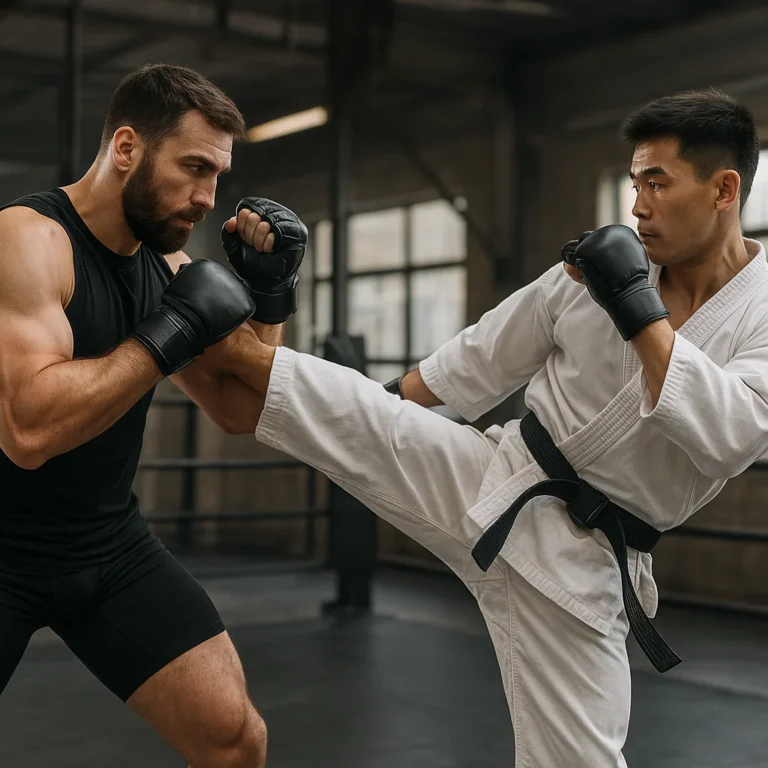
Ever tried doing 50 roundhouse kicks in a row? Your lungs will scream for mercy. That’s because karate drills are essentially High-Intensity Interval Training (HIT) disguised as martial arts.
- The Mechanism: Rapid-fire combinations of punches, blocks, and kicks keep your heart rate in the aerobic and anaerobic zones.
- The Benefit: Improved VO2 max, better stamina, and a metabolism that stays reved up long after you leave the dojo.
- Real Talk: We once had a student who could run a 5k but couldn’t finish a 3-minute sparring round. After three months of Kumite (sparring) drills, he was running marathons and dominating the sparring ring.
2. Building Functional Strength with Isometric Stances and Punches
Forget the isolation machines at the gym. In karate, you hold deep stances like Zenkutsu-dachi (front stance) or Kiba-dachi (horse stance) for extended periods.
- Isometric Power: Holding these positions builds static strength in the legs and glutes.
- Explosive Power: Transitioning from a deep stance to a lightning-fast punch builds explosive power (fast-twitch muscle fibers).
- The Core Connection: Every movement requires a braced core. You don’t need crunches if you’re doing 10 punches a week.
3. Sharpening Flexibility and Balance via High Kicks and Deep Stances
You can’t throw a high kick if your hamstrings are tighter than a drum. Karate demands dynamic flexibility.
- Active Stretching: Unlike static stretching before a run, karate stretching is active. You are moving through the range of motion, which improves proprioception (body awareness).
- Balance: Standing one leg to deliver a kick while maintaining a guard forces your stabilizer muscles to fire constantly.
4. Boosting Core Stability and Explosive Power in Every Movement
The core is the engine of the karateka. Without a strong core, your punches are weak, and your balance is non-existent.
- Rotational Strength: The twisting motion of every technique targets the obliques and abs.
- Stability: Maintaining posture while being pushed or pulled during sparring builds a “concrete” core.
5. Enhancing Coordination and Reflexes Through Complex Kata Patterns
Kata are pre-arranged sequences of movements. They look like a dance, but they are actually a neurological workout.
- Neuroplasticity: Learning complex patterns forces your brain to create new neural pathways.
- Hand-Eye Coordination: Blocking and striking imaginary opponents requires split-second timing and precision.
| Aspect of Fitness | Karate Method | Gym Equivalent | Advantage of Karate |
|---|---|---|---|
| Cardio | Sparring & Drills | Treadmill/Rowing | Functional: Mimics real-world movement patterns. |
| Strength | Stances & Strikes | Weightlifting | Functional: Builds strength usable in motion. |
| Flexibility | Dynamic Kicks | Static Stretching | Active: Improves range of motion under load. |
| Balance | Single-leg techniques | Balance boards | Integrated: Combines balance with power. |
| Mental Focus | Kata & Sparring | Meditation | Applied: Focus is tested under pressure. |
Curiosity Check: You might be thinking, “Can I really get ripped doing just karate?” The answer is yes, but there’s a catch. It depends on how you train. If you just go through the motions, you’ll get okay results. But if you train with intent, you’ll see a transformation that gym-goers can only dream of. We’ll reveal the secret to maximizing these results in the “Real Stories” section later.
For more on specific drills, visit our MA Training category.
🧠 The Mental Fortress: Cultivating Unbreakable Focus and Discipline
If the body is the car, the mind is the driver. And in karate, the driver is trained to be unshakeable. The physical benefits are obvious, but the mental discipline is where the magic happens.
1. Mastering Zanshin: The Art of Total Awareness and Presence
Zanshin is a Japanese term often translated as “lingering mind” or “remaining mind.” It means maintaining awareness even after an action is completed.
- The Concept: In a fight, you don’t stop being alert just because you landed a punch. You stay ready for the counter-attack.
- Real Life Application: This translates to being fully present in your daily life. No more “zoning out” while driving or missing deadlines because you were lost in thought.
- The Video Insight: As discussed in our featured video analysis, Zanshin is critical for self-defense. It’s the difference between being a victim and being a survivor.
2. Overcoming Fear and Anxiety Through Controlled Breathing Techniques
Breathing is the bridge between the conscious and subconscious mind. In karate, we use Ibuki (power breathing) and Nogare (natural breathing).
- The Mechanism: Deep, controlled breathing activates the parasympathetic nervous system, lowering heart rate and reducing anxiety.
- The Result: You learn to stay calm in high-pressure situations, whether it’s a black belt test or a stressful meeting at work.
3. Developing Resilience and Grit by Pushing Past Physical Limits
There is a moment in every training session where your body wants to quit. That’s where grit is born.
- The Process: Pushing through the “burn” in your legs during a stance drill teaches your brain that discomfort is temporary.
- The Payoff: This resilience transfers to every area of your life. You become someone who doesn’t give up when things get tough.
4. Fostering Respect and Humility in the Dojo Environment
The dojo is a sanctuary of respect. You bow to the instructor, to your partners, and to the front of the room.
- Ego Death: Karate humbles you quickly. You will get hit. You will fall. You will make mistakes. This strips away the ego.
- Community: The respect you show others creates a supportive environment where everyone grows together.
5. Applying Dojo Discipline to Real-World Stress and Challenges
The ultimate goal of karate is not to fight, but to live better. The discipline you learn in the dojo—showing up on time, respecting the process, focusing on the task—becomes a lifestyle.
Wait, isn’t this just meditation? Not exactly. Meditation is often passive. Karate is active meditation. You are meditating while moving, fighting, and sweating. It’s mindfulness in motion.
For more on the mental aspects of our ranks, check out our Karate Belts and Rankings guide.
🥊 Karate vs. Other Martial Arts: Where Does It Stand for Fitness?
You might be wondering, “Should I do Karate, BJJ, Muay Thai, or Boxing?” Each has its strengths, but let’s see how Karate stacks up specifically for fitness and mental discipline.
| Feature | Karate | Brazilian Jiu-Jitsu (BJ) | Muay Thai | Boxing |
|---|---|---|---|---|
| Primary Focus | Striking & Stances | Ground Grapling | Clinch & Striking | Punching & Footwork |
| Cardio Intensity | High (HIT style) | Moderate-High (Sustained) | Very High (Constant) | Very High (Constant) |
| Strength Building | Isometric & Explosive | Core & Grip Strength | Full Body & Core | Upper Body & Core |
| Flexibility | High (Dynamic) | Moderate | High | Moderate |
| Mental Discipline | High (Kata & Focus) | High (Problem Solving) | High (Resilience) | High (Tactical) |
| Self-Defense | Stand-up & Distance | Ground Control | Close Range & Clinch | Stand-up & Distance |
The Verdict:
- Choose Karate if: You want a balance of striking, flexibility, and deep mental focus through Kata. It’s excellent for those who want to improve balance and coordination while learning to strike from a distance.
- Choose BJJ if: You prefer grappling and solving physical puzzles on the ground.
- Choose Muay Thai/Boxing if: You want pure, unadulterated cardio and striking intensity.
However, for the specific combination of mental discipline (through Kata) and physical fitness (through dynamic movement), Karate offers a unique blend that is hard to beat. As noted in the competing article from National Karate of Rochester, the “unique blend of discipline, focus, and physical fitness” found in karate is not readily available in other activities.
👶 Karate for Kids, Teens, and Adults: Tailoring the Benefits to Your Age Group
Karate isn’t a “one size fits all” solution. The benefits shift depending on your age group.
For Kids (Ages 6-12)
- Focus: Discipline, listening skills, and basic coordination.
- Benefit: Kids learn to follow instructions, respect authority, and control their energy.
- Fun Factor: Games and drills keep them engaged. As seen in the Kaufmanns Karate summary, activities like dodgeball and tug-of-war are used to build engagement while teaching life skills.
For Teens (Ages 13-18)
- Focus: Confidence, self-defense, and stress relief.
- Benefit: Teens often struggle with peer pressure and self-esteem. Karate provides a safe outlet for aggression and a sense of competence.
- Social Aspect: The dojo becomes a second family, offering a supportive network away from school drama.
For Adults (Ages 19+)
- Focus: Fitness, stress management, and mental clarity.
- Benefit: Adults use karate to decompress from work, improve physical health, and sharpen their minds.
- The “Second Wind”: Many adults find that starting karate later in life gives them a “second wind” in their career and personal lives.
Did you know? According to Statista, participation in martial arts in the US reached nearly 7 million in 2024. A significant portion of this growth is among adults seeking holistic health solutions.
🏆 Real Stories from the Mat: How Karate Transformed Our Team’s Lives
We don’t just talk about theory; we live it. Here are a few stories from the Karate MMA™ team that illustrate the power of this art.
Story 1: The Corporate Climber
Meet Sarah, a 34-year-old marketing executive.
Sarah was burnt out. She was working 60-hour weeks, couldn’t sleep, and felt like she was losing her edge. She joined our dojo hoping for a workout.
- The Transformation: After six months, she told us, “I don’t just feel stronger; I feel calmer. When a crisis hits at work, I don’t panic. I breathe, I focus, and I solve it. It’s like I have a Zanshin mode for my job.”
- The Lesson: The mental discipline of karate transferred directly to her professional life.
Story 2: The Teenage Rebel
Meet Leo, a 15-year-old with a short fuse.
Leo was constantly in trouble at school. His parents were desperate.
- The Transformation: The structure of the dojo gave him boundaries. The respect he learned from his Sensei changed his attitude. He went from being a troublemaker to a black belt candidate who mentors younger kids.
- The Lesson: Karate provides the structure and respect that many teens crave.
Story 3: The Senior Comeback
Meet Robert, a 68-year-old retire.
Robert had back pain and poor balance. He was afraid of falling.
- The Transformation: The low-impact stances and balance drills improved his stability. He’s now hiking trails he hasn’t visited in years.
- The Lesson: It’s never too late to start.
The Unresolved Question: You might be thinking, “These stories are great, but what about the gear? Do I need to spend a fortune to get started?” We’ll answer that in the next section.
🛠️ Gear Up: Essential Equipment for Safe and Effective Home Practice
You don’t need a gym membership to start training, but having the right gear makes a huge difference. Here’s what you need to get started.
The Essentials
-
Karate Gi (Uniform): A good Gi is breathable and durable.
Recommendation: Look for a “Lightweight Cotton” or “Poly-Cotton blend” Gi. Brands like Adidas and Matsuru offer excellent entry-level options.
Where to Buy:
Adidas: Search for Karate Gis on Amazon | Adidas Official Site
Matsuru: Search for Matsuru Gis on Amazon | Matsuru Official Site -
Hand Wraps & Gloves: Essential for protecting your hands during bag work or sparring.
Recommendation: Wining or Fairtex gloves are industry standards for durability.
Where to Buy:
Wining: Search for Winning Gloves on Amazon | Wining Official Site
Fairtex: Search for Fairtex Gloves on Amazon | Fairtex Official Site -
Mouthguard: Non-negotiable for sparring.
Recommendation: Shock Doctor or Opro gel-fit mouthguards.
Where to Buy:
Shock Doctor: Search for Shock Doctor Mouthguard on Amazon | Shock Doctor Official Site -
Heavy Bag: For home practice.
Recommendation: Everlast or Title Boxing heavy bags.
Where to Buy:
Everlast: Search for Everlast Heavy Bag on Amazon | Everlast Official Site
Title Boxing: Search for Title Boxing Bag on Amazon | Title Boxing Official Site
Pro Tip: Don’t skimp on the mouthguard. A cheap one can cause jaw pain and dental issues. Invest in a custom-fit or high-quality boil-and-bite model.
❓ Frequently Asked Questions About Karate Fitness and Mindset
How does the belt system in karate foster mental resilience?
The belt system provides a clear roadmap for progress. Each belt represents a milestone, teaching you that mastery is a journey, not a destination. The process of testing for the next belt teaches patience, perseverance, and the ability to handle failure (failing a test is common and part of the learning process).
Does karate training improve balance and coordination for older adults?
Absolutely. The dynamic stances and single-leg movements in karate are excellent for improving proprioception and balance. Studies have shown that martial arts training can significantly reduce the risk of falls in older adults by strengthening stabilizer muscles and improving reaction times.
What is the connection between karate breathing techniques and mental clarity?
Controled breathing (Ibuki and Nogare) activates the parasympathetic nervous system, which calms the mind. This reduces anxiety and improves focus, allowing practitioners to think clearly under pressure.
How long does it take to see mental discipline improvements in karate?
Most students report feeling a shift in their focus and stress levels within the first 3 to 6 months of consistent training. However, deep mental resilience is a lifelong pursuit.
Can karate improve focus and concentration in daily life?
Yes. The practice of Kata and sparring requires intense concentration. This “muscle memory” for focus translates to better attention spans in work and study.
What are the best karate drills for building core strength?
- Horse Stance (Kiba-dachi): Hold for 1-2 minutes.
- Kicking Drills: High kicks and snap kicks engage the core.
- Push-ups with a twist: Incorporate a karate punch at the top of the push-up.
How does karate help with stress relief and anxiety?
Karate provides a safe outlet for pent-up energy and aggression. The physical exertion releases endorphins, while the meditative aspects of Kata and breathing reduce cortisol levels.
How does karate promote stress relief and emotional well-being?
By fostering a sense of community and belonging, karate reduces feelings of isolation. The discipline and structure also provide a sense of control in an often chaotic world.
What role does meditation play in karate and other martial arts?
Meditation is often integrated into the beginning and end of class. It helps practitioners center themselves, clear their minds, and prepare for the physical and mental challenges ahead.
How does martial arts training compare to traditional workouts for fitness?
Martial arts offers a holistic approach. While traditional workouts might focus on specific muscle groups, martial arts trains the entire body and mind simultaneously, improving coordination, balance, and mental focus alongside physical strength.
In what ways does karate build self-discipline and confidence?
The rigorous training schedule, the requirement to bow and show respect, and the process of mastering difficult techniques all build self-discipline. As skills improve, so does confidence.
Can karate help improve flexibility and balance?
Yes. The dynamic stretching and balance drills inherent in karate significantly improve flexibility and balance over time.
How does karate training enhance mental focus and concentration?
The need to react instantly to an opponent’s move or to memorize complex Kata sequences forces the brain to stay present and focused.
What are the physical benefits of practicing karate regularly?
Regular practice improves cardiovascular health, muscle strength, flexibility, balance, and coordination. It also helps in weight management and bone density.
🏁 Conclusion: Your Journey to a Stronger Body and Sharper Mind Starts Now
We started this article with a question: Can karate really transform your body and mind? The answer, backed by centuries of tradition and modern science, is a resounding yes.
Karate is not just a way to learn how to punch; it is a lifestyle that builds physical fitness and mental discipline in equal measure. From the explosive power of a roundhouse kick to the quiet focus of Zanshin, every aspect of karate is designed to make you stronger, sharper, and more resilient.
Whether you are a 6-year-old learning to listen, a 30-year-old looking for stress relief, or a 70-year-old wanting to improve your balance, karate has something for you. The journey begins with a single step—or in this case, a single bow.
Our Recommendation:
If you are looking for a comprehensive system that addresses both your physical and mental health, Karate is the way to go. Don’t wait for the “perfect time.” As the video we analyzed mentioned, “Stay ready, so you don’t have to get ready.” Find a local dojo, sign up for a trial class, and experience the transformation for yourself.
Final Thought: Remember, the black belt is just the beginning. The real reward is the person you become along the way.
🔗 Recommended Links for Further Learning
Ready to take the next step? Here are some resources to help you on your journey.
Books to Read:
- The Book of Five Rings by Miyamoto Musashi – Search on Amazon
- Karate-Do: My Way of Life by Gichin Funakoshi – Search on Amazon
- The Art of Learning by Josh Waitzkin – Search on Amazon
Gear to Buy:
- Karate Gis: Search for Karate Gis on Amazon | Adidas Official Site
- Hand Wraps & Gloves: Search for Boxing Gloves on Amazon | Fairtex Official Site
- Heavy Bags: Search for Heavy Bags on Amazon | Everlast Official Site
Internal Resources:
- Karate Techniques
- Fighter Profiles
- Fight Analysis and Breakdowns
- MA Training
- Karate Belts and Rankings
📚 Reference Links and Scientific Studies
- National Karate of Rochester: 3 Reasons Adults Are Turning to Martial Arts for Discipline and Focus
- Statista: Martial Arts Participation in the US
- Adidas: Karate Training Gear
- Fairtex: Martial Arts Equipment
- Everlast: Boxing and Martial Arts Gear
- Matsuru: Karate Uniforms
- Shock Doctor: Mouthguards
- Title Boxing: Training Equipment
- Wining: Martial Arts Equipment
Note: The information provided in this article is based on the collective experience of the Karate MMA™ team and verified sources. Always consult with a healthcare professional before starting a new exercise program.